Start every agent at the map
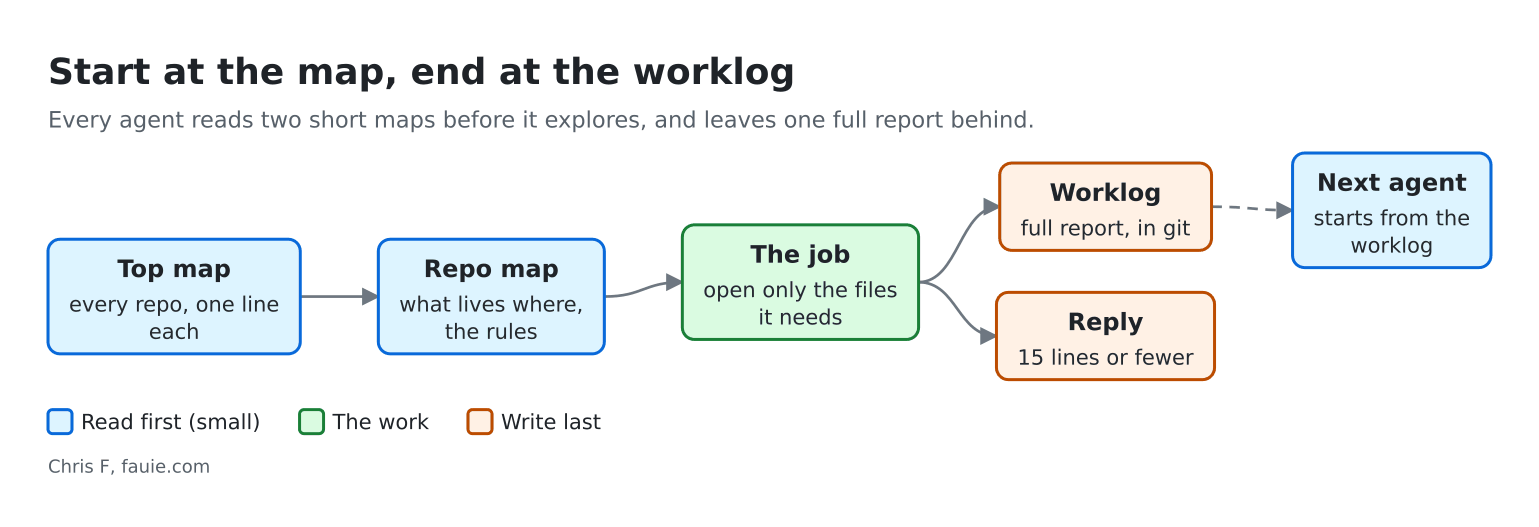
In short: most of what my AI agents spent was not thinking. It was finding their way around. Now every agent reads two short map files before it touches anything, and leaves a full report in a worklog when it is done. The next agent starts from that report instead of from zero.
Context
I run Claude Code at home on a pile of my own projects: a robot side project, a few household tools, an ideas journal, some experiments. That is a couple dozen git repos on one laptop, plus a small always-on box in the house that runs a code forge and CI.
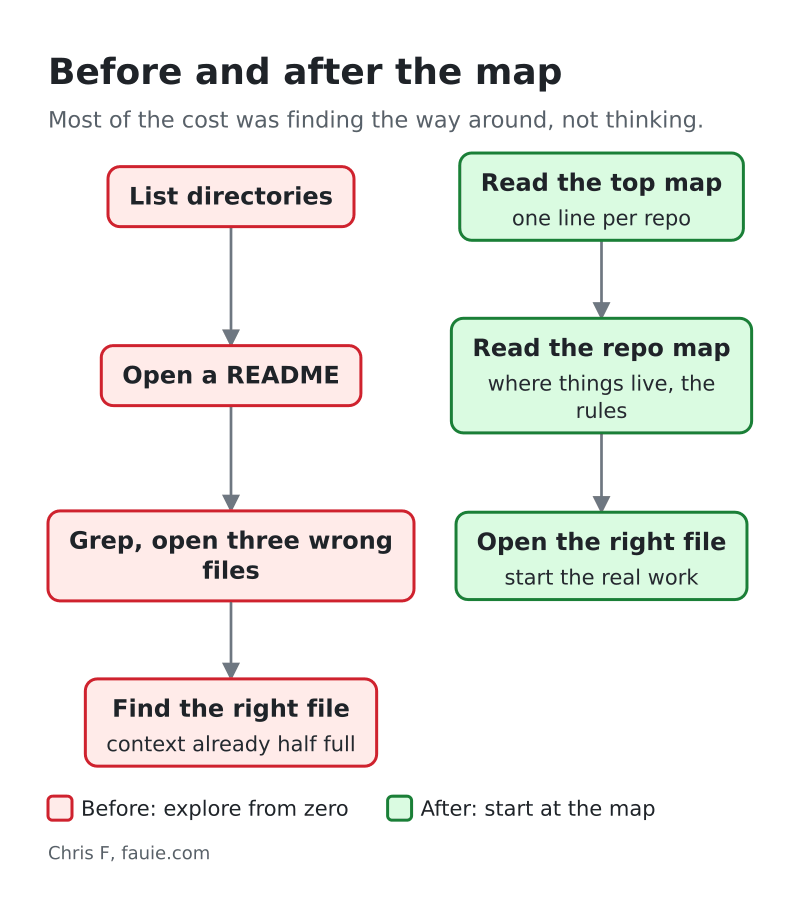
When I started, every new agent session went the same way. It listed directories. It opened a README. It grepped for something, opened three wrong files, then found the right one. On a good day that took a few minutes. On a bad day it took a big slice of the context window, and the real work started with the agent already half full of file listings.
I asked Claude whether a search engine over all my docs would help. The honest answer was: maybe later, but the cheap fix is a map. Most of the cost was re-learning the layout, not searching. A person joining a team gets a "here is where things live" walkthrough on day one. My agents were getting dropped in a field with a flashlight.
The second half of the problem was the other end of the job. Agents wrote long final reports into the chat. I don't read walls of text on my phone, and the next agent couldn't see them at all, because each session starts fresh. The report existed for about ten minutes and then it was gone.
Photo: Carlo Nardone, CC BY-SA 2.0, via Wikimedia Commons (cropped (museum sign removed) and resized)
Detail
Two levels of map
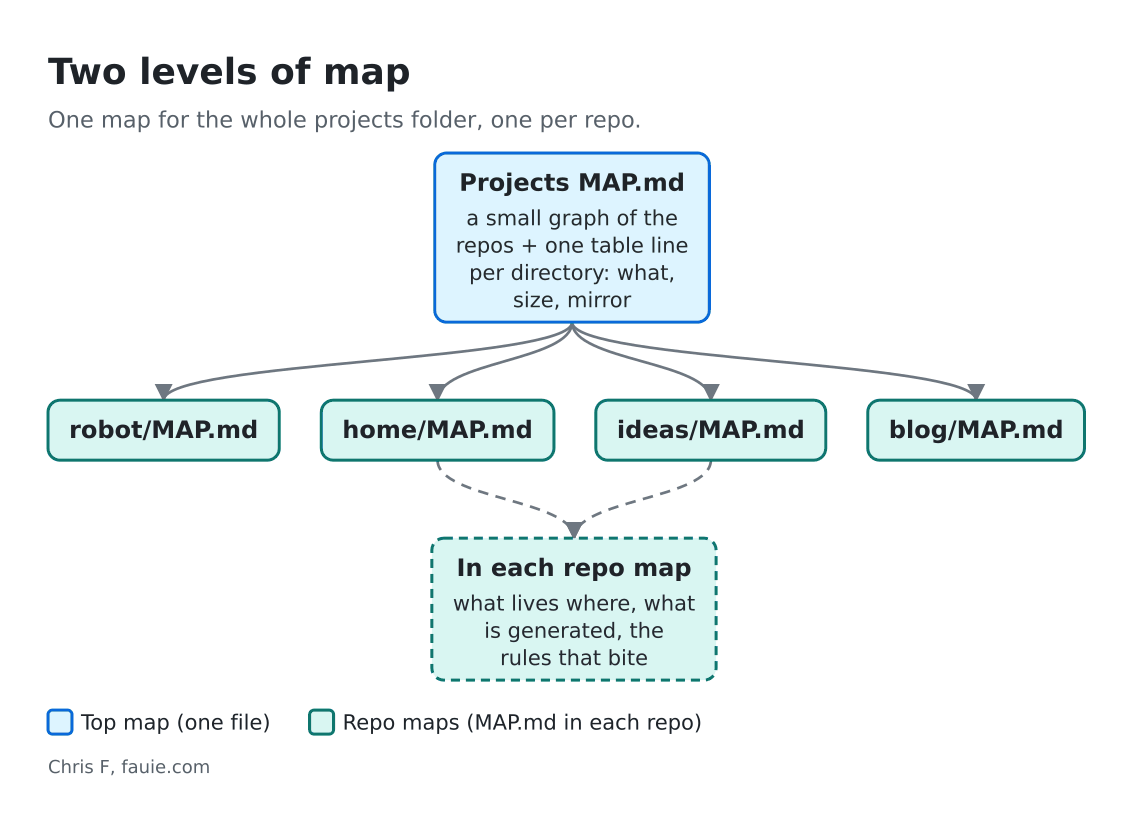
There is one top-level map for the whole projects folder, and one map per repo.
The top map is a single Markdown file. It has a small text graph of how the repos relate, then a table with one line per directory: what it is, how big it is, and where it is mirrored. A trimmed example:
| Directory    | What                                  | Size  | Mirror |
|--------------|---------------------------------------|-------|--------|
| robot        | robot software, sim, devlog sources   | big   | forge  |
| home         | household projects                    | 1 M   | forge  |
| ideas        | ideas journal                         | 400 K | forge  |
| blog         | this blog's drafts and build script   | small | forge  |
Each repo then has its own MAP.md: what lives where, which files are generated (so nobody edits them by hand),
and the rules that matter in that repo. "This folder holds other people's names, never publish it." "This README
is generated by a script, edit the script." The kind of thing a new teammate would otherwise learn by breaking it.
The rule in every agent brief is one line:
Start at ~/projects/MAP.md, then the repo's MAP.md. Fix the map if you find it wrong.
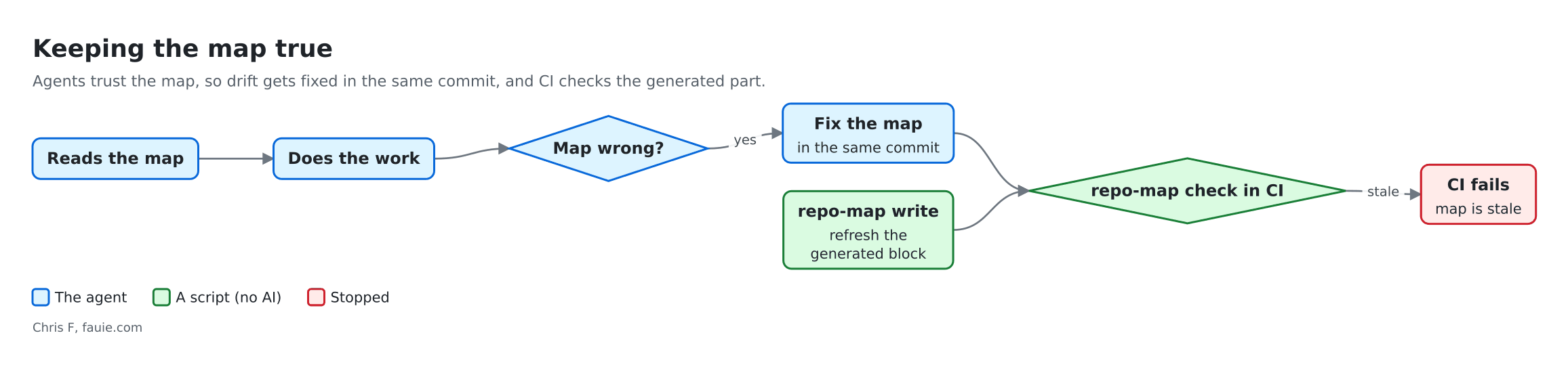
That last sentence matters. A map nobody maintains is worse than no map, because the agent trusts it. So whoever notices the drift fixes it in the same commit as the work.
Generated where it can be
Part of each repo map is generated: a file tree with sizes and a list of entry points. A small script writes that part and can also check it, so CI fails when the map no longer matches the files:
repo-map write    # refresh the generated block in MAP.md
repo-map check    # exit 1 if the generated block is stale
The hand-written part stays short. If a map grows past a screen or two, it is turning into documentation, and the agent will skim it the same way it skimmed the README.
Worklogs: the full report goes in a file
Every agent writes its full report to a dated file in a worklog folder, which is committed with the work:
worklog/2026-11-25/0057-blog-drafts.md
Its reply to me in chat is capped at about 15 lines: what changed, where the report is, and anything I need to decide. The long version, with commands run, numbers and dead ends, is in the file. When the next agent picks up the same thread, its brief just points at that file. It does not need the previous conversation at all.
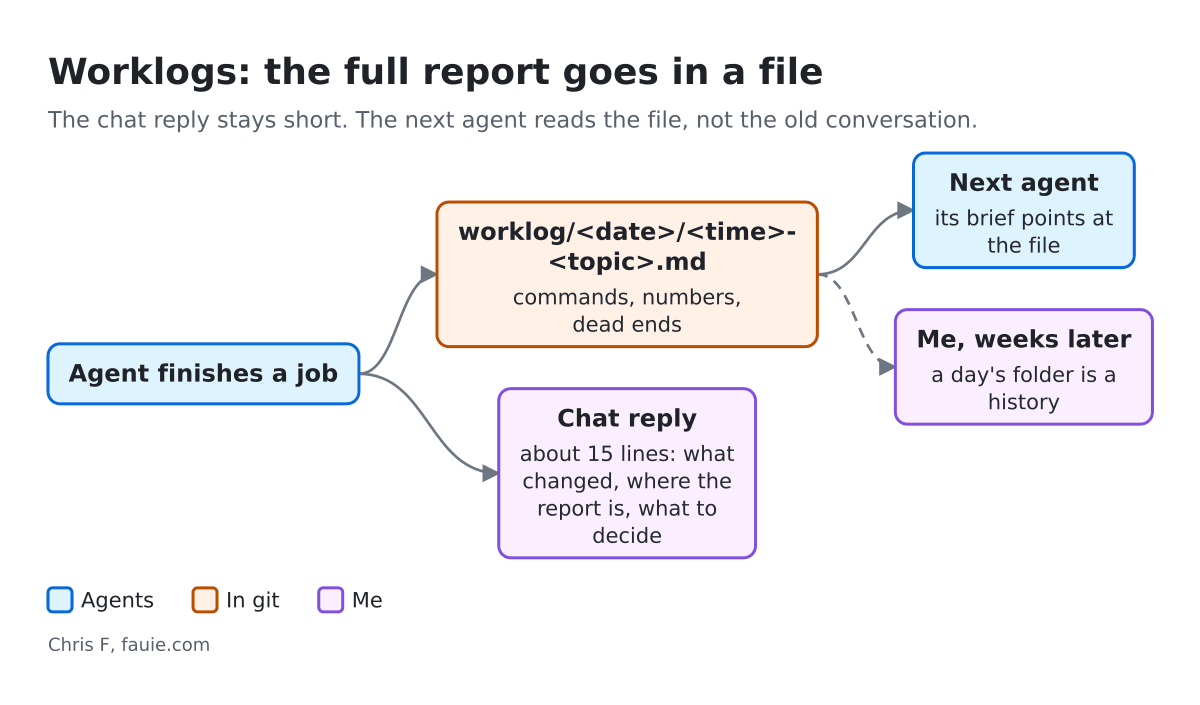
This also gave me something I didn't plan for: a history. Weeks later I can open a day's folder and see what was tried and why it was dropped. That turned out to be as useful for me as for the agents.
Lessons
- A map is only useful while it is true. An agent trusts the map more than its own eyes, so a stale line sends it the wrong way with confidence. That is why "fix the map when you find it wrong" is in every brief, and why the generated part has a check that runs in CI.
- Keep the map to what is. It is tempting to explain every decision in the map. Then it becomes a design document and every agent reads all of it, every time. Mine say what exists and where; the why and when live in a separate history folder that agents skip unless I ask about the past.
- Put reports where the next reader is. A report that only exists in a chat is gone when the session ends. A file in git is there for the next agent, and for me, weeks later.
Try it
You don't need my setup for this. If you use any coding agent on more than one repo:
- Write a top-level
MAP.mdwith one line per project. Ten minutes. - Add a
MAP.mdto your busiest repo: where things live, what is generated, the two or three rules that bite. - Tell the agent, in whatever standing instructions it reads, to start there and fix the map when it is wrong.
- Give it a folder for full reports, and ask for short replies that point to them.
The first session after I did this, the agent went straight to the right file. That was the whole point.
Drafted with Claude.