The Adventure of the Copper Beeches
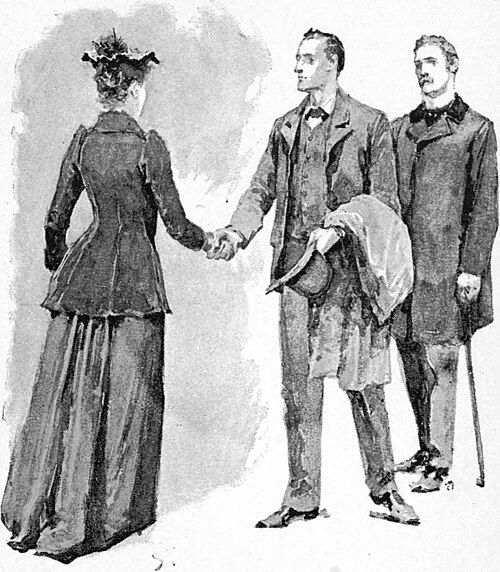
Illustration: Sidney Paget, public domain, via Wikimedia Commons
“To the man who loves art for its own sake,” said Sherlock Holmes, tossing aside the advertisement sheet of The Daily Telegraph, “the keenest pleasure often comes from its smallest and lowliest examples. I’m pleased to see, Watson, that you’ve grasped this. In these little records of our cases, which you’ve been good enough to write up and, I must say, now and then to embellish, you’ve given pride of place not to the causes célèbres and sensational trials I’ve figured in, but to incidents that were trivial in themselves and yet gave room for the deduction and logical synthesis I’ve made my special province.”
“And yet,” I said, smiling, “I can’t quite clear myself of the charge of sensationalism that’s been made against my records.”
“Perhaps you’ve gone wrong,” he said, picking a glowing cinder out of the grate with the tongs and lighting the long cherry-wood pipe he used in place of his clay when he felt like arguing rather than thinking. “Perhaps you’ve gone wrong in trying to put color and life into every account, instead of simply recording the severe reasoning from cause to effect, which is really the only notable thing about the business.”
“It seems to me I’ve done you full justice,” I said a little coldly. I was put off by the egotism that I had more than once noticed in my friend’s unusual character.
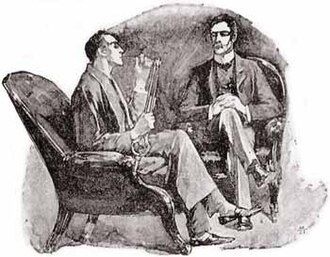
Illustration: Sidney Paget, public domain, via Wikimedia Commons
“No, it isn’t selfishness or conceit,” he said, answering, as he so often did, my thoughts rather than my words. “If I claim full justice for my art, it’s because it’s impersonal, a thing beyond myself. Crime is common. Logic is rare. So it’s the logic, not the crime, you should dwell on. You’ve degraded what should have been a course of lectures into a series of tales.”
It was a cold morning in early spring, and we sat after breakfast on either side of a cheerful fire in the old room at Baker Street. A thick fog rolled down between the rows of dun-colored houses, and the windows opposite loomed through the heavy yellow wreaths like dark, shapeless blurs. That yellow was London’s own: a hundred thousand coal fires pour soot and sulfur into the damp air, and the water droplets of the fog catch it and hold it. Our gas was lit, and it shone on the white cloth and the glimmer of china and metal, for the table hadn’t been cleared. Holmes had been silent all morning, dipping into the advertisement columns of paper after paper, until at last, apparently giving up his search, he had emerged in a sour temper to lecture me on my literary shortcomings.
“At the same time,” he went on after a pause, during which he sat puffing at his long pipe and gazing into the fire, “you can hardly be accused of sensationalism, since a fair share of the cases you’ve taken an interest in don’t involve crime, in the legal sense, at all. The small matter in which I tried to help the King of Bohemia, the singular experience of Miss Mary Sutherland, the problem of the man with the twisted lip, and the incident of the noble bachelor were all outside the reach of the law. But in avoiding the sensational, I fear you may have bordered on the trivial.”
“The ends may have been,” I answered, “but I maintain the methods were new and interesting.”
“Pshaw, my dear fellow! What does the public, the great unobservant public, care about the finer shades of analysis and deduction? They could hardly tell a weaver by his tooth or a compositor by his left thumb!”
I had to grant him that one, though I’d never have thought of it myself. A weaver bites off thread hundreds of times a day until a front tooth wears a small notch, and a compositor, setting type letter by letter, braces each little piece of metal type against his left thumb until the skin there grows flattened and hard. Each trade leaves its fingerprint on the body, if one only knows where to look.
“But really,” Holmes continued, “if you are trivial, I can’t blame you, for the days of the great cases are past. Man, or at least criminal man, has lost all enterprise and originality. As for my own little practice, it seems to be sinking into an agency for recovering lost lead pencils and advising young ladies from boarding schools. I think I’ve hit bottom at last. This note I got this morning marks my zero point, I fancy. Read it!” He tossed a crumpled letter across to me.
It was dated from Montague Place the evening before, and ran:
“DEAR MR. HOLMES,—I am very anxious to consult you as to whether I should or should not accept a situation which has been offered to me as governess. I shall call at half-past ten to-morrow if I do not inconvenience you. Yours faithfully,
“VIOLET HUNTER.”
“Do you know the young lady?” I asked.
“Not I.”
“It’s half-past ten now.”
“Yes, and I have no doubt that’s her ring.”
“It may turn out more interesting than you think. Remember the affair of the blue carbuncle. It looked like a mere whim at first and grew into a serious investigation. This could be the same.”
“Well, let’s hope so. But our doubts will soon be settled, for here, unless I’m much mistaken, is the person in question.”
As he spoke the door opened and a young woman came in. She was plainly but neatly dressed, with a bright, quick face, freckled like a plover’s egg, and the brisk manner of a woman who has had to make her own way in the world.
“I hope you’ll excuse my troubling you,” she said, as my companion rose to greet her, “but I’ve had a very strange experience. I have no parents or relations of any kind to ask for advice, so I thought you might be kind enough to tell me what I should do.”
“Please, sit down, Miss Hunter. I’ll be happy to do whatever I can for you.”
I could see that Holmes liked his new client’s manner and speech. He looked her over in his searching way, then settled back, eyelids drooping and fingertips together, to listen.
“I was a governess for five years,” she said, “in the family of Colonel Spence Munro. Two months ago the colonel was posted to Halifax, in Nova Scotia, and took his children over to America with him, so I found myself without a position. I advertised, and I answered advertisements, but with no luck. At last the little money I’d saved began to run short, and I was at my wits’ end.
“There’s a well-known agency for governesses in the West End called Westaway’s, and I used to call there about once a week to see whether anything had turned up. Westaway was the founder, but the business is really run by Miss Stoper. She sits in her own little office, and the ladies looking for work wait in an anteroom and are shown in one by one, while she checks her ledgers to see if she has anything for them.
“Well, when I called last week I was shown into the little office as usual, but Miss Stoper wasn’t alone. An enormously stout man with a very smiling face and a great heavy chin that rolled down in fold after fold over his throat sat at her elbow, glasses on his nose, looking very earnestly at each lady who came in. When I entered he gave quite a jump in his chair and turned quickly to Miss Stoper.
“‘That will do,’ he said. ‘I couldn’t ask for anything better. Capital! Capital!’ He seemed thrilled and rubbed his hands together in the most genial way. He was such a comfortable-looking man that it was a pleasure just to look at him.
“‘You’re looking for a position, miss?’ he asked.
“‘Yes, sir.’
“‘As governess?’
“‘Yes, sir.’
“‘And what salary do you ask?’
“‘I had £4 a month in my last place, with Colonel Spence Munro.’
“‘Oh, tut, tut! Sweating, rank sweating!’ he cried, flinging his fat hands into the air like a man in a towering passion. ‘How could anyone offer such a pitiful sum to a lady with such attractions and accomplishments?’
“‘My accomplishments, sir, may be fewer than you think,’ I said. ‘A little French, a little German, music, and drawing—’
“‘Tut, tut! That’s beside the point. The point is, do you or don’t you have the bearing and manners of a lady? There it is in a nutshell. If you don’t, you aren’t fit to raise a child who may someday play a considerable part in the history of this country. But if you do, then how could any gentleman ask you to accept anything under three figures? Your salary with me, madam, would start at £100 a year.’
“You can imagine, Mr. Holmes, that to me, penniless as I was, such an offer seemed almost too good to be true.”
I did the sum in my head as she spoke. Four pounds a month is forty-eight a year; the stout gentleman was offering better than double, without so much as asking for a reference.
“The gentleman,” she went on, “perhaps seeing the disbelief on my face, opened his pocketbook and took out a banknote.
“‘It’s also my custom,’ he said, smiling so pleasantly that his eyes became two little shining slits among the white creases of his face, ‘to advance my young ladies half their salary beforehand, so they can meet any little expenses of the journey and their wardrobe.’
“I thought I had never met so charming and thoughtful a man. I was already in debt to the shopkeepers, so the advance would have been a great help. And yet there was something unnatural about the whole thing that made me want to know more before I committed myself.
“‘May I ask where you live, sir?’ I said.
“‘Hampshire. Charming rural spot. The Copper Beeches, five miles on the far side of Winchester. The loveliest country, my dear young lady, and the dearest old country house.’
“‘And my duties, sir? I’d be glad to know what they would be.’
“‘One child. One dear little romper, just six years old. Oh, if you could see him killing cockroaches with a slipper! Smack! Smack! Smack! Three gone before you could blink!’ He leaned back in his chair and laughed until his eyes vanished into his head again.
“I was a little startled at the child’s idea of fun, but his father’s laughter made me think perhaps he was joking.
“‘So my only duty,’ I asked, ‘is to take charge of a single child?’
“‘No, no, not the only one, my dear young lady,’ he cried. ‘Your duty would be, as I’m sure your good sense tells you, to obey any little commands my wife might give, provided always they were commands a lady might properly obey. You see no difficulty there, eh?’
“‘I’d be happy to make myself useful.’
“‘Quite so. In dress, for example. We’re faddy people, you know—faddy but kind-hearted. If you were asked to wear any dress we gave you, you wouldn’t object to our little whim, eh?’
“‘No,’ I said, quite astonished.
“‘Or to sit here, or sit there? That wouldn’t offend you?’
“‘Oh, no.’
“‘Or to cut your hair quite short before you come to us?’
“I could hardly believe my ears. As you can see, Mr. Holmes, my hair is rather thick, and of an unusual shade of chestnut. People have called it artistic. I couldn’t dream of sacrificing it so offhandedly.
“‘I’m afraid that’s quite impossible,’ I said. He had been watching me eagerly out of his small eyes, and I saw a shadow cross his face.
“‘I’m afraid it’s quite essential,’ he said. ‘It’s a little fancy of my wife’s, and ladies’ fancies, you know, madam, must be humored. So you won’t cut your hair?’
“‘No, sir, I really couldn’t,’ I answered firmly.
“‘Ah, very well. That settles it. A pity, because in every other way you’d have done very nicely. In that case, Miss Stoper, I’d best look at a few more of your young ladies.’
“The manageress had sat all this time busy with her papers without a word to either of us, but now she glanced at me with such annoyance that I couldn’t help suspecting she’d lost a handsome commission through my refusal.
“‘Do you want your name kept on the books?’ she asked.
“‘If you please, Miss Stoper.’
“‘Well, really, it seems rather pointless, when you turn down the most excellent offers like this,’ she said sharply. ‘You can hardly expect us to go out of our way to find you another such opening. Good day to you, Miss Hunter.’ She struck a gong on the table, and the page showed me out.
“Well, Mr. Holmes, when I got back to my lodgings and found next to nothing in the cupboard and two or three bills on the table, I began to wonder whether I hadn’t done a very foolish thing. After all, if these people had strange fads and expected obedience in the oddest matters, at least they were ready to pay for it. Very few governesses in England earn £100 a year. Besides, what use was my hair to me? Plenty of people look better with it short, and maybe I’d be one of them. The next day I suspected I’d made a mistake, and by the day after I was sure of it. I had almost swallowed my pride enough to go back to the agency and ask whether the place was still open when I got this letter from the gentleman himself. I have it here, and I’ll read it to you:
“‘The Copper Beeches, near Winchester.
“‘DEAR MISS HUNTER,—Miss Stoper has very kindly given me your address, and I write from here to ask you whether you have reconsidered your decision. My wife is very anxious that you should come, for she has been much attracted by my description of you. We are willing to give £30 a quarter, or £120 a year, so as to recompense you for any little inconvenience which our fads may cause you. They are not very exacting, after all. My wife is fond of a particular shade of electric blue and would like you to wear such a dress indoors in the morning. You need not, however, go to the expense of purchasing one, as we have one belonging to my dear daughter Alice (now in Philadelphia), which would, I should think, fit you very well. Then, as to sitting here or there, or amusing yourself in any manner indicated, that need cause you no inconvenience. As regards your hair, it is no doubt a pity, especially as I could not help remarking its beauty during our short interview, but I am afraid that I must remain firm upon this point, and I only hope that the increased salary may recompense you for the loss. Your duties, as far as the child is concerned, are very light. Now do try to come, and I shall meet you with the dog-cart at Winchester. Let me know your train. Yours faithfully,
“‘JEPHRO RUCASTLE.’
“That’s the letter I’ve just received, Mr. Holmes, and I’ve made up my mind to accept. But before taking the final step, I thought I’d like to put the whole thing before you.”
“Well, Miss Hunter, if your mind is made up, that settles the question,” said Holmes, smiling.
“But you wouldn’t advise me to refuse?”
“I confess it isn’t a situation I’d like to see a sister of mine apply for.”
“What does it all mean, Mr. Holmes?”
“Ah, I have no data. I can’t tell. Perhaps you’ve formed some opinion yourself?”
“Well, there seems to me only one possible explanation. Mr. Rucastle seemed a very kind, good-natured man. Isn’t it possible that his wife is mad, that he wants to keep it quiet for fear she’ll be taken to an asylum, and that he humors her fancies in every way to prevent an outbreak?”
“That’s possible. In fact, as things stand, it’s the most probable explanation. But either way, it doesn’t sound like a nice household for a young lady.”
“But the money, Mr. Holmes, the money!”
“Yes, of course, the pay is good. Too good. That’s what makes me uneasy. Why should they give you £120 a year when they could have their pick for £40? There must be some strong reason behind it.”
“I thought if I told you the circumstances, you’d understand later if I needed your help. I’d feel so much stronger knowing you were behind me.”
“Oh, you may take that feeling away with you. I assure you your little problem promises to be the most interesting to come my way in months. Some of its features are distinctly new. If you should find yourself in doubt or in danger—”
“Danger! What danger do you foresee?”
Holmes shook his head gravely. “It would cease to be a danger if we could define it,” he said. “But at any time, day or night, a telegram would bring me down to help you.”
“That’s enough.” She rose briskly, all the anxiety swept from her face. “I’ll go down to Hampshire with an easy mind now. I’ll write to Mr. Rucastle at once, sacrifice my poor hair tonight, and leave for Winchester tomorrow.” With a few grateful words to Holmes she said goodbye to us both and bustled off.
“At least,” I said, as we heard her quick, firm steps going down the stairs, “she seems a young lady well able to take care of herself.”

Illustration: Sidney Paget, public domain, via Wikimedia Commons
“She’ll need to be,” said Holmes gravely. “I’m much mistaken if we don’t hear from her before many days have passed.”
It wasn’t long before my friend’s prediction came true. A fortnight went by, two weeks in which I often found my thoughts turning to her, and wondering what strange side alley of human experience this lonely woman had wandered into. The unusual salary, the odd conditions, the light duties: everything pointed to something abnormal, though whether a fad or a plot, whether the man was a philanthropist or a villain, I couldn’t begin to decide. As for Holmes, I noticed he would sit for half an hour at a time with knitted brows and a faraway look, but he waved the subject off whenever I raised it. “Data! data! data!” he cried impatiently. “I can’t make bricks without clay.” And yet he always ended by muttering that no sister of his should ever have taken such a position.
The telegram came late one night, just as I was thinking of going to bed and Holmes was settling in for one of those all-night chemical sessions he often indulged in, when I’d leave him bent over a retort and a test tube at night and find him in exactly the same position when I came down to breakfast. He opened the yellow envelope, glanced at the message, and tossed it across to me.
“Just look up the trains in Bradshaw,” he said, and turned back to his chemistry.
The summons was short and urgent.
“Please be at the Black Swan Hotel at Winchester at midday to-morrow,” it said. “Do come! I am at my wit’s end.
“HUNTER.”
“Will you come with me?” asked Holmes, glancing up.
“I’d like to.”
“Then look it up.”
“There’s a train at half-past nine,” I said, running my finger down my Bradshaw, the thick railway timetable no London household was without. “It’s due at Winchester at 11:30.”
“That will do very nicely. Then perhaps I’d better put off my analysis of the acetones, since we may need to be at our best in the morning.”
By eleven o’clock the next day we were well on our way to the old English capital. Holmes had been buried in the morning papers all the way down, but once we crossed the Hampshire border he threw them aside and began to admire the scenery. It was a perfect spring day: a light blue sky flecked with little fleecy white clouds drifting from west to east. The sun was bright, yet there was a bracing nip in the air that put an edge on a man’s energy. All across the countryside, as far as the rolling hills around Aldershot, the little red and gray roofs of the farmsteads peeped out from the light green of the new leaves.
“Aren’t they fresh and beautiful?” I cried, with all the enthusiasm of a man just out of the fogs of Baker Street.
But Holmes shook his head gravely.
“Do you know, Watson,” he said, “it’s one of the curses of a mind like mine that I must look at everything in terms of my own special subject. You look at these scattered houses and you’re struck by their beauty. I look at them, and the only thought that comes to me is how isolated they are, and how easily a crime could be committed there and go unpunished.”
“Good heavens!” I cried. “Who would connect crime with these dear old homesteads?”
“They always fill me with a certain horror. It is my belief, Watson, founded upon my experience, that the lowest and vilest alleys in London do not present a more dreadful record of sin than does the smiling and beautiful countryside.”
“You horrify me!”
“But the reason is very obvious. In town, the pressure of public opinion can do what the law can’t. There’s no lane so vile that the scream of a tortured child, or the thud of a drunkard’s blow, doesn’t stir up sympathy and outrage among the neighbors. And the whole machinery of justice is so close at hand that one word of complaint sets it going, and there’s only a step between the crime and the dock. But look at these lonely houses, each in its own fields, filled mostly with poor, ignorant folk who know little of the law. Think of the deeds of hellish cruelty, the hidden wickedness that may go on in such places year in, year out, and no one the wiser. If this lady who’s asked for our help had gone to live in Winchester, I’d never have feared for her. It’s the five miles of country that makes the danger. Still, she clearly isn’t personally threatened.”
“No. If she can come to Winchester to meet us, she can get away.”
“Quite so. She has her freedom.”
“Then what can be the matter? Can’t you suggest any explanation?”
“I’ve devised seven separate explanations, each of which would cover the facts as far as we know them. But which is correct can only be decided by the fresh information that no doubt awaits us. Well, there’s the cathedral tower, and we’ll soon learn all Miss Hunter has to tell.”
The Black Swan is a respectable inn on the High Street, not far from the station, and there we found the young lady waiting. She had taken a sitting room, and lunch was on the table.
“I’m so glad you’ve come,” she said earnestly. “It’s so kind of you both. I truly don’t know what to do. Your advice will be worth everything to me.”
“Tell us what’s happened.”
“I will, and I must be quick, because I promised Mr. Rucastle I’d be back before three. I got his permission to come into town this morning, though he had no idea why.”
“Let’s have everything in its proper order.” Holmes stretched his long thin legs out toward the fire and settled himself to listen.
“First, I should say that on the whole Mr. and Mrs. Rucastle haven’t actually mistreated me. It’s only fair to them to say so. But I can’t understand them, and I’m not easy in my mind about them.”
“What can’t you understand?”
“Their reasons for what they do. But you shall have it all just as it happened. When I came down, Mr. Rucastle met me here and drove me in his dog-cart to the Copper Beeches. It’s beautifully situated, as he said, but not beautiful in itself: a big square block of a house, whitewashed, but all stained and streaked by damp and weather. There are grounds around it, woods on three sides, and on the fourth a field that slopes down to the Southampton high road, which curves past about a hundred yards from the front door. The ground in front belongs to the house, but the woods all around are part of Lord Southerton’s game preserves. A clump of copper beeches right in front of the hall door gives the place its name.
“My employer drove me over, as friendly as ever, and that evening he introduced me to his wife and the child. There was no truth, Mr. Holmes, in the guess that seemed so likely in your rooms at Baker Street. Mrs. Rucastle isn’t mad. She’s a silent, pale woman, much younger than her husband, not more than thirty, I’d think, while he can hardly be less than forty-five. From their conversation I gathered they’ve been married about seven years, that he was a widower, and that his only child by his first wife was the daughter who has gone to Philadelphia. Mr. Rucastle told me privately that she left because she had an unreasonable dislike of her stepmother. Since the daughter can’t have been less than twenty, I can easily imagine her position with her father’s young wife was uncomfortable.
“Mrs. Rucastle struck me as colorless in mind as well as in looks. She made no impression on me, good or bad. She was a nonentity. It was easy to see she was passionately devoted both to her husband and to her little son. Her light gray eyes wandered constantly from one to the other, noticing every little want and heading it off if she could. He was kind to her too, in his bluff, boisterous way, and on the whole they seemed a happy couple. And yet she had some secret sorrow, that woman. She was often lost in deep thought, with the saddest look on her face. More than once I’ve surprised her in tears. Sometimes I’ve thought it was her child’s nature that weighed on her, for I’ve never met such a utterly spoiled and ill-natured little creature. He’s small for his age, with a head far too large for his body. His whole life seems to swing between savage fits of temper and gloomy spells of sulking. Hurting any creature weaker than himself seems to be his one idea of fun, and he shows a remarkable talent for planning the capture of mice, little birds, and insects. But I’d rather not talk about him, Mr. Holmes. He has little to do with my story.”
“I’m glad of every detail,” said my friend, “whether it seems relevant to you or not.”
I made a note of that, for I had seen him do it before. Holmes never threw away a fact merely because its owner thought it unimportant. A clue, in his system, earns its place by what it explains, not by how it is offered.
“I’ll try not to miss anything important. The one unpleasant thing about the house, which struck me at once, was the look and behavior of the servants. There are only two, a man and his wife. Toller, that’s his name, is a rough, coarse man with grizzled hair and whiskers and a constant smell of drink. Twice since I came he’s been quite drunk, and yet Mr. Rucastle seemed to take no notice. His wife is a very tall, strong woman with a sour face, as silent as Mrs. Rucastle and much less pleasant. They’re a most disagreeable couple, but luckily I spend most of my time in the nursery and my own room, which are side by side in one corner of the building.
“For two days after I arrived, life was very quiet. On the third, Mrs. Rucastle came down just after breakfast and whispered something to her husband.
“‘Oh, yes,’ he said, turning to me. ‘We’re very much obliged to you, Miss Hunter, for going along with our whims so far as to cut your hair. I assure you it hasn’t taken the tiniest bit from your looks. Now let’s see how the electric-blue dress suits you. You’ll find it laid out on the bed in your room, and if you’d be good enough to put it on, we’d both be extremely grateful.’
“The dress waiting for me was an odd shade of blue. It was excellent material, a sort of beige fabric, but it had plainly been worn before. It couldn’t have fit better if I’d been measured for it. Mr. and Mrs. Rucastle were delighted by the look of it, far more than seemed natural. They were waiting for me in the drawing room, a very large room running the whole front of the house, with three long windows reaching to the floor. A chair had been placed close to the middle window, with its back to it. I was asked to sit in it, and then Mr. Rucastle, walking up and down on the far side of the room, began telling me a string of the funniest stories I’ve ever heard. You can’t imagine how comical he was, and I laughed until I was quite worn out. Mrs. Rucastle, though, who evidently has no sense of humor, never so much as smiled, but sat with her hands in her lap and a sad, anxious look on her face. After an hour or so, Mr. Rucastle suddenly announced it was time to begin the day’s duties, and that I might change my dress and go to little Edward in the nursery.
“Two days later the same performance was gone through, exactly as before. Again I changed my dress, again I sat in the window, and again I laughed heartily at the funny stories, of which my employer had an immense répertoire and which he told brilliantly. Then he handed me a yellow-backed novel, and moving my chair a little sideways so my own shadow wouldn’t fall on the page, asked me to read aloud to him. I read for about ten minutes, starting in the middle of a chapter, and then suddenly, mid-sentence, he told me to stop and change my dress.”
I caught Holmes’s eye at that. The shadow told its own small story. With the window at her back, the daylight came over her shoulders and her own head and body blocked it, so the page in her lap fell into her shadow. Shifting the chair sideways let the light past her onto the book. Rucastle had thought carefully about where she sat, and about what could be seen from that window.
“You can imagine, Mr. Holmes, how curious I became about what this extraordinary performance could mean. They were always very careful, I noticed, to keep my face turned away from the window, until I was burning to see what was happening behind my back. At first it seemed impossible, but I soon thought of a way. My hand mirror had been broken, and a happy idea struck me: I hid a piece of the glass in my handkerchief. The next time, in the middle of my laughing, I raised the handkerchief to my eyes, and with a little care I could see everything behind me.”
Holmes nodded with open approval, and I didn’t blame him. A mirror returns light at the same angle it receives it, the way a ball comes off a wall, so a shard held near the eye and tilted just so will show whatever lies behind one’s shoulder. It was a rearview mirror made from a broken looking glass and a handkerchief, and a sound bit of physics.
“I confess I was disappointed. There was nothing. At least that was my first impression. At a second glance, though, I saw a man standing in the Southampton Road, a small bearded man in a gray suit, who seemed to be looking my way. It’s a busy highway, and there are usually people on it. But this man was leaning against the railings that border our field and staring earnestly up. I lowered my handkerchief and glanced at Mrs. Rucastle, and found her eyes fixed on me with a most searching look. She said nothing, but I’m convinced she guessed I had a mirror in my hand and had seen what was behind me. She got up at once.
“‘Jephro,’ she said, ‘there’s an impertinent fellow on the road who’s staring up at Miss Hunter.’
“‘No friend of yours, Miss Hunter?’ he asked.
“‘No, I don’t know anyone around here.’
“‘Dear me! How very impertinent! Kindly turn around and wave him away.’
“‘Surely it would be better to take no notice.’
“‘No, no, we’d have him hanging about here forever. Kindly turn around and wave him off, like that.’
“I did as I was told, and at the same instant Mrs. Rucastle pulled down the blind. That was a week ago, and since then I haven’t sat in the window again, or worn the blue dress, or seen the man in the road.”
“Please go on,” said Holmes. “Your story promises to be a most interesting one.”
“You’ll find it rather disconnected, I’m afraid, and there may turn out to be little link between the different things I tell you. On my very first day at the Copper Beeches, Mr. Rucastle took me to a small outbuilding near the kitchen door. As we came near, I heard the sharp rattle of a chain and the sound of a large animal moving about.
“‘Look in here!’ said Mr. Rucastle, showing me a crack between two planks. ‘Isn’t he a beauty?’
“I looked through and saw two glowing eyes and a vague shape huddled in the dark.
“‘Don’t be frightened,’ said my employer, laughing at how I’d jumped. ‘It’s only Carlo, my mastiff. I call him mine, but really old Toller, my groom, is the only man who can do anything with him. We feed him once a day, and not much then, so he’s always as keen as mustard. Toller lets him loose every night, and God help the trespasser he gets his fangs into. For goodness’ sake, never on any excuse set foot over the threshold at night, for it’s as much as your life is worth.’
“It was no idle warning. Two nights later I happened to look out of my bedroom window at about two in the morning. It was a beautiful moonlit night, and the lawn in front of the house was silvered over, almost as bright as day. I was standing there, lost in the peace of it, when I noticed something moving under the shadow of the copper beeches. As it came out into the moonlight, I saw what it was. It was a giant dog, as big as a calf, tawny, with hanging jowls, a black muzzle, and huge jutting bones. It walked slowly across the lawn and vanished into the shadow on the far side. That dreadful sentry chilled my heart as no burglar ever could have.
“And now I have a very strange thing to tell you. As you know, I cut off my hair in London, and I’d put it in a great coil at the bottom of my trunk. One evening, after the child was in bed, I began amusing myself by looking over the furniture in my room and rearranging my own few things. There was an old chest of drawers there, the two upper drawers empty and open, the lower one locked. I’d filled the first two with my linen, and as I still had a lot to put away, I was naturally annoyed at not having the third. It struck me it might have been locked by mistake, so I took out my bunch of keys and tried it. The very first key fitted perfectly, and I pulled the drawer open. There was only one thing in it, and I’m sure you’d never guess what. It was my coil of hair.
“I took it out and examined it. It was the same peculiar tint and the same thickness. But then the impossibility of it hit me. How could my hair be locked in that drawer? With shaking hands I unlocked my trunk, turned out everything in it, and pulled my own hair from the bottom. I laid the two tresses side by side, and I assure you they were identical. Wasn’t that extraordinary? Puzzle as I might, I could make nothing of it. I put the strange hair back in the drawer and said nothing to the Rucastles, since I felt I’d put myself in the wrong by opening a drawer they’d locked.”
I turned that over as she talked. Two coils of hair, both of a rare chestnut and of the same thickness, in one house. Coincidence happens, but a color she herself called peculiar is exactly the sort of thing coincidence seldom repeats. Holmes, I noticed, had gone very still.
“I’m naturally observant, as you may have noticed, Mr. Holmes, and I soon had a pretty good plan of the whole house in my head. But there was one wing that seemed not to be lived in at all. A door facing the one that led to the Tollers’ quarters opened into this suite, and it was always locked. One day, though, as I came up the stairs, I met Mr. Rucastle coming out through that door, keys in hand, with a look on his face that made him a completely different person from the round, jolly man I was used to. His cheeks were red, his brow was all creased with anger, and the veins stood out at his temples. He locked the door and hurried past me without a word or a look.
“That made me curious, so when I took my charge out for a walk in the grounds, I strolled around to the side where I could see the windows of that part of the house. There were four in a row, three of them simply dirty, while the fourth was shuttered. They all looked deserted. As I walked up and down, glancing at them now and then, Mr. Rucastle came out to me, as merry and jovial as ever.
“‘Ah!’ he said. ‘You mustn’t think me rude for passing you without a word, my dear young lady. I was preoccupied with business.’
“I assured him I wasn’t offended. ‘By the way,’ I said, ‘you seem to have quite a suite of spare rooms up there, and one has its shutters up.’
“He looked surprised and, it seemed to me, a little startled.
“‘Photography is one of my hobbies,’ he said. ‘I’ve made my darkroom up there. But dear me, what an observant young lady we’ve come across! Who would have believed it? Who would ever have believed it?’ He said it jokingly, but there was no joke in his eyes as he looked at me. I read suspicion there, and annoyance, but no joke.”
It was a plausible lie, I thought, which is the best kind. A darkroom does need its window blacked out, since light spoils the plates before they’re developed. A man who wanted to hide a shuttered window could hardly have chosen a better excuse.
“Well, Mr. Holmes, from the moment I understood there was something about that suite of rooms I wasn’t meant to know, I was on fire to see them. It wasn’t just curiosity, though I have my share of that. It was more a sense of duty, a feeling that some good might come from my getting in there. People talk of woman’s instinct; perhaps that’s what it was. At any rate, it was there, and I was watching keenly for any chance to get past that forbidden door.
“The chance came only yesterday. I should tell you that besides Mr. Rucastle, both Toller and his wife have business in those empty rooms, and I once saw him carrying a large black linen bag through the door. Lately he’s been drinking hard, and yesterday evening he was very drunk, and when I came upstairs, there was the key in the door. I have no doubt at all he’d left it there. Mr. and Mrs. Rucastle were both downstairs, with the child, so it was a perfect opportunity. I turned the key gently, opened the door, and slipped through.
“In front of me was a little passage, without paper or carpet, which turned at a right angle at the far end. Around the corner were three doors in a row, the first and third open. Each led into an empty room, dusty and cheerless, one with two windows and the other with one, so thick with dirt that the evening light barely glimmered through. The middle door was shut, and across the outside of it someone had fastened one of the broad iron bars from a bedstead, padlocked at one end to a ring in the wall and tied at the other with stout cord. The door was locked as well, and the key wasn’t there. This barricaded door clearly matched the shuttered window outside, and yet I could see by the glimmer under it that the room wasn’t dark. There must have been a skylight letting in light from above.”
Holmes’s eyes opened a fraction at that, and I followed his thought. A room whose only window is shuttered should be black as a cellar. If light shows under its door, it must be coming in some other way, and in a top-floor room the likeliest other way is through the roof. Miss Hunter had reasoned it out on the spot, and she had it right.
“As I stood in the passage staring at that sinister door and wondering what secret it hid, I suddenly heard footsteps inside the room and saw a shadow pass back and forth across the thin strip of dim light under the door. A mad, senseless terror rose up in me at the sight, Mr. Holmes. My overstrained nerves gave way all at once, and I turned and ran, ran as if some dreadful hand were behind me clutching at my skirt. I rushed down the passage, through the door, and straight into the arms of Mr. Rucastle, who was waiting outside.
“‘So,’ he said, smiling, ‘it was you, then. I thought it must be, when I saw the door open.’
“‘Oh, I’m so frightened!’ I gasped.
“‘My dear young lady! My dear young lady!’ You can’t imagine how caressing and soothing he was. ‘And what has frightened you, my dear young lady?’
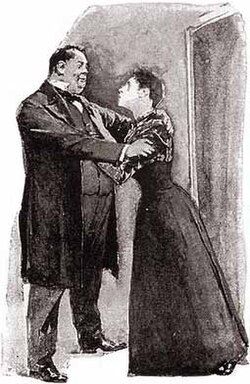
Illustration: Sidney Paget, public domain, via Wikimedia Commons
“But his voice was just a little too coaxing. He overdid it. I was very much on my guard against him.
“‘I was silly enough to go into the empty wing,’ I answered. ‘But it’s so lonely and eerie in this dim light that I got frightened and ran out again. Oh, it’s so dreadfully still in there!’
“‘Only that?’ he said, watching me keenly.
“‘Why, what did you think?’ I asked.
“‘Why do you think I lock this door?’
“‘I’m sure I don’t know.’
“‘It’s to keep out people who have no business there. Do you see?’ He was still smiling in the friendliest way.
“‘I’m sure if I’d known—’
“‘Well, now you know. And if you ever set foot over that threshold again—’ and in an instant the smile hardened into a grin of rage, and he glared down at me with the face of a demon, ‘—I’ll throw you to the mastiff.’
“I was so terrified I don’t know what I did. I suppose I must have rushed past him to my room. I remember nothing until I found myself lying on my bed, trembling all over. Then I thought of you, Mr. Holmes. I couldn’t stay there any longer without advice. I was afraid of the house, of the man, of the woman, of the servants, even of the child. They were all horrible to me. If I could only bring you down, all would be well. Of course I could have run away, but my curiosity was almost as strong as my fear. I made up my mind quickly. I’d send you a wire. I put on my hat and cloak, walked to the telegraph office, about half a mile from the house, and came back feeling much easier. As I neared the door, a horrible fear struck me that the dog might be loose, but I remembered Toller had drunk himself senseless that evening, and I knew he was the only one in the household who could manage the savage creature or would dare let it out. I slipped in safely and lay awake half the night, overjoyed at the thought of seeing you. I had no trouble getting leave to come into Winchester this morning, but I must be back before three, because Mr. and Mrs. Rucastle are going visiting and will be out all evening, so I have to look after the child. Now I’ve told you all my adventures, Mr. Holmes, and I’d be very glad if you could tell me what it all means, and above all, what I should do.”
Holmes and I had listened spellbound to this extraordinary story. My friend got up now and paced the room, hands in his pockets, his face profoundly grave.
“Is Toller still drunk?” he asked.
“Yes. I heard his wife tell Mrs. Rucastle she couldn’t do anything with him.”
“Good. And the Rucastles go out tonight?”
“Yes.”
“Is there a cellar with a good strong lock?”
“Yes, the wine cellar.”
“You seem to me to have acted all through this business like a very brave and sensible young woman, Miss Hunter. Do you think you could manage one more feat? I wouldn’t ask it if I didn’t think you quite exceptional.”
“I’ll try. What is it?”
“My friend and I will be at the Copper Beeches by seven o’clock. The Rucastles will be gone by then, and Toller, we hope, will be past doing anything. That leaves only Mrs. Toller, who might raise the alarm. If you could send her into the cellar on some errand and then turn the key on her, it would help us enormously.”
“I’ll do it.”
“Excellent! Then we’ll look into the affair thoroughly. Of course there’s only one workable explanation. You’ve been brought there to impersonate someone, and the real person is imprisoned in that room. That’s obvious. As to who the prisoner is, I have no doubt it’s the daughter, Miss Alice Rucastle, if I remember right, who was said to have gone to America. You were chosen, no doubt, because you resemble her in height, figure, and the color of your hair. Hers had been cut off, very possibly during some illness she’s been through, and so of course yours had to be sacrificed too. By a curious chance you came across her tresses. The man in the road was surely some friend of hers, possibly her fiancé, and as you wore the girl’s dress and looked so like her, he was convinced, from your laughter whenever he saw you and then from your gesture, that Miss Rucastle was perfectly happy and no longer wanted his attentions. The dog is let loose at night to keep him from trying to reach her. So much is fairly clear. The most serious point in the case is the child’s nature.”
And there it was: every odd piece suddenly locked into one shape. The haircut, the borrowed dress, the chair with its back to the window, the laughter, the wave, the second coil of hair, the shuttered room, the dog. Each had seemed a separate whim. Seen together, every one of them was a single instruction: look like Alice, from the road, and look happy.
“What on earth does that have to do with it?” I exclaimed.
“My dear Watson, as a medical man you’re continually learning about a child’s tendencies by studying the parents. Don’t you see that the reverse is equally valid? I have often gained my first real insight into the character of parents by studying their children. This child’s nature is abnormally cruel, cruel for cruelty’s sake, and whether he gets it from his smiling father, as I’d suspect, or from his mother, it bodes ill for the poor girl in their power.”
“I’m sure you’re right, Mr. Holmes,” cried our client. “A thousand things come back to me that make me certain you’ve hit it. Oh, let’s not lose a moment in helping that poor creature.”
“We must be careful, for we’re dealing with a very cunning man. We can do nothing before seven o’clock. At that hour we’ll be with you, and it won’t be long before we solve the mystery.”
We were as good as our word. It was just seven when we reached the Copper Beeches, having left our trap at a wayside pub. The clump of trees, their dark leaves shining like burnished metal in the setting sun, would have marked the house even if Miss Hunter hadn’t been standing smiling on the doorstep. I’d always wondered about that coppery color, and once read the answer: the leaves have their green chlorophyll like any beech, but a red-purple pigment crowds in alongside it and masks the green, so that low evening light turns them to polished copper.
“Have you managed it?” asked Holmes.
A loud thudding came from somewhere downstairs. “That’s Mrs. Toller in the cellar,” she said. “Her husband is snoring on the kitchen rug. Here are his keys, which are duplicates of Mr. Rucastle’s.”
“Well done indeed!” cried Holmes. “Now lead the way, and we’ll soon see the end of this black business.”
We went up the stairs, unlocked the door, followed the passage, and found ourselves in front of the barricade Miss Hunter had described. Holmes cut the cord and lifted away the iron bar. Then he tried the various keys in the lock, without success. No sound came from inside, and at the silence Holmes’s face darkened.
“I trust we aren’t too late,” he said. “I think, Miss Hunter, we’d better go in without you. Now, Watson, put your shoulder to it, and we’ll see whether we can’t get in.”
It was an old, rickety door and gave at once under our combined weight. We rushed in together. The room was empty. There was no furniture except a little cot, a small table, and a basket of linen. The skylight above was open, and the prisoner gone.
“There’s been some villainy here,” said Holmes. “This beauty has guessed Miss Hunter’s intentions and carried his victim off.”
“But how?”
“Through the skylight. We’ll soon see how he managed it.” He swung himself up onto the roof. “Ah, yes,” he called. “Here’s the end of a long light ladder against the eaves. That’s how he did it.”
“But that’s impossible,” said Miss Hunter. “The ladder wasn’t there when the Rucastles left.”
“He’s come back and done it. I tell you, he’s a clever and dangerous man. I wouldn’t be at all surprised if that’s his step I hear now on the stairs. I think, Watson, you’d do well to have your pistol ready.”
The words were hardly out of his mouth when a man appeared in the doorway, a very fat and burly man with a heavy stick in his hand. Miss Hunter screamed and shrank against the wall at the sight of him, but Sherlock Holmes sprang forward and faced him.
“You villain!” he said. “Where’s your daughter?”
The fat man looked around, and then up at the open skylight.

Illustration: Sidney Paget, public domain, via Wikimedia Commons
“It’s for me to ask you that,” he shrieked, “you thieves! Spies and thieves! I’ve caught you, have I? You’re in my power. I’ll serve you!” He turned and clattered down the stairs as fast as he could go.
“He’s gone for the dog!” cried Miss Hunter.
“I have my revolver,” I said.
“Better shut the front door,” cried Holmes, and we all rushed downstairs together. We had barely reached the hall when we heard the baying of a hound, then a scream of agony and a horrible worrying sound that was dreadful to hear. An elderly man with a red face and shaking limbs came staggering out of a side door.
“My God!” he cried. “Someone’s let the dog loose. It’s not been fed for two days. Quick, quick, or it’ll be too late!”
Holmes and I ran out and around the corner of the house, with Toller hurrying behind us. There was the huge starving brute, its black muzzle buried in Rucastle’s throat, while he writhed and screamed on the ground. I ran up and blew its brains out, and it toppled over with its keen white teeth still locked in the great creases of his neck. With much effort we pulled them apart and carried him, alive but horribly mangled, into the house. We laid him on the drawing-room sofa, and after sending the now sober Toller to tell his wife, I did what I could to ease his pain. We were all gathered around him when the door opened and a tall, gaunt woman came in.
“Mrs. Toller!” cried Miss Hunter.
“Yes, miss. Mr. Rucastle let me out when he came back, before he went up to you. Ah, miss, it’s a pity you didn’t let me know what you were planning, for I’d have told you your trouble was wasted.”
“Ha!” said Holmes, looking at her keenly. “It’s clear Mrs. Toller knows more about this business than anyone else.”
“Yes, sir, I do, and I’m ready enough to tell what I know.”
“Then please, sit down, and let’s hear it, for there are several points on which I confess I’m still in the dark.”
“I’ll soon make it clear to you,” she said, “and I’d have done it before now if I could’ve got out of that cellar. If there’s police-court business over this, you’ll remember I was the one that stood your friend, and that I was Miss Alice’s friend too.
“She was never happy at home, Miss Alice wasn’t, not from the time her father married again. She was slighted, like, and had no say in anything, but it never got really bad for her until she met Mr. Fowler at a friend’s house. As near as I could learn, Miss Alice had money of her own by a will, but she was so quiet and patient, she was, that she never said a word about it and just left everything in Mr. Rucastle’s hands. He knew he was safe with her. But when there was a chance of a husband coming along who’d ask for everything the law would give him, her father thought it was time to put a stop to it. He wanted her to sign a paper so that whether she married or not, he could use her money. When she wouldn’t, he kept on at her until she got brain fever, and for six weeks she was at death’s door. Then she got better at last, all worn to a shadow, and with her beautiful hair cut off. But that didn’t make no difference to her young man, and he stuck by her as true as a man could be.”
“Ah,” said Holmes, “I think what you’ve been good enough to tell us makes the matter fairly clear, and I can deduce the rest. Mr. Rucastle then, I presume, took to this system of imprisonment?”
“Yes, sir.”
“And brought Miss Hunter down from London to get rid of Mr. Fowler’s unwelcome persistence.”
“That was it, sir.”
“But Mr. Fowler, being a persevering man, as a good seaman should be, laid siege to the house, met you, and by certain arguments, metallic or otherwise, convinced you that your interests were the same as his.”
“Mr. Fowler was a very kind-spoken, free-handed gentleman,” said Mrs. Toller serenely.
“And in that way he made sure your good man never went short of drink, and that a ladder would be ready the moment your master went out.”
“You have it, sir, just as it happened.”
So that was the last piece. Toller’s convenient drinking, the key left in the door, the ladder that appeared from nowhere: none of it was luck. Someone had been paying for it, in coin, which was what Holmes meant by “metallic.”
“I’m sure we owe you an apology, Mrs. Toller,” said Holmes, “for you’ve certainly cleared up everything that puzzled us. And here come the country doctor and Mrs. Rucastle, so I think, Watson, we’d best escort Miss Hunter back to Winchester, since it seems to me our locus standi, our right to be here at all, is now rather questionable.”
And so the mystery of the sinister house with the copper beeches in front of the door was solved. Mr. Rucastle survived, but was a broken man ever after, kept alive only by the care of his devoted wife. They still live with their old servants, who probably know so much of Rucastle’s past that he finds it hard to part with them. Mr. Fowler and Miss Rucastle were married by special license in Southampton the day after their flight, and he now holds a government appointment on the island of Mauritius. As for Miss Violet Hunter, my friend Holmes, rather to my disappointment, showed no further interest in her once she had stopped being the center of one of his problems. She is now the head of a private school at Walsall, where I believe she has done very well.