The Adventure of the Beryl Coronet
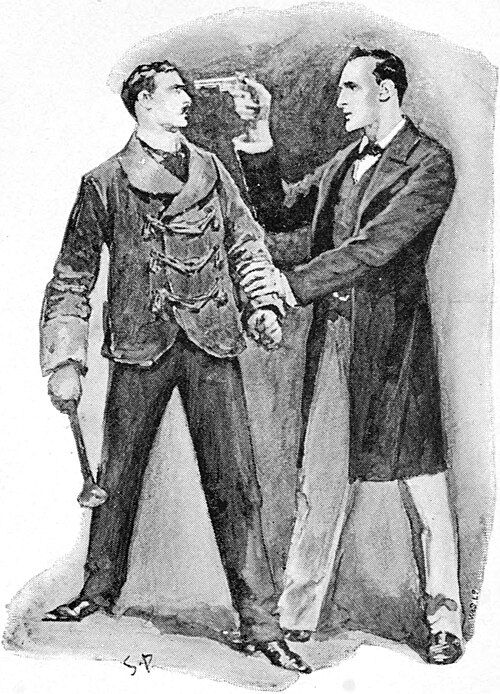
Illustration: Sidney Paget, public domain, via Wikimedia Commons
“Holmes,” I said one morning, standing at our bow window and looking down the street, “here’s a madman coming along. It seems rather sad that his family lets him out alone.”
My friend got up lazily from his armchair and came to look over my shoulder, hands in the pockets of his dressing gown. It was a bright, crisp February morning. Yesterday’s snow still lay deep on the ground, glittering in the winter sun. Down the center of Baker Street the traffic had churned it into a brown, crumbly band, but along the sides and on the heaped-up edges of the sidewalks it lay as white as when it fell. The gray pavement had been scraped, but it was still treacherously slippery, so there were fewer people about than usual. In fact, from the direction of the Metropolitan Station, where the underground trains came in, no one was coming at all except the single gentleman whose odd behavior had caught my eye.
He was about fifty, tall, stout and imposing, with a massive, strongly marked face and a commanding figure. He was dressed soberly but richly: black frock coat, shining top hat, neat brown gaiters, and well-cut pearl-gray trousers. Yet his actions made an absurd contrast with all that dignity. He was running hard, with a little hop now and then, the kind a tired man gives when he isn’t used to asking much of his legs. As he ran he jerked his hands up and down, waggled his head, and twisted his face into the most extraordinary contortions.
“What on earth is the matter with him?” I asked. “He’s looking up at the house numbers.”
“I believe he’s coming here,” said Holmes, rubbing his hands.
“Here?”
“Yes. I rather think he’s coming to consult me professionally. I think I recognize the symptoms. Ha! Didn’t I tell you?” As he spoke, the man, puffing and blowing, rushed at our door and pulled the bell until the whole house rang with it.
A few moments later he was in our room, still puffing, still waving his hands, but with such a fixed look of grief and despair in his eyes that our smiles turned at once to horror and pity. For a while he couldn’t get a word out. He swayed and plucked at his hair like a man driven to the very edge of his reason. Then he sprang to his feet and beat his head against the wall so hard that we both rushed at him and dragged him back to the middle of the room. Sherlock Holmes pushed him down into the easy chair, sat beside him, patted his hand, and talked to him in the calm, soothing tone he knew so well how to use.
“You’ve come to tell me your story, haven’t you?” he said. “You’re worn out from hurrying. Please wait until you’ve recovered yourself, and then I’ll be very happy to look into any little problem you care to bring me.”
The man sat for a minute or more, chest heaving, fighting his emotions. Then he passed his handkerchief over his forehead, pressed his lips together, and turned to face us.
“No doubt you think I’m mad?” he said.
“I see that you’ve had some great trouble,” Holmes replied.
“God knows I have! A trouble enough to unseat my reason, it came so suddenly and so terribly. Public disgrace I might have faced, though my character has never had a stain on it. Private sorrow comes to every man. But the two together, and in such a frightful form, have shaken me to my soul. And it isn’t only me. The very noblest in the land may suffer unless some way is found out of this horrible business.”
“Please, calm yourself, sir,” said Holmes, “and give me a clear account of who you are and what has happened to you.”
“My name,” our visitor answered, “is probably familiar to you. I am Alexander Holder, of the banking firm of Holder & Stevenson, of Threadneedle Street.”
We knew the name. It belonged to the senior partner of the second-largest private bank in the City of London. What could have brought one of London’s foremost citizens to this pitiful state? We waited, all curiosity, until with another effort he braced himself to tell his story.
“I feel that time matters,” he said. “That’s why I hurried here when the police inspector suggested I get your help. I came to Baker Street by the Underground and ran from the station, because the cabs crawl through this snow. That’s why I was so out of breath. I’m a man who takes very little exercise. I feel better now, and I’ll give you the facts as briefly and clearly as I can.
“You know, of course, that a successful bank depends as much on finding profitable investments for its money as on gaining new customers. One of our best ways of putting money to work is in loans where the security is beyond question. We’ve done a good deal of that in the last few years, and there are many noble families to whom we’ve lent large sums against their paintings, their libraries, or their silver plate.
“Yesterday morning I was sitting in my office at the bank when one of the clerks brought me a card. I started when I saw the name, for it was none other than—well, perhaps even to you I’d better say only that it was a name known in every household on earth, one of the highest, noblest, most exalted names in England. I was overwhelmed by the honor and tried to say so when he came in, but he plunged straight into business, like a man who wants to get through an unpleasant task as fast as he can.
“‘Mr. Holder,’ he said, ‘I’m told you’re in the habit of lending money.’
“‘The firm does, when the security is good,’ I answered.
“‘It is absolutely essential to me,’ he said, ‘that I have fifty thousand pounds at once. I could, of course, borrow so trifling a sum ten times over from my friends, but I much prefer to make it a matter of business and to handle that business myself. In my position, you’ll understand, it’s unwise to put oneself under obligations.’
“‘For how long, may I ask, do you need this sum?’ I asked.
“‘Next Monday a large sum is due to me, and I’ll certainly repay you then, with whatever interest you think right. But it’s essential that the money be paid at once.’
“‘I’d gladly lend it from my own pocket without another word,’ I said, ‘if the strain weren’t more than my pocket could bear. If, on the other hand, I’m to do it in the firm’s name, then in fairness to my partner I must insist that, even in your case, every businesslike precaution be taken.’
“‘I’d much prefer it that way,’ he said, lifting a square case of black morocco leather that he’d set beside his chair. ‘You’ve no doubt heard of the Beryl Coronet?’
“‘One of the most precious public possessions of the empire,’ I said.
“‘Exactly.’ He opened the case, and there, bedded in soft, flesh-colored velvet, lay the magnificent piece of jewelry he’d named. ‘There are thirty-nine enormous beryls,’ he said, ‘and the value of the gold work is beyond calculation. The lowest estimate would put the coronet at double what I’ve asked. I’m prepared to leave it with you as security.’
“I took the precious case in my hands and looked, a little puzzled, from it to my illustrious client.
“‘You doubt its value?’ he asked.
“‘Not at all. I only doubt—’
“‘Whether it’s proper for me to leave it. You can set your mind at rest. I wouldn’t dream of it if I weren’t absolutely certain of reclaiming it in four days. It’s purely a formality. Is the security enough?’
“‘Ample.’
“‘You understand, Mr. Holder, that I’m giving you a strong proof of my confidence in you, based on everything I’ve heard of you. I rely on you not only to be discreet and avoid all gossip, but above all to guard this coronet with every possible precaution. I needn’t tell you that a great public scandal would follow if any harm came to it. Any damage would be almost as serious as losing it outright, for there are no beryls in the world to match these, and it would be impossible to replace them. I leave it with you, though, with complete confidence, and I’ll call for it in person on Monday morning.’
“Seeing that my client was eager to go, I said no more. I called my cashier and had him pay over fifty thousand-pound notes. Once I was alone again, though, with the precious case on the desk in front of me, I couldn’t help feeling uneasy about the huge responsibility I’d taken on. Since it was national property, there would be a horrible scandal if anything happened to it. I already regretted agreeing to take charge of it. But it was too late to change that, so I locked it in my private safe and went back to work.
“When evening came, I felt it would be reckless to leave something so precious behind me in the office. Bankers’ safes had been broken open before; why not mine? And then what a terrible position I’d be in! So I decided that for the next few days I’d carry the case back and forth with me, so it would never really be out of my reach. I called a cab and drove out to my house at Streatham with the jewel beside me. I didn’t breathe easily until I’d taken it upstairs and locked it in the bureau in my dressing room.
“And now a word about my household, Mr. Holmes, because I want you to understand the situation thoroughly. My groom and my page sleep out of the house and can be set aside entirely. I have three maids who’ve been with me for years and whose reliability is quite beyond suspicion. Another, Lucy Parr, the second waiting-maid, has been with me only a few months. She came with an excellent reference, though, and has always given satisfaction. She’s a very pretty girl and has attracted admirers who sometimes hang about the place. That’s the only drawback we’ve found in her, but we believe her to be a thoroughly good girl in every way.
“So much for the servants. My family is so small it won’t take long to describe. I’m a widower with an only son, Arthur. He has been a disappointment to me, Mr. Holmes—a bitter disappointment. No doubt I’m to blame. People tell me I spoiled him. Very likely I did. When my dear wife died, I felt he was all I had left to love. I couldn’t bear to see the smile leave his face even for a moment. I never refused him anything. Perhaps it would have been better for us both if I’d been sterner, but I meant it for the best.
“Naturally I meant him to follow me into the business, but he had no head for it. He was wild and wayward, and, to be honest, I couldn’t trust him with large sums of money. As a young man he joined an aristocratic club, and there, with his charming manners, he soon became close friends with a set of men with deep pockets and expensive habits. He learned to play cards for high stakes and to throw money away at the races, until again and again he had to come and beg me for an advance on his allowance to settle his debts of honor—gambling debts, which no court could make him pay but which a gentleman who left them unpaid could never live down. More than once he tried to break away from that dangerous crowd, but each time the influence of his friend, Sir George Burnwell, was enough to pull him back.
“And honestly, I can’t wonder that a man like Sir George Burnwell has such a hold on him, because he’s often brought him to my house, and I’ve found myself that I could hardly resist the charm of his manner. He’s older than Arthur, a man of the world to his fingertips, who has been everywhere and seen everything, a brilliant talker and a strikingly handsome man. Yet when I think of him in cold blood, away from the glamour of his presence, I’m convinced by his cynical talk, and by a look I’ve caught in his eyes, that he’s a man to be deeply distrusted. So I think, and so does my little Mary, who has a woman’s quick insight into character.
“And now there’s only she left to describe. She’s my niece. When my brother died five years ago and left her alone in the world, I adopted her, and I’ve thought of her as my daughter ever since. She’s a sunbeam in my house—sweet, loving, beautiful, a wonderful manager and housekeeper, and yet as tender and quiet and gentle as anyone could be. She’s my right hand. I don’t know what I’d do without her. Only once has she ever gone against my wishes. Twice my boy has asked her to marry him, because he loves her devotedly, and each time she’s refused him. I think if anyone could have set him on the right path it would have been she, and that marriage might have changed his whole life. But now, alas, it’s too late—forever too late!
“Now, Mr. Holmes, you know the people who live under my roof, and I’ll go on with my miserable story.
“That night after dinner, while we were having coffee in the drawing room, I told Arthur and Mary what had happened and about the precious treasure under our roof, holding back only my client’s name. Lucy Parr, who had brought in the coffee, had left the room, I’m sure, but I can’t swear the door was closed. Mary and Arthur were very interested and wanted to see the famous coronet, but I thought it better not to disturb it.
“‘Where have you put it?’ Arthur asked.
“‘In my own bureau.’
“‘Well, I hope to goodness the house won’t be burgled tonight,’ he said.
“‘It’s locked up,’ I answered.
“‘Oh, any old key will fit that bureau. When I was a boy I opened it myself with the key to the box-room cupboard.’
“He often talked wildly like that, so I thought little of it. But that night he followed me to my room with a very grave face.
“‘Look here, Dad,’ he said, eyes on the floor, ‘can you let me have two hundred pounds?’
“‘No, I can’t!’ I answered sharply. ‘I’ve been far too generous with you about money.’
“‘You’ve been very kind,’ he said, ‘but I must have this money, or I can never show my face in the club again.’
“‘And a very good thing, too!’ I cried.
“‘Yes, but you wouldn’t have me leave it a disgraced man,’ he said. ‘I couldn’t bear it. I must raise the money somehow, and if you won’t give it to me, then I must try other means.’
“I was very angry, because this was the third demand that month. ‘You won’t get one farthing from me,’ I cried, at which he bowed and left the room without another word.
“When he’d gone, I unlocked my bureau, made sure my treasure was safe, and locked it again. Then I went round the house to check that everything was secure—a job I usually leave to Mary, but which I thought I’d better do myself that night. As I came down the stairs I saw Mary herself at the side window of the hall, which she closed and fastened as I came near.
“‘Tell me, Dad,’ she said, looking, I thought, a little upset, ‘did you give Lucy, the maid, permission to go out tonight?’
“‘Certainly not.’
“‘She came in just now by the back door. I’m sure she’s only been to the side gate to see someone, but I don’t think it’s safe, and it ought to be stopped.’
“‘You must speak to her in the morning, or I will if you’d rather. Are you sure everything’s fastened?’
“‘Quite sure, Dad.’
“‘Then good night.’ I kissed her and went back up to my bedroom, where I soon fell asleep.
“I’m trying to tell you everything that might bear on the case, Mr. Holmes, but please question me on any point I don’t make clear.”
“On the contrary, your statement is remarkably lucid.”
“I’m coming to a part of my story where I especially want to be. I’m not a heavy sleeper, and the worry on my mind made me lighter than usual. At about two in the morning I was woken by some sound in the house. It had stopped before I was fully awake, but it left the impression that a window had been gently closed somewhere. I lay listening with all my ears. Suddenly, to my horror, I heard the distinct sound of footsteps moving softly in the next room. I slipped out of bed, my heart pounding, and peeped round the edge of my dressing-room door.
“‘Arthur!’ I screamed. ‘You villain! You thief! How dare you touch that coronet?’
“The gas was half turned up, as I’d left it, and my unhappy boy, dressed only in his shirt and trousers, was standing beside the light, holding the coronet in his hands. He seemed to be wrenching at it, or bending it with all his strength. At my cry he dropped it and went as pale as death. I snatched it up and examined it. One of the gold corners, with three of the beryls in it, was missing.
“‘You scoundrel!’ I shouted, beside myself with rage. ‘You’ve ruined it! You’ve disgraced me forever! Where are the jewels you’ve stolen?’
“‘Stolen!’ he cried.
“‘Yes, thief!’ I roared, shaking him by the shoulder.
“‘There are none missing. There can’t be any missing,’ he said.
“‘There are three missing. And you know where they are. Must I call you a liar as well as a thief? Didn’t I see you trying to tear off another piece?’
“‘You’ve called me names enough,’ he said. ‘I won’t stand any more of it. I won’t say another word about this business, since you’ve chosen to insult me. I’ll leave your house in the morning and make my own way in the world.’
“‘You’ll leave it in the hands of the police!’ I cried, half mad with grief and rage. ‘I’ll have this matter searched to the bottom.’
“‘You’ll learn nothing from me,’ he said, with a passion I wouldn’t have thought was in him. ‘If you choose to call the police, let the police find what they can.’
“By then the whole house was awake, because I’d raised my voice in anger. Mary was the first to rush into my room, and at the sight of the coronet and of Arthur’s face she read the whole story, screamed, and fell senseless to the floor. I sent the housemaid for the police and put the investigation in their hands at once. When the inspector and a constable came in, Arthur, who had been standing sullenly with his arms folded, asked whether I meant to charge him with theft. I told him it was no longer a private matter but a public one, since the ruined coronet was national property. I was determined that the law should take its course in everything.
“‘At least,’ he said, ‘you won’t have me arrested right away. It would be to your advantage as well as mine if I could leave the house for five minutes.’
“‘So you can get away, or hide what you’ve stolen,’ I said. And then, realizing the dreadful position I was in, I begged him to remember that not only my honor but that of someone far greater than I was at stake, and that he threatened to raise a scandal that would shake the nation. He could prevent it all if he’d only tell me what he’d done with the three missing stones.
“‘You may as well face it,’ I said. ‘You were caught in the act, and no confession could make your guilt any worse. If you’ll only make what amends you can, by telling us where the beryls are, all will be forgiven and forgotten.’
“‘Save your forgiveness for people who ask for it,’ he answered, turning away from me with a sneer. I saw he was too hardened for any words of mine to move him. There was only one thing to do. I called in the inspector and gave him into custody. They searched at once, not only his person but his room and every corner of the house where he could possibly have hidden the gems, and found no trace of them. And the wretched boy wouldn’t open his mouth for all our pleading and threats. This morning he was taken to a cell, and I, after going through all the police formalities, have hurried round to beg you to use your skill to untangle the matter. The police have openly admitted that, for now, they can make nothing of it. You may go to any expense you think necessary. I’ve already offered a reward of a thousand pounds. My God, what shall I do? I’ve lost my honor, my gems, and my son in a single night. Oh, what shall I do?”
He put a hand on each side of his head and rocked to and fro, droning to himself like a child whose grief has gone beyond words.
Sherlock Holmes sat silent for some minutes, brows knitted, eyes fixed on the fire.
“Do you have many visitors?” he asked.
“None except my partner and his family, and now and then a friend of Arthur’s. Sir George Burnwell has been several times lately. No one else, I think.”
“Do you go out much in society?”
“Arthur does. Mary and I stay home. Neither of us cares for it.”
“That’s unusual in a young woman.”
“She’s of a quiet nature. Besides, she isn’t so very young. She’s twenty-four.”
“From what you say, this has been a shock to her too.”
“A terrible one! She’s even more affected than I am.”
“Neither of you has any doubt of your son’s guilt?”
“How can we, when I saw him with my own eyes with the coronet in his hands?”
“I hardly call that conclusive proof. Was the rest of the coronet damaged at all?”
“Yes, it was twisted.”
“Don’t you think, then, that he might have been trying to straighten it?”
“God bless you! You’re doing what you can for him and for me. But it’s too heavy a task. What was he doing there at all? If his purpose was innocent, why didn’t he say so?”
“Exactly. And if it was guilty, why didn’t he invent a lie? His silence seems to me to cut both ways. There are several curious points about this case. What did the police make of the noise that woke you?”
“They thought it might have been Arthur closing his bedroom door.”
“A likely story! As if a man bent on a felony would slam his door and wake the household. And what did they say about the disappearance of the gems?”
“They’re still tapping the floorboards and probing the furniture in the hope of finding them.”
“Have they thought of looking outside the house?”
“Yes, they’ve shown extraordinary energy. The whole garden has already been searched inch by inch.”
“Now, my dear sir,” said Holmes, “isn’t it obvious that this matter goes much deeper than either you or the police first thought? It seemed to you a simple case; to me it seems extremely complex. Consider what your theory requires. You suppose that your son got out of bed, went at great risk to your dressing room, opened your bureau, took out the coronet, broke off a small piece of it by main force, went off somewhere else, hid three gems out of the thirty-nine so skillfully that nobody can find them, and then came back with the other thirty-six into the very room where he was in the greatest danger of being caught. I ask you, does such a theory hold up?”
Laid out like that, step by step, I had to admit the theory looked like a staircase with every tread in place and no way to climb it. Each step was possible on its own. Taken together, they made no sense.
“But what other theory is there?” cried the banker, with a gesture of despair. “If his motives were innocent, why won’t he explain them?”
“That’s our job to find out,” Holmes replied. “So now, if you please, Mr. Holder, we’ll set off for Streatham together and spend an hour looking a little more closely at the details.”
My friend insisted that I come along, and I was eager to, for the story had stirred both my curiosity and my sympathy. I confess the banker’s son seemed to me as plainly guilty as he did to his unhappy father, but I trusted Holmes’s judgment so completely that I felt there must be some ground for hope as long as he was dissatisfied with the obvious explanation. He hardly said a word the whole way out to the southern suburb but sat with his chin on his chest and his hat pulled over his eyes, sunk in the deepest thought. Our client seemed to have taken fresh heart from the little glimpse of hope he’d been given, and he even fell into a rambling chat with me about his business affairs. A short train ride and a shorter walk brought us to Fairbank, the modest home of the great financier.
Fairbank was a good-sized square house of white stone, set back a little from the road. A double carriage drive curved across a snowy lawn down to two large iron gates. On the right, a small wooded thicket led to a narrow path between two neat hedges, running from the road to the kitchen door: the tradesmen’s entrance. On the left ran a lane that led to the stables. It wasn’t part of the grounds at all, but a public road, though little used. Holmes left us at the door and walked slowly all round the house: across the front, down the tradesmen’s path, round through the garden behind, and into the stable lane.
I watched him for a minute through the window, bent nearly double, and it struck me that a field of fresh snow is the most honest witness there is. Every foot that crosses it presses down a print of its own exact shape, deep where the weight fell and shallow where it didn’t, and until more snow falls or a thaw sets in, it keeps that record like a ledger. Holmes was reading the ledger.
He was gone so long that Mr. Holder and I went into the dining room and waited by the fire. We were sitting there in silence when the door opened and a young woman came in. She was a little above average height and slim, with dark hair and eyes that looked darker still against the deadly pallor of her skin. I don’t think I’ve ever seen a woman’s face so white. Her lips were bloodless, but her eyes were red from crying. As she swept silently into the room she struck me as even more grief-stricken than the banker had been that morning, and it was all the more striking because she was clearly a woman of strong character, with an immense capacity for self-control. Ignoring me, she went straight to her uncle and stroked his head with a gentle, loving hand.
“You’ve given orders for Arthur to be released, haven’t you, Dad?” she asked.
“No, no, my girl. The matter must be searched to the bottom.”
“But I’m so sure he’s innocent. You know what a woman’s instincts are. I know he’s done no harm, and that you’ll be sorry for treating him so harshly.”
“Then why is he silent, if he’s innocent?”
“Who knows? Perhaps because he was so angry that you suspected him.”
“How could I help suspecting him, when I actually saw him with the coronet in his hands?”
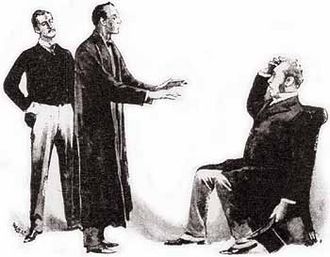
Illustration: Sidney Paget, public domain, via Wikimedia Commons
“Oh, but he’d only picked it up to look at it. Oh, please, please take my word that he’s innocent. Let it drop and say no more. It’s so dreadful to think of our dear Arthur in prison!”
“I’ll never let it drop until the gems are found—never, Mary! Your affection for Arthur blinds you to what this means for me. Far from hushing it up, I’ve brought a gentleman down from London to look into it more deeply.”
“This gentleman?” she asked, turning to me.
“No, his friend. He asked us to leave him alone. He’s round in the stable lane now.”
“The stable lane?” She raised her dark eyebrows. “What can he hope to find there? Ah! This, I suppose, is he. I hope, sir, you’ll succeed in proving what I’m sure is the truth: that my cousin Arthur is innocent of this crime.”
“I fully share your opinion, and I hope, with you, that we may prove it,” Holmes replied, going back to the mat to knock the snow from his shoes. “I believe I have the honor of addressing Miss Mary Holder. May I ask you a question or two?”
“Please do, sir, if it may help clear up this horrible business.”
“You heard nothing yourself last night?”
“Nothing, until my uncle here began talking loudly. I heard that, and I came down.”
“You shut up the windows and doors the night before. Did you fasten all the windows?”
“Yes.”
“Were they all fastened this morning?”
“Yes.”
“You have a maid who has a sweetheart? I think you told your uncle last night that she’d been out to see him?”
“Yes, and she was the girl who served in the drawing room, and who may have heard Uncle’s remarks about the coronet.”
“I see. You infer that she may have gone out to tell her sweetheart, and that the two of them may have planned the robbery.”
“But what’s the use of all these vague theories,” cried the banker impatiently, “when I’ve told you I saw Arthur with the coronet in his hands?”
“Wait a little, Mr. Holder. We’ll come back to that. About this girl, Miss Holder. You saw her come back by the kitchen door, I take it?”
“Yes. When I went to check that the door was fastened for the night, I met her slipping in. I saw the man, too, in the dark.”
“Do you know him?”
“Oh, yes! He’s the greengrocer who brings our vegetables. His name is Francis Prosper.”
“He stood,” said Holmes, “to the left of the door—that is, farther up the path than he needed to go to reach the door?”
“Yes, he did.”
“And he’s a man with a wooden leg?”
Something like fear leaped into the young woman’s expressive black eyes. “Why, you’re like a magician,” she said. “How do you know that?” She smiled, but there was no answering smile on Holmes’s thin, eager face.
I didn’t think it was magic. A man on a wooden leg leaves, beside each ordinary footprint, a small round hole with no heel and no toe, and a man standing on one in the snow for any time would leave it pressed deep. Holmes had just come in from the very path where they’d stood. What I couldn’t see was why the greengrocer’s leg should matter in the slightest.
“I’d be very glad to go upstairs now,” he said. “I’ll probably want to go over the outside of the house again. Perhaps I’d better look at the lower windows before I go up.”
He walked quickly from one to the next, pausing only at the large one that looked from the hall onto the stable lane. This he opened, and he examined the sill very carefully with his powerful magnifying lens. “Now we’ll go upstairs,” he said at last.
The banker’s dressing room was a plain little room with a gray carpet, a large bureau, and a long mirror. Holmes went to the bureau first and looked hard at the lock.
“Which key was used to open it?” he asked.
“The one my son himself pointed to—the key of the lumber-room cupboard.”
“Do you have it here?”
“That’s it on the dressing table.”
Sherlock Holmes picked it up and opened the bureau.
“It’s a noiseless lock,” he said. “No wonder it didn’t wake you. This case, I take it, holds the coronet. We must have a look at it.” He opened the case, lifted out the diadem, and laid it on the table. It was a magnificent example of the jeweler’s art, and the thirty-six stones were the finest I have ever seen. Beryl, I knew from my student mineralogy, is the same mineral as emerald and aquamarine, colored by different traces of metal, and hard enough to scratch steel. The stones were hard enough to take rough handling. The gold around them was another matter. On one side was a cracked edge where a corner holding three gems had been torn away.
“Now, Mr. Holder,” said Holmes, “here is the corner that matches the one so unfortunately lost. Would you be so kind as to break it off?”
The banker recoiled in horror. “I wouldn’t dream of trying,” he said.
“Then I will.” Holmes suddenly bent all his strength on it, without result. “I feel it give a little,” he said, “but though I’m unusually strong in the fingers, it would take everything I have to break it. An ordinary man couldn’t do it. Now, what do you think would happen if I did break it, Mr. Holder? There would be a noise like a pistol shot. Are you telling me that all this happened within a few yards of your bed and you heard nothing?”
I could see why. Good gold is soft. It bends before it breaks, which is exactly why goldsmiths love it and thieves don’t. To tear a piece off, you have to wrench it back and forth until the metal at the bend grows hard and brittle (any smith knows the effect), and then it finally gives way, often with a sudden snap. Nobody does that quietly a few yards from a light sleeper.
“I don’t know what to think. It’s all dark to me.”
“Perhaps it will grow lighter as we go. What do you think, Miss Holder?”
“I admit I still share my uncle’s confusion.”
“Your son had no shoes or slippers on when you saw him?”
“He had nothing on but his trousers and shirt.”
“Thank you. We’ve certainly had extraordinary luck in this inquiry, and it will be entirely our own fault if we don’t clear the matter up. With your permission, Mr. Holder, I’ll now continue my investigations outside.”
He went alone, at his own request, explaining that any unnecessary footprints might make his work harder. For an hour or more he was at it, coming back at last with his feet caked in snow and his face as unreadable as ever.
“I think I’ve now seen all there is to see, Mr. Holder,” he said. “I can serve you best by going back to my rooms.”
“But the gems, Mr. Holmes. Where are they?”
“I can’t tell you.”
The banker wrung his hands. “I’ll never see them again!” he cried. “And my son? Do you give me hope?”
“My opinion hasn’t changed in the slightest.”
“Then, for God’s sake, what was this dark business that went on in my house last night?”
“If you’ll call on me at my Baker Street rooms tomorrow morning between nine and ten, I’ll be happy to do what I can to make it clearer. I understand you give me carte blanche, a free hand, to act for you, provided only that I get the gems back, and that you set no limit on what I may spend.”
“I’d give my fortune to have them back.”
“Very good. I’ll look into the matter between now and then. Goodbye. It’s just possible I may have to come back here before evening.”
It was obvious to me that my companion had made up his mind about the case, though what he’d concluded I couldn’t even dimly imagine. Several times on the way home I tried to sound him out, but he always slid away to some other subject, until at last I gave up in despair. It wasn’t yet three when we were back in our rooms. He hurried to his bedroom and came down a few minutes later dressed as a common loafer. With his collar turned up, his shiny, shabby coat, his red cravat, and his worn-out boots, he was a perfect specimen of the type.
“I think this should do,” he said, glancing into the mirror over the fireplace. “I only wish you could come with me, Watson, but I’m afraid it won’t do. I may be on the trail in this matter, or I may be chasing a will-o’-the-wisp, but I’ll soon know which. I hope to be back in a few hours.” He cut a slice of beef from the joint on the sideboard, sandwiched it between two rounds of bread, thrust this rough meal into his pocket, and set off on his expedition.
I’d just finished my tea when he came back, clearly in excellent spirits, swinging an old elastic-sided boot in his hand. He tossed it into a corner and poured himself a cup of tea.
“I’ve only looked in on my way past,” he said. “I’m going straight on.”
“Where to?”
“Oh, to the other side of the West End. It may be some time before I’m back. Don’t wait up in case I’m late.”
“How are you getting on?”
“Oh, so-so. Nothing to complain of. I’ve been out to Streatham since I saw you, but I didn’t call at the house. It’s a very sweet little problem, and I wouldn’t have missed it for a good deal. But I mustn’t sit here gossiping. I must get out of these disreputable clothes and back into my highly respectable self.”
I could tell from his manner that he had better reasons for satisfaction than his words let on. His eyes twinkled, and there was even a touch of color in his sallow cheeks. He hurried upstairs, and a few minutes later I heard the slam of the front door, which told me he was off once more on the hunt he loved.
The boot sat in its corner all evening. Twice I picked it up and turned it over under the lamp, as if it might tell me where it had been. It didn’t.
I waited until midnight, but there was no sign of him, so I went to bed. He was often away for days and nights at a stretch when he was hot on a scent, so his lateness didn’t surprise me. I don’t know what time he came in, but when I came down to breakfast, there he was, a cup of coffee in one hand and the newspaper in the other, as fresh and neat as could be.
“You’ll excuse my starting without you, Watson,” he said, “but you remember our client has a rather early appointment this morning.”
“Why, it’s after nine now,” I answered. “I wouldn’t be surprised if that were he. I thought I heard the bell.”
It was indeed our friend the financier. I was shocked by the change in him. His face, naturally broad and massive, was pinched and sunken, and his hair seemed to me at least a shade whiter. He came in with a weariness and listlessness even more painful to see than his wildness of the morning before, and he dropped heavily into the armchair I pushed forward for him.
“I don’t know what I’ve done to be tried so hard,” he said. “Only two days ago I was a happy and prosperous man without a care in the world. Now I’m left to a lonely and disgraced old age. One sorrow treads on the heels of another. My niece, Mary, has deserted me.”
“Deserted you?”
“Yes. Her bed hadn’t been slept in this morning, her room was empty, and a note for me was lying on the hall table. Last night I said to her, in sorrow and not in anger, that if she had married my boy, all might have been well with him. Perhaps it was thoughtless of me. It’s that remark she refers to in this note:
“‘My dearest Uncle,—I feel that I have brought trouble upon you, and that if I had acted differently this terrible misfortune might never have happened. With this thought in my mind I can never again be happy under your roof, and I feel that I must leave you forever. Don’t worry about my future, for that is provided for; and, above all, don’t search for me, for it will be wasted labor and a poor service to me. In life or in death, I am ever your loving
“‘Mary.’
“What can she mean by that note, Mr. Holmes? Do you think it points to suicide?”
“No, no, nothing of the kind. It’s perhaps the best possible solution. I believe, Mr. Holder, that you’re nearing the end of your troubles.”
“Ha! You say so! You’ve heard something, Mr. Holmes. You’ve learned something! Where are the gems?”
“You wouldn’t think a thousand pounds apiece too much for them?”
“I’d pay ten.”
“That won’t be necessary. Three thousand will cover it. And there’s a little reward, I believe. Do you have your checkbook? Here’s a pen. Better make it out for four thousand pounds.”
With a dazed face the banker wrote out the check. Holmes walked over to his desk, took out a little triangular piece of gold with three gems in it, and tossed it onto the table.
With a shriek of joy our client snatched it up.
“You have it!” he gasped. “I’m saved! I’m saved!”
His joy was as wild as his grief had been, and he hugged the recovered gems to his chest.
“There’s one other thing you owe, Mr. Holder,” said Sherlock Holmes, rather sternly.
“Owe!” He caught up a pen. “Name the sum, and I’ll pay it.”

Illustration: Sidney Paget, public domain, via Wikimedia Commons
“No, the debt isn’t to me. You owe a very humble apology to that noble lad, your son, who has carried himself in this affair as I’d be proud to see my own son do, if I ever happen to have one.”
“Then it wasn’t Arthur who took them?”
“I told you yesterday, and I repeat it today: it was not.”
“You’re sure of it! Then let’s hurry to him at once and let him know the truth is out.”
“He knows already. When I’d cleared it all up, I went to see him, and when I found he wouldn’t tell me the story, I told it to him. He had to admit I was right and add the very few details that weren’t yet quite clear to me. Your news this morning, though, may open his lips.”
“For heaven’s sake, then, tell me what this extraordinary mystery is!”
“I will, and I’ll show you the steps by which I reached it. And let me say first the thing that’s hardest for me to say and for you to hear: there has been an understanding between Sir George Burnwell and your niece, Mary. They have now run away together.”
“My Mary? Impossible!”
“Unfortunately it’s more than possible; it’s certain. Neither you nor your son knew this man’s true character when you let him into your family circle. He’s one of the most dangerous men in England—a ruined gambler, an utterly desperate villain, a man without heart or conscience. Your niece knew nothing of such men. When he whispered his vows to her, as he had to a hundred before her, she flattered herself that she alone had touched his heart. The devil knows best what he said, but at any rate she became his tool and was in the habit of seeing him nearly every evening.”
“I can’t, and I won’t, believe it!” cried the banker, his face ashen.
“Then I’ll tell you what happened in your house that night. Your niece, when she thought you’d gone to your room, slipped downstairs and talked to her lover through the window that opens onto the stable lane. He stood there so long that his footprints pressed right through the snow. She told him about the coronet. His wicked greed for gold flared up at the news, and he bent her to his will. I have no doubt that she loved you, but there are women in whom the love of a lover snuffs out every other love, and I think she must have been one. She’d hardly heard his instructions when she saw you coming downstairs. She shut the window quickly and told you about one of the maids’ escapade with her wooden-legged sweetheart, which was all perfectly true.
“Your boy, Arthur, went to bed after his talk with you but slept badly, worrying about his club debts. In the middle of the night he heard a soft step pass his door. He got up, looked out, and was astonished to see his cousin creeping very stealthily along the passage until she disappeared into your dressing room. Frozen with astonishment, the lad pulled on some clothes and waited in the dark to see what would come of this strange business. Presently she came out again, and in the light of the passage lamp your son saw that she was carrying the precious coronet. She went down the stairs, and he, thrilling with horror, ran along and slipped behind the curtain near your door, where he could see what happened in the hall below. He saw her quietly open the window, hand the coronet out to someone in the dark, and then, closing it again, hurry back to her room, passing quite close to where he stood hidden behind the curtain.
“As long as she was there, he couldn’t act without horribly exposing the woman he loved. But the moment she was gone, he realized what a crushing blow this would be to you, and how vital it was to set it right. He rushed down just as he was, in his bare feet, opened the window, jumped out into the snow, and ran down the lane, where he could see a dark figure in the moonlight. Sir George Burnwell tried to get away, but Arthur caught him, and they struggled, your lad tugging at one side of the coronet and his opponent at the other. In the scuffle your son struck Sir George and cut him over the eye. Then something suddenly snapped, and your son, finding the coronet in his hands, rushed back, closed the window, went up to your room, and had just noticed that the coronet had been twisted in the struggle and was trying to straighten it when you appeared.”
“Is it possible?” gasped the banker.
“You then roused his anger by calling him names at a moment when he felt he’d earned your warmest thanks. He couldn’t explain the truth without betraying someone who certainly deserved very little consideration from him. He took the more chivalrous view, though, and kept her secret.”
“And that’s why she screamed and fainted when she saw the coronet,” cried Mr. Holder. “Oh, my God! What a blind fool I’ve been! And his asking to be let out for five minutes! The dear fellow wanted to see if the missing piece was at the scene of the struggle. How cruelly I’ve misjudged him!”
“When I arrived at the house,” Holmes went on, “I at once went very carefully round it, to see if there were any traces in the snow that might help me. I knew none had fallen since the evening before, and that there had been a hard frost to preserve the prints.”
I saw at once why that mattered. In a thaw, the rim of every footprint softens and slumps, and within hours the finer details blur away. In a hard frost the snow stays crisp, and each print keeps its sharp edges like a plaster cast. Holmes had been handed a full night’s record, sealed.
“I went along the tradesmen’s path,” he continued, “but found it all trampled and impossible to read. Just beyond it, though, on the far side of the kitchen door, a woman had stood and talked with a man whose round prints on one side showed that he had a wooden leg. I could even tell they’d been disturbed, because the woman had run swiftly back to the door, as the deep toe and light heel marks showed, while Wooden-leg had waited a little and then gone away. I thought at the time that this might be the maid and her sweetheart, whom you’d already mentioned, and inquiry showed it was so. I went round the garden without seeing anything but random tracks, which I took to be the police; but when I got into the stable lane, a very long and complicated story was written in the snow in front of me.”
That part I could have worked out myself, and I felt a little foolish that I hadn’t. When you walk, your heel strikes first and takes much of your weight, so the heel prints deep. When you run fast, you land farther forward and drive off the toes, so the toe digs in and the heel often barely touches. The snow had simply recorded which one she was doing.
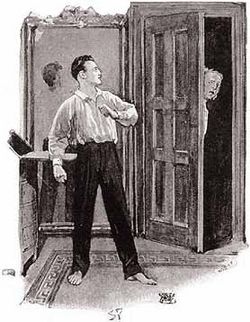
Illustration: Sidney Paget, public domain, via Wikimedia Commons
“There was a double line of tracks of a man in boots,” said Holmes, “and a second double line, which I saw with delight belonged to a man with bare feet. From what you’d told me, I was at once convinced the second was your son. The first had walked both ways, but the other had run fast, and since his tread was printed in places over the hollow of the boot, it was obvious that he’d come after the other.”
It is the same rule a geologist uses on a cliff face. Whatever lies on top was laid down last. A bare foot pressed into a boot print can only mean the boot came first.
“I followed them and found they led to the hall window, where Boots had worn away all the snow while he waited. Then I walked to the other end, a hundred yards or more down the lane. I saw where Boots had turned round, where the snow was churned up as if there’d been a struggle, and finally where a few drops of blood had fallen, to show me I wasn’t mistaken. Boots had then run down the lane, and another little smudge of blood showed that it was he who’d been hurt. When he reached the high road at the other end, I found the pavement had been cleared, so that was the end of that clue.
“On entering the house, however, I examined the sill and frame of the hall window with my lens, as you’ll remember, and I could see at once that someone had passed out through it. I could make out the outline of an instep where the wet foot had been set down coming back in. I was then beginning to form an opinion about what had happened. A man had waited outside the window; someone had brought him the gems; the deed had been watched by your son; he had chased the thief and struggled with him; they had each tugged at the coronet, their combined strength causing damage that neither alone could have done. He had come back with the prize but left a fragment in his opponent’s grip. So far it was clear. The question now was: who was the man, and who had brought him the coronet?”
So that was why he’d made the banker try to snap the corner, and then tried it himself. No one man’s fingers could break that gold. Two men hauling on it from opposite ends could, out in the lane, a hundred yards from any sleeper’s ear. And a bare foot that has run through snow comes back carrying meltwater, so it leaves a damp print of its sole on a dry wooden sill. A booted foot would have left something else entirely. Every piece had been on the table since yesterday. I had simply been looking at them one at a time.
“It’s an old maxim of mine,” Holmes went on, “that when you have excluded the impossible, whatever remains, however improbable, must be the truth. Now, I knew it wasn’t you who’d brought it down, so that left only your niece and the maids. But if it were one of the maids, why would your son let himself be accused in her place? There could be no possible reason. Since he loved his cousin, though, there was an excellent reason for him to keep her secret—all the more because the secret was a shameful one. When I remembered that you’d seen her at that very window, and how she’d fainted on seeing the coronet again, my guess became a certainty.

Illustration: Sidney Paget, public domain, via Wikimedia Commons
“And who could her accomplice be? A lover, obviously, for who else could outweigh the love and gratitude she must feel toward you? I knew you went out little and that your circle of friends was very small. But among them was Sir George Burnwell. I’d heard of him before as a man with an evil reputation among women. It must have been he who wore those boots and kept the missing gems. Even though he knew Arthur had discovered him, he might still flatter himself that he was safe, since the lad couldn’t say a word without compromising his own family.
“Well, your own good sense will tell you what I did next. I went, dressed as a loafer, to Sir George’s house, managed to strike up an acquaintance with his valet, learned that his master had cut his head the night before, and finally, at a cost of six shillings, made everything sure by buying a pair of his cast-off shoes. With these I traveled down to Streatham and saw that they fitted the tracks exactly.”
I glanced at the corner of the room. The old elastic-sided boot was still sitting there, looking smug.
“I saw a shabby-looking tramp in the lane yesterday evening,” said Mr. Holder.

Illustration: Sidney Paget, public domain, via Wikimedia Commons
“Exactly. It was I. I found I had my man, so I came home and changed my clothes. Then I had a delicate part to play, for I saw that a prosecution must be avoided to prevent a scandal, and I knew so clever a villain would see that our hands were tied. I went and saw him. At first, of course, he denied everything. But when I gave him every detail of what had happened, he tried to bluster and took down a life-preserver, a short club weighted with lead, from the wall. I knew my man, though, and I clapped a pistol to his head before he could strike. Then he became a little more reasonable. I told him we’d pay him a price for the stones he held—a thousand pounds apiece. That brought out the first sign of grief he’d shown. ‘Why, dash it all!’ he said. ‘I’ve let them go at six hundred for the three!’ I soon got the address of the receiver of stolen goods who had them, by promising there’d be no prosecution. Off I went to him, and after a great deal of haggling I got our stones at a thousand pounds apiece. Then I looked in on your son, told him all was well, and finally got to bed about two o’clock, after what I may call a really hard day’s work.”
“A day that has saved England from a great public scandal,” said the banker, rising. “Sir, I can’t find words to thank you, but you won’t find me ungrateful for what you’ve done. Your skill has indeed exceeded everything I’d heard of it. And now I must fly to my dear boy and apologize for the wrong I’ve done him. As for what you tell me of poor Mary, it goes to my very heart. Not even your skill can tell me where she is now.”
“I think we may safely say,” Holmes replied, “that she is wherever Sir George Burnwell is. It is equally certain that, whatever her sins, they will soon receive a more than sufficient punishment.”