A Case of Identity
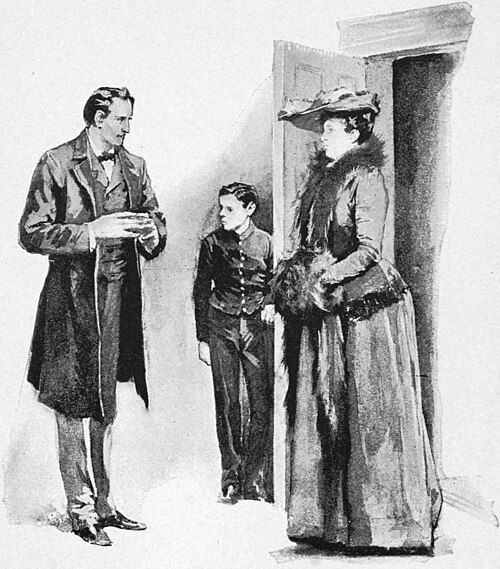
Illustration: Sidney Paget, public domain, via Wikimedia Commons
“My dear fellow,” said Sherlock Holmes, as we sat on either side of the fire in his lodgings at Baker Street, “life is infinitely stranger than anything which the mind of man could invent. We wouldn’t dare to imagine the things that are really the mere commonplaces of existence. If we could fly out of that window hand in hand, hover over this great city, gently lift off the roofs, and peep in at the strange things going on, the coincidences, the plans, the cross-purposes, the wonderful chains of events working through generations and leading to the most outré results, it would make all fiction, with its conventions and foreseen endings, look stale and unprofitable.”
“And yet I’m not convinced,” I answered. “The cases that turn up in the papers are, as a rule, bald and vulgar enough. Our police reports give us realism pushed to its very limit, and the result, I have to say, is neither fascinating nor artistic.”
“A certain selection and discretion is needed to produce a realistic effect,” Holmes said. “That’s what the police report lacks. It puts more weight on the magistrate’s platitudes than on the details, and to an observer the details are the vital essence of the whole matter. Depend upon it, there is nothing so unnatural as the commonplace.”
I smiled and shook my head. “I can see why you’d think so. In your position, unofficial adviser to everybody who is absolutely stumped, across three continents, you meet everything strange and bizarre. But here”—I picked the morning paper up off the floor—“let’s put it to a practical test. Here’s the first headline I see. ‘A husband’s cruelty to his wife.’ Half a column of print, and I know without reading a word that it’s perfectly familiar. The other woman, the drink, the push, the blow, the bruise, the sympathetic sister or landlady. The crudest writer alive couldn’t invent anything cruder.”
“Your example is an unlucky one for your argument,” said Holmes, taking the paper and running his eye down it. “This is the Dundas separation case, and as it happens I cleared up some small points in it. The husband was a teetotaler, there was no other woman, and the conduct complained of was that he’d drifted into the habit of ending every meal by taking out his false teeth and hurling them at his wife. You’ll allow that isn’t an action likely to occur to the average storyteller. Take a pinch of snuff, Doctor, and admit I’ve scored off you with your own example.”
He held out his snuffbox of old gold, with a great amethyst in the center of the lid. It was so splendid, and so out of keeping with his plain habits, that I couldn’t help remarking on it.
“Ah,” he said, “I forgot I hadn’t seen you for some weeks. It’s a little souvenir from the King of Bohemia, in return for my help in the matter of the Irene Adler papers.”
“And the ring?” I asked, glancing at a remarkable diamond sparkling on his finger.
“From the reigning family of Holland. That matter was so delicate that I can’t confide it even to you, though you’ve been good enough to chronicle one or two of my little problems.”
“Do you have anything on hand just now?” I asked with interest.
“Ten or twelve cases, and not one with any feature of interest. They’re important, you understand, without being interesting. I’ve found that it’s usually in the unimportant matters that there’s room for observation, and for the quick analysis of cause and effect that gives an investigation its charm. The larger crimes tend to be the simpler, because the bigger the crime, the more obvious, as a rule, the motive. Apart from one rather intricate affair sent to me from Marseilles, there’s nothing worth a second look. But I may have something better before many minutes are out, for unless I’m much mistaken, that is one of my clients.”
He had risen and was standing between the parted blinds, gazing down into the dull, gray London street. Looking over his shoulder, I saw a large woman on the pavement opposite. She had a heavy fur boa around her neck and a big curling red feather in a broad-brimmed hat, which was tilted flirtatiously over one ear in the Duchess of Devonshire style. From under all this finery she peeped up at our windows in a nervous, hesitating way, her body swaying backward and forward, her fingers fidgeting with her glove buttons. Then, with a sudden plunge, like a swimmer leaving the bank, she hurried across the road, and we heard the sharp clang of the bell.
“I’ve seen those symptoms before,” said Holmes, tossing his cigarette into the fire. “Swaying on the pavement always means an affaire de cœur, an affair of the heart. She wants advice, but she isn’t sure the matter isn’t too delicate to talk about. And even here we can be precise. When a woman has been seriously wronged by a man, she doesn’t sway. She yanks, and the usual symptom is a broken bell wire. So we can take it there’s a love matter, but that the lady is less angry than puzzled, or grieved. And here she comes in person to settle our doubts.”
As he spoke there was a tap at the door, and the page boy in his buttoned uniform came in to announce Miss Mary Sutherland. The lady herself loomed behind his small dark figure like a merchant ship under full sail behind a tiny pilot boat. Holmes welcomed her with the easy courtesy he was known for, shut the door, bowed her into an armchair, and looked her over in that minute and yet abstracted way that was all his own.
“Don’t you find,” he said, “that with your short sight it’s a little trying to do so much typewriting?”
“I did at first,” she answered, “but now I know where the letters are without looking.” Then, suddenly understanding what he’d said, she gave a violent start and looked up, fear and astonishment on her broad, good-humored face. “You’ve heard about me, Mr. Holmes,” she cried, “or how could you know all that?”
“Never mind,” said Holmes, laughing. “It’s my business to know things. Perhaps I’ve trained myself to see what others overlook. If not, why would you come to consult me?”
“I came to you, sir, because Mrs. Etherege told me about you. You found her husband so easily, when the police and everyone had given him up for dead. Oh, Mr. Holmes, I wish you’d do as much for me. I’m not rich, but I have a hundred a year in my own right, besides the little I make on the machine, and I’d give every penny of it to know what has become of Mr. Hosmer Angel.”
“Why did you rush off to consult me in such a hurry?” asked Holmes, his fingertips pressed together and his eyes on the ceiling.
Again that startled look crossed Miss Sutherland’s face. “Yes, I did bang out of the house,” she said, “because it made me angry to see how easily Mr. Windibank—that is, my father—took it all. He wouldn’t go to the police, and he wouldn’t come to you. He just kept saying there was no harm done, until it made me mad, and I just put on my things and came straight here.”
“Your father,” said Holmes. “Your stepfather, surely, since the name is different.”
“Yes, my stepfather. I call him father, though it sounds funny, because he’s only five years and two months older than I am.”
“And your mother is living?”
“Oh, yes, mother’s alive and well. I wasn’t best pleased, Mr. Holmes, when she married again so soon after father died, and to a man nearly fifteen years younger than herself. Father was a plumber in the Tottenham Court Road, and he left a tidy business, which mother kept going with Mr. Hardy, the foreman. But when Mr. Windibank came along he made her sell it, because he was very superior, being a traveling salesman in wines. They got £4,700 for the goodwill and the stock, which wasn’t near what father could have got if he’d been alive.”
I had expected Holmes to grow impatient with this rambling story. Instead he was listening with the closest attention.
“Your own little income,” he asked. “Does it come from the business?”
“Oh, no, sir. That’s quite separate. My uncle Ned in Auckland left it to me. It’s in New Zealand stock, paying four and a half per cent. Two thousand five hundred pounds was the amount, but I can only touch the interest.”
I did the sum in my head. Four and a half per cent on two thousand five hundred is a hundred and twelve pounds ten a year, which is a very respectable income for a single woman when a clerk might keep a family on not much more.
“You interest me extremely,” said Holmes. “And since you draw as much as a hundred a year, plus what you earn, I suppose you travel a little and treat yourself generously. I believe a single lady can get along very nicely on about sixty pounds.”
“I could manage on much less than that, Mr. Holmes. But as long as I live at home I don’t want to be a burden to them, so they have the use of the money while I’m with them. Only for the time being, of course. Mr. Windibank draws my interest every quarter and pays it to mother, and I do pretty well on what I earn at typewriting. It pays twopence a sheet, and I can often do fifteen or twenty sheets a day.”
Twenty sheets at twopence is three shillings and fourpence. An honest day’s wage, and every bit of the hundred a year going into someone else’s pocket. I noticed Holmes noticing it too.
“You’ve made your position very clear,” said Holmes. “This is my friend Dr. Watson, and you can speak as freely in front of him as in front of me. Now, please tell us everything about your connection with Mr. Hosmer Angel.”
A flush crept over Miss Sutherland’s face, and she picked nervously at the fringe of her jacket. “I met him first at the gasfitters’ ball,” she said. “They used to send father tickets when he was alive, and afterward they remembered us and sent them to mother. Mr. Windibank didn’t want us to go. He never wanted us to go anywhere. He’d get quite mad if I so much as wanted to go on a Sunday-school outing. But this time I was set on it, and I would go, for what right did he have to stop me? He said those people weren’t fit for us to know, when all father’s friends would be there. He said I had nothing fit to wear, when I had my purple plush that I’d never even taken out of the drawer. In the end, when nothing else worked, he went off to France on the firm’s business. But we went anyway, mother and I, with Mr. Hardy, our old foreman, and that’s where I met Mr. Hosmer Angel.”
“I suppose,” said Holmes, “that when Mr. Windibank got back from France he was very annoyed you’d gone.”
“Oh, he was very good about it. He laughed, I remember, and shrugged, and said there was no use denying a woman anything, because she’d have her way.”
“I see. So at the gasfitters’ ball you met a gentleman called Mr. Hosmer Angel.”
“Yes, sir. I met him that night, and he called the next day to ask if we’d got home safely, and after that we met him—that is, Mr. Holmes, I met him twice for walks. But then father came back again, and Mr. Hosmer Angel couldn’t come to the house anymore.”
“No?”
“Well, father didn’t like anything of that kind. He wouldn’t have visitors if he could help it, and he used to say a woman should be happy in her own family circle. But, as I used to tell mother, a woman needs her own circle to begin with, and I hadn’t got mine yet.”

Illustration: Sidney Paget, public domain, via Wikimedia Commons
“But what about Mr. Hosmer Angel? Did he make no attempt to see you?”
“Well, father was going off to France again in a week, and Hosmer wrote that it would be safer and better not to see each other until he’d gone. We could write in the meantime, and he wrote every day. I took the letters in myself in the morning, so father didn’t need to know.”
“Were you engaged to the gentleman by then?”
“Oh, yes, Mr. Holmes. We got engaged after the first walk. Hosmer—Mr. Angel—was a cashier in an office in Leadenhall Street—and—”
“What office?”
“That’s the worst of it, Mr. Holmes. I don’t know.”
“Where did he live, then?”
“He slept on the premises.”
“And you don’t know his address?”
“No, except that it was Leadenhall Street.”
“Then where did you send your letters?”
“To the Leadenhall Street Post Office, to be left till called for. He said if they went to the office all the other clerks would tease him about getting letters from a lady. So I offered to typewrite them, the way he did his, but he wouldn’t have that. He said when I wrote them by hand they seemed to come from me, but when they were typewritten he always felt the machine had come between us. That just shows you how fond he was of me, Mr. Holmes, and the little things he’d think of.”
“It was most suggestive,” said Holmes. “It has long been an axiom of mine that the little things are infinitely the most important. Can you remember any other little things about Mr. Hosmer Angel?”
“He was a very shy man, Mr. Holmes. He’d rather walk with me in the evening than in daylight, because he said he hated to be noticed. Very retiring and gentlemanly. Even his voice was gentle. He’d had quinsy and swollen glands when he was young, he told me, and it left him with a weak throat and a hesitating, whispery way of talking. He was always well dressed, very neat and plain, but his eyes were weak, just like mine, and he wore tinted glasses against the glare.”
I wrote it down. Evening walks, a whisper, dark glasses. As a doctor I couldn’t help thinking that a man with a weak throat and weak eyes was having remarkably bad luck with his face.
“Well, and what happened when Mr. Windibank, your stepfather, went back to France?”
“Mr. Hosmer Angel came to the house again and proposed that we marry before father got back. He was dreadfully in earnest. He made me swear, with my hands on the Testament, that whatever happened I would always be true to him. Mother said he was quite right to make me swear, and that it showed how much he felt. Mother was all in his favor from the start, and was even fonder of him than I was. Then, when they talked of marrying within the week, I started to ask about father. But they both said never mind father, just tell him afterward, and mother said she’d make it all right with him. I didn’t quite like that, Mr. Holmes. It seemed funny to ask his permission, since he was only a few years older than me, but I didn’t want to do anything behind his back. So I wrote to father at Bordeaux, where the company has its French offices. But the letter came back to me on the very morning of the wedding.”
“It missed him, then?”
“Yes, sir. He’d started for England just before it arrived.”
“Ha! That was unfortunate. So the wedding was set for Friday. Was it to be in a church?”
“Yes, sir, but very quiet. At St. Saviour’s, near King’s Cross, and we were to have breakfast afterward at the St. Pancras Hotel. Hosmer came for us in a hansom cab, but since there were two of us he put us both in it and got into a four-wheeler himself, which happened to be the only other cab in the street. We reached the church first, and when the four-wheeler drove up we waited for him to step out. But he never did. When the cabman got down from his seat and looked, there was no one inside! The cabman said he couldn’t imagine what had happened to him, for he’d seen him get in with his own eyes. That was last Friday, Mr. Holmes, and I haven’t seen or heard a thing since to explain what became of him.”
“It seems to me you’ve been treated very shamefully,” said Holmes.
“Oh, no, sir! He was too good and kind to leave me like that. Why, all that morning he kept telling me that whatever happened I was to be true. That even if something quite unexpected came between us, I was always to remember I was pledged to him, and that he’d claim his pledge sooner or later. It seemed strange talk for a wedding morning, but what’s happened since gives it a meaning.”
“It certainly does. So your own opinion is that some unforeseen catastrophe has happened to him?”
“Yes, sir. I believe he saw some danger coming, or he wouldn’t have talked that way. And then I think what he saw coming happened.”
“But you have no idea what it could have been?”
“None.”
“One more question. How did your mother take it?”
“She was angry, and said I was never to speak of it again.”
“And your father? Did you tell him?”

Illustration: Sidney Paget, public domain, via Wikimedia Commons
“Yes, and he seemed to think, like me, that something had happened, and that I’d hear from Hosmer again. As he said, what interest could anyone have in bringing me to the church door and then leaving me? Now, if he’d borrowed my money, or married me and got my money settled on him, there might be a reason. But Hosmer was very independent about money and would never look at a shilling of mine. And yet what could have happened? And why couldn’t he write? Oh, it drives me half mad to think of it, and I can’t sleep a wink at night.” She pulled a little handkerchief out of her muff and began to sob into it.
“I’ll look into the case for you,” said Holmes, rising, “and I have no doubt we’ll reach a definite result. Let the weight of it rest on me now, and don’t let your mind dwell on it. Above all, try to let Mr. Hosmer Angel vanish from your memory, as he has vanished from your life.”
“Then you don’t think I’ll see him again?”
“I’m afraid not.”
“Then what has happened to him?”
“You’ll leave that question in my hands. I’d like an exact description of him, and any of his letters you can spare.”
“I advertised for him in last Saturday’s Chronicle,” she said. “Here’s the clipping, and here are four of his letters.”
“Thank you. And your address?”
“No. 31 Lyon Place, Camberwell.”
“Mr. Angel’s address you never had, I understand. Where does your father work?”
“He travels for Westhouse & Marbank, the big claret importers in Fenchurch Street.”
“Thank you. You’ve told your story very clearly. Leave the papers here, and remember my advice. Let the whole thing be a sealed book, and don’t let it shape your life.”
“You’re very kind, Mr. Holmes, but I can’t do that. I’ll be true to Hosmer. He’ll find me ready when he comes back.”
For all the absurd hat and the guileless face, there was something noble in our visitor’s simple faith, and it earned our respect. She laid her little bundle of papers on the table and went her way, promising to come again whenever she was sent for.
Holmes sat silent for a few minutes, fingertips still pressed together, legs stretched out in front of him, gaze fixed on the ceiling. Then he took down from the rack the old, oily clay pipe that served him as a kind of counselor, lit it, and leaned back, thick blue smoke curling up around him, a look of infinite laziness on his face.
“Quite an interesting study, that young woman,” he said. “I found her more interesting than her little problem, which is rather a stale one, by the way. You’ll find parallel cases in my index: Andover in ’77, and something of the sort at The Hague last year. Old as the idea is, though, there were one or two details new to me. But the lady herself was most instructive.”
“You seemed to read a great deal about her that was quite invisible to me,” I said.
“Not invisible but unnoticed, Watson. You didn’t know where to look, so you missed everything important. I can never make you realize the importance of sleeves, the suggestiveness of thumbnails, or the great issues that may hang from a bootlace. Now, what did you gather from her appearance? Describe it.”
“Well, she had a slate-colored, broad-brimmed straw hat, with a brick-red feather. Her jacket was black, with black beads sewn on it and a fringe of little jet ornaments. Her dress was brown, darker than coffee, with a little purple plush at the neck and sleeves. Her gloves were grayish, worn through at the right forefinger. Her boots I didn’t notice. She had small round gold earrings, and a general air of being fairly comfortable, in a showy, easygoing way.”
Holmes clapped his hands softly and chuckled.
“’Pon my word, Watson, you’re coming along wonderfully. You’ve really done very well. It’s true you’ve missed everything of importance, but you’ve hit on the method, and you have a quick eye for color. Never trust to general impressions, my boy, but concentrate yourself upon details. My first glance is always at a woman’s sleeve. With a man it’s perhaps better to start with the knee of the trouser. As you saw, she had plush on her sleeves, and plush is a most useful material for showing traces. The double line a little above the wrist, where a typist presses against the table, was beautifully clear. A hand sewing machine leaves a similar mark, but only on the left arm, and on the side away from the thumb, not straight across the broadest part, as this was. Then I glanced at her face, saw the dent of a pince-nez on either side of her nose, and ventured a remark about short sight and typewriting, which seemed to surprise her.”
“It surprised me.”
I turned it over afterward and saw how simple it was, which is always the infuriating part. Plush is a fabric with a deep pile, thousands of tiny upright fibers, and an upright fiber catches light differently from one lying flat, which is why plush seems to change color when you stroke it. Lean the same spot of your sleeve on a table edge for hours a day, and the fibers there are pressed down and stay down, a band that shines while the rest stays dull. The pince-nez was simpler still. Those spectacles have no arms; a spring pinches them onto the bridge of the nose, and a spring that grips all day leaves two little red dents. Glasses for short sight, and a sleeve worn by typing at a desk: put them together and you have a short-sighted typist.
“But surely it was obvious,” Holmes went on. “Then I was much surprised and interested, glancing down, to see that her boots, though not unlike each other, were really an odd pair. One had a slightly decorated toecap and the other a plain one. One was fastened only by the two lower buttons out of five, the other by the first, third, and fifth. Now, when a young lady who is otherwise neatly dressed leaves home in odd boots, half buttoned, it’s no great deduction to say she left in a hurry.”
“And what else?” I asked, gripped, as I always was, by my friend’s sharp reasoning.
“I noted, in passing, that she’d written a note before leaving home, but after she was fully dressed. You saw that her right glove was torn at the forefinger, but you didn’t apparently see that glove and finger were both stained with violet ink. She wrote in a hurry and dipped her pen too deep. It must have been this morning, or the mark wouldn’t still be clear on her finger.”
That one I worked out on the spot, and was rather pleased with myself. Violet ink of that kind is made with one of the new aniline dyes, and those dyes bind fiercely to the proteins in skin, so soap alone won’t take them off. But the outer skin is always shedding and wearing away, and washing and handling fade such a stain over a few days. A sharp, bright stain is therefore a fresh one. And it was on the finger and the glove both: the glove was on when she wrote, so she was already dressed for the street.
“All this is amusing, though rather elementary,” said Holmes. “But I must get back to business, Watson. Would you mind reading me the advertised description of Mr. Hosmer Angel?”
I held the little printed slip to the light. “Missing,” it said, “on the morning of the fourteenth, a gentleman named Hosmer Angel. About five ft. seven in. in height; strongly built, sallow complexion, black hair, a little bald in the center, bushy black side-whiskers and mustache; tinted glasses, slight infirmity of speech. Was dressed, when last seen, in black frock coat faced with silk, black waistcoat, gold Albert watch chain, and gray Harris tweed trousers, with brown gaiters over elastic-sided boots. Known to have been employed in an office in Leadenhall Street. Anybody bringing,” and so on.

Illustration: Sidney Paget, public domain, via Wikimedia Commons
“That will do,” said Holmes. “As for the letters,” he went on, glancing through them, “they’re very commonplace. Absolutely no clue to Mr. Angel in them, except that he quotes Balzac once. There is one remarkable point, though, which will no doubt strike you.”
“They’re typewritten,” I said.
“Not only that. The signature is typewritten. Look at the neat little ‘Hosmer Angel’ at the bottom. There’s a date, you see, but no address except Leadenhall Street, which is rather vague. The point about the signature is very suggestive. In fact, we may call it conclusive.”
“Of what?”
“My dear fellow, is it possible you don’t see how strongly it bears on the case?”
“I can’t say I do, unless he wanted to be able to deny his signature if she sued him for breach of promise.”
“No, that wasn’t the point. However, I’ll write two letters, which should settle the matter. One to a firm in the City, the other to the young lady’s stepfather, Mr. Windibank, asking whether he could meet us here at six o’clock tomorrow evening. It’s just as well to do business with the male relatives. And now, Doctor, we can do nothing until the answers come, so we may put our little problem on the shelf for now.”
I had so many reasons to trust my friend’s subtle reasoning and his extraordinary energy in action that I felt he must have solid grounds for the easy confidence with which he treated this strange mystery. Only once had I known him to fail, in the case of the King of Bohemia and the Irene Adler photograph. But when I looked back on the weird business of the Sign of Four, and the extraordinary circumstances of the Study in Scarlet, I felt it would be a strange tangle indeed that he couldn’t unravel.
I left him still puffing at his black clay pipe, convinced that when I came back the next evening he would be holding every clue to the identity of Miss Mary Sutherland’s vanishing bridegroom.
A serious professional case had claimed my own attention at the time, and I spent the whole of the next day at the patient’s bedside. It was close to six before I was free to jump into a hansom and drive to Baker Street, half afraid I’d be too late for the dénouement of the little mystery. But I found Holmes alone and half asleep, his long thin body curled up deep in his armchair. A formidable array of bottles and test tubes, and the sharp, clean smell of hydrochloric acid, told me he had spent the day at the chemistry he loved.
That smell is unmistakable to anyone who has worked in a laboratory. Strong hydrochloric acid is simply a gas, hydrogen chloride, dissolved in water, and the gas is always escaping from it, which is why an open bottle fumes and stings the nose from across a room.
“Well, have you solved it?” I asked as I came in.
“Yes. It was the bisulphate of baryta.”
“No, no, the mystery!” I cried.
“Oh, that! I was thinking of the salt I’ve been working on.” I knew a little of it: baryta is the old name for the oxide of barium, and barium and sulfuric acid together make a salt so stubbornly insoluble that chemists use it to weigh out sulfur to a hair. Holmes had evidently spent the day coaxing it into the bisulphate, which does dissolve, in strong hot acid, and with a fortnight’s worth of glassware. “There was never any mystery in the matter,” he went on, “though, as I said yesterday, some of the details are interesting. The only drawback is that there’s no law, I’m afraid, that can touch the scoundrel.”
“Who was he, then, and why did he desert Miss Sutherland?”
The question was barely out of my mouth, and Holmes hadn’t yet opened his lips to answer, when we heard a heavy step in the passage and a tap at the door.
“This is the girl’s stepfather, Mr. James Windibank,” said Holmes. “He wrote to say he’d be here at six. Come in!”
The man who entered was a sturdy fellow of middle height, about thirty, clean-shaven and sallow-skinned, with a smooth, ingratiating manner and a pair of wonderfully sharp and penetrating gray eyes. He shot a questioning glance at each of us, set his shiny top hat on the sideboard, and with a slight bow slid sideways into the nearest chair.
“Good evening, Mr. James Windibank,” said Holmes. “I think this typewritten letter, making an appointment with me for six o’clock, is from you?”
“Yes, sir. I’m afraid I’m a little late, but I’m not quite my own master, you know. I’m sorry Miss Sutherland troubled you about this little matter. I think it’s far better not to wash this sort of linen in public. She came quite against my wishes, but she’s a very excitable, impulsive girl, as you may have noticed, and not easily controlled once she’s made up her mind. Of course, I don’t mind you so much, since you’re not connected with the official police, but it isn’t pleasant to have a family misfortune talked about. Besides, it’s a useless expense. How could you possibly find this Hosmer Angel?”
“On the contrary,” said Holmes quietly, “I have every reason to believe I will succeed in discovering Mr. Hosmer Angel.”
Mr. Windibank started violently and dropped his gloves. “I’m delighted to hear it,” he said.
“It’s a curious thing,” Holmes remarked, “that a typewriter has really quite as much individuality as a man’s handwriting. Unless they’re quite new, no two of them write exactly alike. Some letters get more worn than others, and some wear only on one side. Now, in this note of yours, Mr. Windibank, you’ll notice that every ‘e’ is a little slurred, and there’s a slight defect in the tail of the ‘r.’ There are fourteen other characteristics, but those are the most obvious.”
I leaned forward, because I suddenly saw it, and it was beautiful. A typewriter prints each letter by swinging a little steel arm, a typebar, with the letter cast in relief on its tip, up against an inked ribbon and the paper. Every strike is a tiny hammer blow. Over thousands of blows the metal wears, a serif chips, a typebar gets knocked a fraction out of true and lands a hair crooked forever after. And the wear isn’t random: the commonest letters, and ‘e’ is the commonest letter in English, take the most blows and wear first. Each machine, in other words, collects its own unique set of scars, and prints them faithfully on every page. A man can disguise his handwriting. He can’t disguise his machine.
“We do all our correspondence on this machine at the office, and no doubt it’s a little worn,” our visitor answered, watching Holmes keenly with his bright little eyes.
“And now I’ll show you a really very interesting study, Mr. Windibank,” Holmes went on. “I’m thinking of writing another little monograph one of these days on the typewriter and its relation to crime. It’s a subject I’ve given some attention. I have here four letters that claim to come from the missing man. They’re all typewritten. In each one, not only are the ‘e’s’ slurred and the ‘r’s’ tailless, but you’ll find, if you care to use my magnifying glass, that the fourteen other characteristics I mentioned are there as well.”
Mr. Windibank sprang out of his chair and snatched up his hat. “I can’t waste time on this kind of fantastic talk, Mr. Holmes,” he said. “If you can catch the man, catch him, and let me know when you have.”
“Certainly,” said Holmes, stepping over and turning the key in the door. “Then I’m letting you know: I have caught him!”
“What! Where?” shouted Mr. Windibank, turning white to the lips and glancing about him like a rat in a trap.
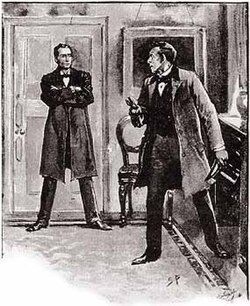
Illustration: Sidney Paget, public domain, via Wikimedia Commons
“Oh, it won’t do. Really it won’t,” said Holmes smoothly. “There’s no possible way out of it, Mr. Windibank. It’s far too transparent, and it was a very poor compliment when you said I couldn’t possibly solve so simple a question. That’s right! Sit down and let’s talk it over.”
Our visitor collapsed into a chair, his face ghastly, a glitter of sweat on his forehead. “It—it’s not actionable,” he stammered.
“I’m very much afraid it isn’t. But between ourselves, Windibank, it was as cruel and selfish and heartless a trick, in its petty way, as any that has ever come before me. Now, let me just run over the course of events, and you can contradict me if I go wrong.”
The man sat hunched in his chair, head sunk on his chest, utterly crushed. Holmes propped his feet on the corner of the mantelpiece and, leaning back with his hands in his pockets, began to talk, more to himself, it seemed, than to us.
“The man married a woman much older than himself, for her money,” he said, “and he enjoyed the use of the daughter’s money as long as she lived with them. For people in their position it was a considerable sum, and losing it would have made a serious difference. It was worth an effort to keep it. The daughter was good-natured and amiable, but affectionate and warm-hearted, so it was plain that with her looks and her little income she wouldn’t stay single long. Her marriage would mean the loss of a hundred a year. So what does her stepfather do to prevent it? The obvious thing. He keeps her at home and forbids her to seek out people her own age. But soon he finds that won’t work forever. She gets restless, insists on her rights, and finally announces she is going to a certain ball. What does her clever stepfather do then? He hits on an idea that does more credit to his head than to his heart. With his wife’s knowledge and help, he disguises himself. He covers those sharp eyes with tinted glasses, masks his face with a mustache and a pair of bushy whiskers, sinks that clear voice into a coaxing whisper, and, doubly safe because of the girl’s short sight, he appears as Mr. Hosmer Angel, and keeps other suitors away by courting her himself.”
“It was only a joke at first,” our visitor groaned. “We never thought she’d be so carried away.”
“Very likely not. Be that as it may, the young lady was very decidedly carried away, and since she was quite certain her stepfather was in France, the suspicion of a trick never once entered her head. She was flattered by the gentleman’s attentions, all the more because her mother admired him so loudly. Then Mr. Angel began to call, for obviously the thing had to be pushed as far as it would go if it was going to work. There were meetings, and an engagement, which would finally secure the girl’s affections against anyone else. But the deception couldn’t be kept up forever. These pretend trips to France were awkward. The thing to do was to end the business so dramatically that it would leave a permanent mark on the young lady’s mind and stop her from looking at any other suitor for a long time to come. Hence the vows of faithfulness sworn on a Testament, and hence the hints, on the very morning of the wedding, that something might happen. James Windibank wanted Miss Sutherland so bound to Hosmer Angel, and so uncertain of his fate, that for ten years at least she wouldn’t listen to another man. He brought her as far as the church door, and then, since he could go no farther, he conveniently vanished by the old trick of stepping in at one door of a four-wheeler and out at the other. I think that was the chain of events, Mr. Windibank!”
Our visitor had recovered some of his nerve while Holmes talked, and now he stood up with a cold sneer on his pale face.
“It may be so, or it may not, Mr. Holmes,” he said. “But if you’re so very sharp, you ought to be sharp enough to know that it’s you who are breaking the law now, not me. I’ve done nothing actionable from the start, but as long as you keep that door locked you lay yourself open to a charge of assault and unlawful restraint.”
“The law can’t touch you, as you say,” said Holmes, unlocking the door and throwing it open, “yet there never was a man who deserved punishment more. If the young lady has a brother or a friend, he ought to lay a whip across your shoulders. By Jove!” he went on, flushing at the sight of the bitter sneer on the man’s face, “it’s no part of my duty to my client, but here’s a riding crop handy, and I think I’ll just treat myself to—” He took two quick steps toward the whip, but before he could grab it there was a wild clatter of feet on the stairs, the heavy front door banged, and from the window we saw Mr. James Windibank running down the road as fast as his legs would carry him.
“There goes a cold-blooded scoundrel!” said Holmes, laughing, as he dropped back into his chair. “That fellow will rise from crime to crime until he does something very bad and ends on the gallows. The case has, in some respects, not been entirely without interest.”
“I still can’t see every step of your reasoning,” I said.
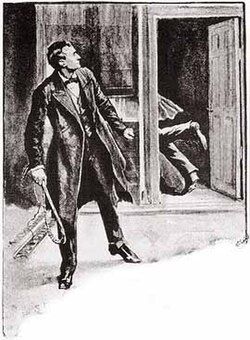
Illustration: Sidney Paget, public domain, via Wikimedia Commons
“Well, it was obvious from the start that this Mr. Hosmer Angel must have some strong reason for his curious behavior. It was equally clear that the only man who really profited from the whole affair, as far as we could see, was the stepfather. Then there was the fact that the two men were never together, but that one always appeared when the other was away. That was suggestive. So were the tinted glasses and the odd voice, which both hinted at a disguise, as did the bushy whiskers. My suspicions were all confirmed by his peculiar habit of typewriting his signature, which of course meant that his handwriting was so familiar to her she would recognize even the smallest sample. You see, all these separate facts, along with many minor ones, pointed the same way.”
Laid out like that, it was a system as hard and clean as a proof, and I was annoyed with myself for not running it. Short sight blurs a face beyond a short distance, because the eye focuses the image in front of the retina instead of on it. Walk her only in the evening, by gaslight, where the eye’s pupil opens wide and sharpness suffers further, and the blur gets worse. Dark glasses hide the one feature she might know best. And a whisper is a cleverer mask than it looks: in a whisper the vocal cords don’t vibrate, so the pitch that does much to make a voice recognizable vanishes, and what’s left is breath shaped by the mouth, far harder to tell from one man to the next. Every piece of Hosmer Angel was built to defeat one particular pair of eyes and ears.
“And how did you confirm it?”
“Once I’d spotted my man, corroboration was easy. I knew the firm he worked for. I took the printed description and struck out everything that could be the result of a disguise: the whiskers, the glasses, the voice. Then I sent it to the firm and asked whether it matched any of their traveling men. I’d already noticed the peculiarities of the typewriter, and I wrote to the man himself at his business address, asking him to come here. As I expected, his reply was typewritten and showed the same trivial but telltale defects. The same post brought a letter from Westhouse & Marbank, of Fenchurch Street, saying the description matched in every respect that of their employee, James Windibank. Voilà tout! That’s all there is to it.”
“And Miss Sutherland?”
“If I tell her, she won’t believe me. You may remember the old Persian saying, ‘There is danger for him who taketh the tiger cub, and danger also for whoso snatches a delusion from a woman.’ There is as much sense in Hafiz as in Horace, and as much knowledge of the world.”