The Boscombe Valley Mystery
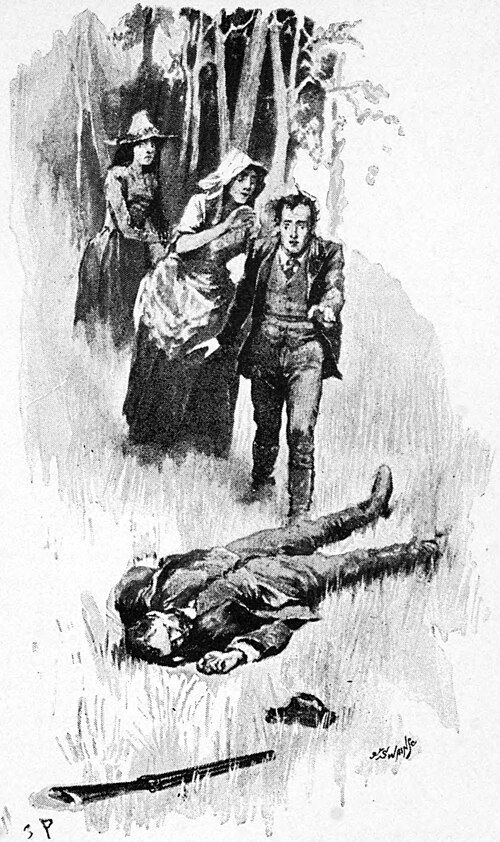
Illustration: Sidney Paget, public domain, via Wikimedia Commons
My wife and I were at breakfast one morning when the maid brought in a telegram. It was from Sherlock Holmes, and it read:
“Have you a couple of days to spare? Have just been wired for from the west of England in connection with Boscombe Valley tragedy. Shall be glad if you will come with me. Air and scenery perfect. Leave Paddington by the 11:15.”
“What do you say, dear?” my wife asked, looking across the table at me. “Will you go?”
“I honestly don’t know. My list of patients is fairly long just now.”
“Oh, Anstruther would see to them for you. You’ve been looking a little pale lately. I think the change would do you good, and you’re always so interested in Mr. Sherlock Holmes’s cases.”
“I’d be ungrateful if I weren’t, considering what one of them brought me,” I said, and she knew exactly what I meant. “But if I’m going, I must pack at once. I have only half an hour.”
My time in camp in Afghanistan had at least taught me to travel quickly. My needs were few and simple, and well inside the half hour I was in a cab with my valise, rattling off to Paddington Station. Holmes was pacing up and down the platform, his tall, gaunt figure made even taller and gaunter by a long gray traveling cloak and a close-fitting cloth cap.
“It’s really very good of you to come, Watson,” he said. “It makes a considerable difference to me, having someone with me on whom I can thoroughly rely. Local aid is always either worthless or else biased. If you’ll keep the two corner seats, I’ll get the tickets.”
We had the compartment to ourselves, apart from an immense litter of newspapers Holmes had brought along. He rummaged through them, reading, scribbling notes and staring into space, until we were past Reading. Then he abruptly rolled the whole lot into one gigantic ball and tossed it up onto the luggage rack.
“Have you heard anything of the case?” he asked.
“Not a word. I haven’t seen a paper for days.”
“The London press hasn’t given it much space. I’ve just been through every recent paper to master the details. It seems, from what I gather, to be one of those simple cases which are so extremely difficult.”
“That sounds a little paradoxical.”
“But it is profoundly true. Singularity is almost invariably a clue. The more featureless and commonplace a crime is, the more difficult it is to bring it home. In this case, though, they’ve built a very serious case against the son of the murdered man.”
“It’s a murder, then?”
“Well, it is conjectured to be so. I shall take nothing for granted until I’ve had the chance to look into it personally. Let me explain where things stand, as far as I understand them, in a very few words.
“Boscombe Valley is a country district not far from Ross, in Herefordshire. The largest landowner there is a Mr. John Turner, who made his money in Australia and came back to the old country some years ago. One of his farms, Hatherley, was let to Mr. Charles McCarthy, another man back from Australia. The two had known each other in the colonies, so it was natural enough that when they settled down, they settled as close together as they could. Turner was apparently the richer man, so McCarthy became his tenant, yet they seem to have stayed on terms of perfect equality, since they were often together. McCarthy had one son, a lad of eighteen; Turner had an only daughter of the same age. Neither man had a living wife. They kept away from the neighboring English families and lived quietly, though both the McCarthys were fond of sport and were often seen at the local race meetings. McCarthy kept two servants, a man and a girl. Turner had a sizable household, half a dozen at least. That’s all I’ve gathered about the families. Now for the facts.
“On June 3rd, that is, last Monday, McCarthy left his house at Hatherley about three in the afternoon and walked down to the Boscombe Pool, a small lake formed where the stream running down the Boscombe Valley spreads out. He had been in Ross that morning with his serving-man, and he’d told the man he must hurry, because he had an important appointment to keep at three. From that appointment he never came back alive.
“From Hatherley farmhouse to the Boscombe Pool is a quarter of a mile, and two people saw him cross that ground. One was an old woman, whose name isn’t given. The other was William Crowder, a game-keeper in Mr. Turner’s employ. Both swear that Mr. McCarthy was walking alone. The game-keeper adds that a few minutes after he saw Mr. McCarthy go by, he saw the son, Mr. James McCarthy, going the same way with a gun under his arm. To the best of his belief, the father was still in sight at the time, and the son was following him. He thought no more about it until he heard that evening what had happened.
“The two McCarthys were seen again after William Crowder, the game-keeper, lost sight of them. The Boscombe Pool is thickly wooded all around, with just a fringe of grass and reeds at the edge. A girl of fourteen, Patience Moran, daughter of the lodge-keeper of the Boscombe Valley estate, was in one of the woods picking flowers. She says that from there she saw Mr. McCarthy and his son at the edge of the wood near the lake, and that they seemed to be having a violent quarrel. She heard the elder Mr. McCarthy using very strong language to his son, and she saw the son raise his hand as if to strike his father. She was so frightened that she ran away, and when she got home she told her mother she’d left the two McCarthys quarreling by Boscombe Pool and was afraid they were going to fight. She had hardly said the words when young Mr. McCarthy came running up to the lodge to say he’d found his father dead in the wood, and to ask the lodge-keeper for help. He was badly shaken. He had neither his gun nor his hat, and his right hand and sleeve were stained with fresh blood. They followed him and found the body stretched out on the grass beside the pool. The head had been beaten in by repeated blows from some heavy, blunt weapon, injuries that could very well have come from the butt of the son’s gun, which lay on the grass a few paces from the body. Under the circumstances the young man was arrested at once. The inquest on Tuesday returned a verdict of ‘willful murder,’ and on Wednesday he was brought before the magistrates at Ross, who have sent the case on to the next Assizes, the court of senior judges that rides into each county a few times a year to try its gravest crimes. Those are the main facts as they came out before the coroner and the police court.”
“I can hardly imagine a more damning case,” I said. “If circumstantial evidence ever pointed to a criminal, it does here.”
“Circumstantial evidence is a very tricky thing,” Holmes answered thoughtfully. “It may seem to point very straight to one thing, but if you shift your own point of view a little, you may find it pointing in an equally uncompromising manner to something entirely different. I’ll admit the case looks very grave against the young man, and it’s quite possible he did it. Still, there are several people in the neighborhood, Miss Turner, the landowner’s daughter, among them, who believe he’s innocent. They’ve retained Lestrade, whom you may remember from an earlier case of ours, to work it up on his behalf. Lestrade, rather puzzled, has passed it on to me, and that is why two middle-aged gentlemen are flying west at fifty miles an hour instead of quietly digesting their breakfasts at home.”
“I’m afraid,” I said, “the facts are so obvious that you’ll find little credit to be gained from this one.”
“There is nothing more deceptive than an obvious fact,” he answered, laughing. “Besides, we may stumble on some other obvious facts which were by no means obvious to Mr. Lestrade. You know me too well to think I’m boasting when I say that I shall either confirm or destroy his theory by means which he is quite incapable of using, or even of understanding. To take the first example to hand: I see very clearly that the window in your bedroom is on the right-hand side, and I doubt Mr. Lestrade would have noticed anything so self-evident.”
“How on earth—”
“My dear fellow, I know you well. I know your military neatness. You shave every morning, and at this time of year you shave by sunlight. But your shave grows less and less thorough the farther back we go on the left side, until it becomes positively slovenly around the angle of the jaw. Surely that side is less well lit than the other. I can’t imagine a man of your habits seeing himself in an even light and being satisfied with that result. I quote it only as a trivial example of observation and inference. Therein lies my métier, my trade, and it may just be of some use in the investigation ahead of us. There are one or two minor points that came out at the inquest which are worth considering.”
I rubbed my jaw, a little stung, and worked it through. Daylight from a window comes mostly from one direction, and a face isn’t flat. The cheek turned toward the glass catches the light full on, while the far cheek and the curve of the jaw behind it sit in the face’s own shadow. With the window on my right, my left side would be the dim one, and the stubble there the hardest to see. My razor had been giving me away every morning, and I was the last to know.
“What are they?” I asked.
“It seems he wasn’t arrested on the spot, but only after he’d gone back to Hatherley Farm. When the police inspector told him he was a prisoner, he said he wasn’t surprised to hear it, and that it was no more than he deserved. That remark naturally removed whatever doubt might have lingered in the minds of the coroner’s jury.”
“It was a confession,” I exclaimed.
“No, because he followed it with a protest that he was innocent.”
“Coming on top of such a damning chain of events, it was at least a most suspicious remark.”
“On the contrary,” said Holmes, “it’s the brightest rift I can see in the clouds so far. However innocent he might be, he couldn’t be such a complete fool as not to see that things looked very black against him. If he’d seemed surprised at his arrest, or put on a show of outrage, I’d have thought it highly suspicious, because surprise or anger wouldn’t be natural under the circumstances, and yet they might seem the best policy to a scheming man. His frank acceptance of the situation marks him as either an innocent man or a man of considerable self-control and nerve. As for the remark about what he deserved, that’s natural enough, if you consider that he was standing beside his father’s dead body, and that he had certainly, that very day, so far forgotten his duty as a son as to trade hard words with him, and even, according to the little girl whose evidence matters so much, to raise his hand as if to strike him. The self-reproach and remorse in that remark look to me like the signs of a healthy mind rather than a guilty one.”
I shook my head. “Many men have been hanged on far slighter evidence,” I said.
“So they have. And many men have been wrongfully hanged.”
“What’s the young man’s own account?”
“Not very encouraging to his supporters, I’m afraid, though there are one or two suggestive points in it. Here. Read it for yourself.”
He fished a copy of the local Herefordshire paper out of his bundle, folded back the sheet, and pointed to the paragraph in which the unlucky young man had given his own statement. I settled into the corner of the carriage and read it very carefully. It went like this:
“Mr. James McCarthy, the only son of the deceased, was then called and gave evidence as follows: ‘I had been away from home for three days in Bristol, and had only just come back on the morning of last Monday, the 3rd. My father was out when I arrived, and the maid told me he had driven over to Ross with John Cobb, the groom. Shortly after I got back I heard the wheels of his trap, his light two-wheeled cart, in the yard, and, looking out of my window, I saw him get out and walk quickly out of the yard, though I didn’t notice which way he went. I then took my gun and strolled out toward the Boscombe Pool, meaning to visit the rabbit warren on the other side. On the way I saw William Crowder, the game-keeper, as he has said in his evidence; but he is mistaken in thinking that I was following my father. I had no idea he was ahead of me. When I was about a hundred yards from the pool, I heard a cry of “Cooee!” which was a usual signal between my father and me. I hurried forward and found him standing by the pool. He seemed very surprised to see me and asked rather roughly what I was doing there. A conversation followed that led to high words and almost to blows, for my father had a very violent temper. Seeing that his anger was getting out of hand, I left him and started back toward Hatherley Farm. I hadn’t gone more than 150 yards, however, when I heard a hideous cry behind me, which made me run back. I found my father dying on the ground, his head terribly injured. I dropped my gun and held him in my arms, but he died almost at once. I knelt beside him for some minutes, then went to Mr. Turner’s lodge-keeper, his house being the nearest, to ask for help. I saw no one near my father when I came back, and I have no idea how he got his injuries. He was not a popular man, being rather cold and forbidding in his manner, but as far as I know he had no active enemies. I know nothing more about the matter.’
“The Coroner: Did your father say anything to you before he died?
“Witness: He mumbled a few words, but all I could catch was something about a rat.
“The Coroner: What did you take that to mean?
“Witness: It meant nothing to me. I thought he was delirious.
“The Coroner: What was the point on which you and your father had this final quarrel?
“Witness: I would rather not answer.
“The Coroner: I’m afraid I must press you.
“Witness: It’s really impossible for me to tell you. I can assure you it had nothing to do with the sad tragedy that followed.
“The Coroner: That is for the court to decide. I needn’t point out that your refusal to answer will hurt your case considerably in any future proceedings.
“Witness: I must still refuse.
“The Coroner: I understand that the cry of ‘Cooee’ was a common signal between you and your father?
“Witness: It was.
“The Coroner: How was it, then, that he gave it before he saw you, and before he even knew you were back from Bristol?
“Witness (in considerable confusion): I don’t know.
“A Juryman: Did you see nothing that roused your suspicions when you came back at the cry and found your father fatally hurt?
“Witness: Nothing definite.
“The Coroner: What do you mean?
“Witness: I was so upset and excited as I rushed out into the open that I could think of nothing but my father. Yet I have a vague impression that as I ran forward something lay on the ground to my left. It seemed to be something gray, a coat of some kind, or a plaid perhaps. When I got up from my father I looked around for it, but it was gone.
“‘Do you mean that it disappeared before you went for help?’
“‘Yes, it was gone.’
“‘You can’t say what it was?’
“‘No. I just had a feeling something was there.’
“‘How far from the body?’
“‘A dozen yards or so.’
“‘And how far from the edge of the wood?’
“‘About the same.’
“‘Then if it was taken away, it was while you were within a dozen yards of it?’
“‘Yes, but with my back to it.’
“That concluded the examination of the witness.”
“I see,” I said, running my eye down the column, “that the coroner was rather hard on young McCarthy in his closing remarks. He points out, and fairly, the contradiction about the father signaling before he saw him, the refusal to say what the quarrel was about, and the strange account of the dying words. All of that, as he says, tells heavily against the son.”
Holmes laughed softly and stretched out on the cushioned seat. “You and the coroner have both gone to some trouble,” he said, “to pick out the very strongest points in the young man’s favor. Don’t you see that you give him credit, by turns, for too much imagination and too little? Too little, if he couldn’t invent a reason for the quarrel that would win the jury’s sympathy. Too much, if he dreamed up, out of his own head, anything so bizarre as a dying reference to a rat, and the business of the vanishing cloth. No, sir. I shall approach this case on the assumption that what this young man says is true, and we’ll see where that hypothesis leads us. And now here is my pocket Petrarch, and not another word will I say about this case until we’re on the scene of action. We lunch at Swindon, and I see we’ll be there in twenty minutes.”
He buried himself in the poet, and I sat turning his rule over. It was as tidy as anything in mechanics. A liar tells the story that helps him. Every odd detail in young McCarthy’s account helped him not at all, and so, by Holmes’s logic, every odd detail was likely true.
It was nearly four o’clock when, after the lovely Stroud Valley and the broad, gleaming Severn, we finally reached the pretty little country town of Ross. A lean, ferret-like man, furtive and sly-looking, was waiting on the platform. Despite the light brown dust coat and leather leggings he wore in honor of the countryside, I had no trouble recognizing Lestrade, of Scotland Yard. We drove with him to the Hereford Arms, where a room had already been taken for us.
“I’ve ordered a carriage,” Lestrade said as we sat over a cup of tea. “I know your energetic nature, and that you won’t be happy until you’ve been to the scene of the crime.”
“That’s very kind and complimentary of you,” Holmes answered. “It is entirely a question of barometric pressure.”
Lestrade looked startled. “I don’t quite follow,” he said.
“How is the glass? Twenty-nine, I see. No wind, and not a cloud in the sky. I have a caseful of cigarettes here which need smoking, and the sofa is far superior to the usual country hotel abomination. I don’t think I shall use the carriage tonight.”
I followed his glance to the barometer on the wall, the “glass” every Victorian household consulted like a household oracle. It is a sealed tube of mercury standing in an open cup, and the whole weight of the air overhead presses on the cup and holds the column up, to a height of roughly thirty inches. When the air thins out ahead of a storm, the mercury sinks. When it stays put under a still, clear sky, the weather is settled. Holmes wasn’t being idle. He had checked that the footprints by the pool would keep until morning.

Illustration: Sidney Paget, public domain, via Wikimedia Commons
Lestrade laughed indulgently. “No doubt you’ve already made up your mind from the newspapers,” he said. “The case is as plain as a pikestaff, and the further you go into it the plainer it gets. Still, of course, one can’t refuse a lady, and such a very determined one, too. She’d heard of you and wanted your opinion, though I told her again and again that there was nothing you could do that I hadn’t already done. Why, bless my soul! Here’s her carriage at the door.”
He’d hardly spoken when one of the loveliest young women I have ever seen rushed into the room. Her violet eyes were shining, her lips parted, a pink flush on her cheeks; all her natural reserve had been swept away by excitement and worry.
“Oh, Mr. Sherlock Holmes!” she cried, glancing from one of us to the other and settling, quickly and surely, on my companion. “I’m so glad you’ve come. I’ve driven down to tell you so. I know James didn’t do it. I know it, and I want you to start your work knowing it too. Never let yourself doubt it. We’ve known each other since we were little children, and I know his faults as no one else does, but he’s too tender-hearted to hurt a fly. Such a charge is absurd to anyone who really knows him.”
“I hope we may clear him, Miss Turner,” said Sherlock Holmes. “You may count on my doing all that I can.”
“But you’ve read the evidence. You’ve come to some conclusion? Don’t you see some loophole, some flaw? Don’t you yourself think he’s innocent?”
“I think it very probable.”
“There, now!” she cried, throwing back her head and looking defiantly at Lestrade. “You hear! He gives me hope.”
Lestrade shrugged. “I’m afraid my colleague has been a little quick in forming his conclusions,” he said.
“But he’s right. Oh, I know he’s right. James never did it. And about his quarrel with his father, I’m sure the reason he wouldn’t tell the coroner was that it concerned me.”
“In what way?” asked Holmes.
“This is no time for me to hide anything. James and his father disagreed about me many times. Mr. McCarthy was very anxious that we should marry. James and I have always loved each other like brother and sister; but of course he’s young and has seen very little of life yet, and—and—well, naturally he didn’t want to do anything like that yet. So there were quarrels, and this, I’m sure, was one of them.”
“And your father?” asked Holmes. “Was he in favor of such a match?”
“No, he was against it too. No one but Mr. McCarthy was in favor of it.” A quick blush crossed her fresh young face as Holmes shot her one of his keen, questioning glances.
“Thank you for this information,” he said. “May I see your father if I call tomorrow?”
“I’m afraid the doctor won’t allow it.”
“The doctor?”
“Yes, haven’t you heard? Poor Father hasn’t been strong for years, but this has broken him down completely. He’s taken to his bed, and Dr. Willows says he’s a wreck and his nerves are shattered. Mr. McCarthy was the only man alive who had known Dad in the old days in Victoria.”
“Ha! In Victoria! That is important.”
“Yes, at the mines.”
“Quite so. At the gold mines, where, as I understand it, Mr. Turner made his money.”
“Yes, certainly.”
“Thank you, Miss Turner. You’ve been of real help to me.”
“You’ll tell me if you have any news tomorrow. No doubt you’ll go to the prison to see James. Oh, if you do, Mr. Holmes, please tell him that I know he’s innocent.”
“I will, Miss Turner.”
“I must go home now. Dad is very ill, and he misses me so when I leave him. Good-bye, and God help you in what you’re doing.” She hurried out as impulsively as she’d come in, and we heard her carriage wheels rattle off down the street.
“I’m ashamed of you, Holmes,” Lestrade said with dignity after a few minutes’ silence. “Why raise hopes you’re bound to disappoint? I’m not soft-hearted, but I call that cruel.”
“I think I see my way to clearing James McCarthy,” said Holmes. “Do you have an order to see him in prison?”
“Yes, but only for you and me.”
“Then I shall reconsider my decision about going out. Is there still time to take a train to Hereford and see him tonight?”
“Ample.”
“Then let’s do it. Watson, I’m afraid you’ll find it very slow, but I’ll be gone only a couple of hours.”
I walked down to the station with them, then wandered the streets of the little town before going back to the hotel, where I lay on the sofa and tried to interest myself in a cheap yellow-covered novel. Its puny plot was so thin beside the deep mystery we were groping through, and my attention kept drifting so steadily from the fiction to the facts, that at last I flung it across the room and gave myself up entirely to the events of the day. Supposing this unhappy young man’s story were absolutely true, then what hellish thing, what utterly unforeseen calamity, could have happened between the moment he left his father and the moment when, drawn back by the screams, he rushed into the clearing? It was something terrible and deadly. But what? Might the nature of the injuries tell my medical instincts something? I rang for the weekly county paper, which printed a word-for-word account of the inquest. In the surgeon’s statement it said that the back third of the left parietal bone and the left half of the occipital bone had been shattered by a heavy blow from a blunt weapon.
I put my hand to my own head and found the spot. The parietal bones are the two great plates that form the top and sides of the skull; the occipital is the curved bone at the very back, above the neck. Damage to the rear of the left parietal and the left half of the occipital meant the back of the head, on the left. A man facing his attacker gets struck on the front or the side; to land a blow there, a man had almost surely to be standing behind his victim. That was something in favor of the accused, since when he was seen quarreling he was face to face with his father. Still, it didn’t count for much, because the older man might have turned his back before the blow fell. Even so, it might be worth pointing out to Holmes. Then there was that odd dying reference to a rat. What could it mean? It couldn’t be delirium. A man dying from a sudden blow does not usually become delirious; I had seen enough head wounds to know that. No, more likely it was an attempt to say how he had met his end. But what could it point to? I racked my brains for an explanation. And then there was the gray cloth young McCarthy had seen. If that were true, the murderer must have dropped some part of his clothing, presumably his overcoat, as he fled, and then had the nerve to come back and carry it off while the son knelt, back turned, not a dozen paces away. What a tangle of mysteries and improbabilities the whole thing was! I didn’t wonder at Lestrade’s opinion, and yet I had such faith in Sherlock Holmes’s insight that I couldn’t lose hope, so long as every fresh fact seemed to strengthen his belief in young McCarthy’s innocence.
It was late when Sherlock Holmes came back. He came alone, since Lestrade was staying in lodgings in the town.
“The glass still keeps very high,” he remarked as he sat down. “It matters that it shouldn’t rain before we can go over the ground. On the other hand, a man should be at his very best and keenest for delicate work like that, and I didn’t want to do it worn out from a long journey. I’ve seen young McCarthy.”
“And what did you learn from him?”
“Nothing.”
“He couldn’t throw any light on it?”
“None at all. At one point I was inclined to think he knew who had done it and was shielding him, or her, but I’m now convinced he’s as puzzled as everyone else. He isn’t a very quick-witted youth, though good-looking and, I should think, sound at heart.”
“I can’t admire his taste,” I said, “if he really was against marrying so charming a young lady as Miss Turner.”
“Ah, thereby hangs a rather painful tale. This fellow is madly, insanely in love with her. But some two years ago, when he was only a lad, and before he really knew her, since she’d been away five years at boarding school, what does the idiot do but fall into the clutches of a barmaid in Bristol and marry her at a registry office? A civil ceremony, Watson: no church, no banns, no witnesses from home. Not a soul knows a word about it. You can imagine how maddening it must be for him to be scolded for not doing the one thing he’d give his very eyes to do, and which he knows is utterly impossible. It was sheer frenzy of that sort that made him throw his hands up in the air when his father, at their last meeting, was goading him to propose to Miss Turner. On the other hand, he had no means of supporting himself, and his father, by all accounts a very hard man, would have cast him off completely if he’d known the truth. It was with his barmaid wife that he had spent the last three days in Bristol, and his father didn’t know where he was. Mark that point. It matters. Still, good has come out of evil. The barmaid, learning from the papers that he’s in serious trouble and likely to be hanged, has thrown him over completely. She’s written to say she already has a husband working in the Bermuda Dockyard, so there’s really no tie between them at all. I think that bit of news has consoled young McCarthy for everything he’s suffered.”

Illustration: Sidney Paget, public domain, via Wikimedia Commons
“But if he’s innocent, who did it?”
“Ah! Who? I’d draw your attention very particularly to two points. One is that the murdered man had an appointment with someone at the pool, and that the someone couldn’t have been his son, because his son was away and he didn’t know when he’d be back. The second is that the murdered man was heard to cry ‘Cooee!’ before he knew his son had returned. Those are the crucial points on which the whole case turns. And now let’s talk about George Meredith, if you please, and leave all minor matters until tomorrow.”
There was no rain, just as Holmes had foretold, and the morning broke bright and cloudless. At nine o’clock Lestrade called for us with the carriage, and we set off for Hatherley Farm and the Boscombe Pool.
“There’s serious news this morning,” Lestrade said. “They say Mr. Turner, of the Hall, is so ill his life is despaired of.”
“An elderly man, I presume?” said Holmes.
“About sixty, but his constitution was wrecked by his life abroad, and he’s been failing for some time. This business has hit him hard. He was an old friend of McCarthy’s, and, I may add, a great benefactor to him, for I’ve learned he let him have Hatherley Farm rent free.”
“Indeed! That’s interesting,” said Holmes.
“Oh, yes! And he helped him in a hundred other ways. Everyone around here talks about his kindness to him.”
“Really! Doesn’t it strike you as a little odd that this McCarthy, who seems to have had little of his own and to have owed so much to Turner, should still talk of marrying his son to Turner’s daughter, who is presumably heiress to the estate, and in such a very cocksure way, as if it were merely a matter of proposing and all the rest would follow? It’s stranger still since we know Turner himself was against the idea. The daughter told us so. Don’t you deduce something from that?”
“Now we’ve come to the deductions and inferences,” said Lestrade, winking at me. “I find it hard enough to tackle facts, Holmes, without flying off after theories and fancies.”
“You’re right,” said Holmes demurely. “You do find it very hard to tackle the facts.”
“Anyhow, I’ve grasped one fact that you seem to find difficult to get hold of,” Lestrade replied with some heat.
“And that is—”
“That McCarthy senior met his death from McCarthy junior, and that all theories to the contrary are the merest moonshine.”
“Well, moonshine is a brighter thing than fog,” said Holmes, laughing. “But I’m very much mistaken if that isn’t Hatherley Farm on the left.”
“Yes, that’s it.” It was a sprawling, comfortable-looking building, two stories, slate-roofed, with great yellow blotches of lichen on its gray walls. The drawn blinds and smokeless chimneys, though, gave it a stricken look, as if the weight of this horror still lay heavy on it. We knocked, and at Holmes’s request the maid showed us the boots her master had worn when he died, and also a pair of the son’s, though not the pair he’d had on that day. Holmes measured them very carefully at seven or eight different points, then asked to be taken to the courtyard, and from there we all followed the winding track down to Boscombe Pool.
Sherlock Holmes was transformed when he was hot on a scent like this. People who knew only the quiet thinker and logician of Baker Street would not have recognized him. His face flushed and darkened. His brows drew into two hard black lines, and his eyes shone out beneath them with a steely glitter. His head was bent, his shoulders hunched, his lips pressed tight, and the veins stood out like whipcord in his long, sinewy neck. His nostrils seemed to flare with a pure animal hunger for the chase, and his mind was so completely fixed on the matter in front of him that any question or remark fell unheard, or at most drew a quick, impatient snarl. Swiftly and silently he made his way along the track through the meadows, and then through the woods to the Boscombe Pool. It was damp, marshy ground, like all that district, and there were marks of many feet, both on the path and in the short grass on either side. Sometimes Holmes would hurry on, sometimes stop dead, and once he made quite a detour into the meadow. Lestrade and I walked behind him, the detective bored and contemptuous, while I watched my friend with the interest that comes from knowing that every one of his actions was aimed at a definite end.
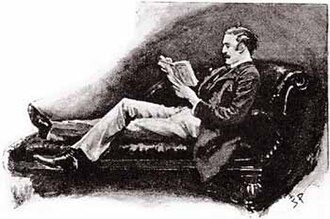
Illustration: Sidney Paget, public domain, via Wikimedia Commons
The Boscombe Pool, a little reed-ringed sheet of water some fifty yards across, lies on the boundary between Hatherley Farm and the private park of the wealthy Mr. Turner. Above the woods on the far side we could see the red, jutting turrets that marked the rich landowner’s house. On the Hatherley side the woods grew very thick, and there was a narrow strip of sodden grass, twenty paces wide, between the edge of the trees and the reeds that lined the lake. Lestrade showed us the exact spot where the body had been found, and the ground was so wet that I could plainly see the hollow left where the stricken man had fallen. To Holmes, as I could tell from his eager face and peering eyes, a great many other things could be read in the trampled grass. He circled around like a dog picking up a scent, then rounded on Lestrade.
“What did you go into the pool for?” he asked.
“I fished about with a rake. I thought there might be a weapon or some other trace. But how on earth—”
“Oh, tut, tut! I have no time! That left foot of yours, with its inward twist, is all over the place. A mole could trace it, and there it vanishes among the reeds. Oh, how simple it would all have been if I’d been here before they came like a herd of buffalo and wallowed all over it. Here’s where the party with the lodge-keeper came, and they’ve covered every track for six or eight feet around the body. But here are three separate tracks of the same feet.” He drew out a lens and lay down on his waterproof coat to get a better view, talking the whole time, more to himself than to us. “These are young McCarthy’s feet. Twice he was walking, and once he ran fast, so the soles are deeply marked and the heels hardly show. That bears out his story. He ran when he saw his father on the ground. Then here are the father’s feet as he paced up and down. What’s this, then? It’s the butt of the gun, as the son stood listening. And this? Ha, ha! What have we here? Tiptoes! Tiptoes! Square, too, quite unusual boots! They come, they go, they come again—of course, that was for the cloak. Now where did they come from?”
I could follow that much, at least. A walking man lands heel first and rolls forward, so his whole foot prints evenly. A running man drives off the balls of his feet, and all his weight and speed go into the front of the sole; in soft ground the toe sinks deep and the heel barely touches. The mud had recorded young McCarthy’s panic as faithfully as a clerk.
Holmes ran up and down, sometimes losing the track and sometimes finding it, until we were well inside the edge of the wood, in the shadow of a great beech, the largest tree in the neighborhood. Holmes traced his way around to the far side of it and lay down on his face again with a little cry of satisfaction. He stayed there a long time, turning over the leaves and dry sticks, gathering what looked to me like dust into an envelope, and examining with his lens not only the ground but even the bark of the tree, as high as he could reach. A jagged stone lay among the moss, and this too he examined carefully and kept. Then he followed a path through the wood until he came out on the high road, where every trace was lost.
“It has been a case of considerable interest,” he said, returning to his normal manner. “I fancy this gray house on the right must be the lodge. I think I’ll go in and have a word with Moran, and perhaps write a little note. After that we can drive back to lunch. You two walk on to the cab, and I’ll be with you shortly.”
It was about ten minutes before we were back in the cab and driving into Ross, Holmes still carrying the stone he’d picked up in the wood.
“This may interest you, Lestrade,” he said, holding it out. “The murder was done with it.”
“I see no marks.”
“There are none.”
“Then how do you know?”
“The grass was growing under it. It had only lain there a few days. There was no sign of a place it had been taken from. It matches the injuries. There is no sign of any other weapon.”
I saw the beauty of it at once. Grass is green because it keeps making its pigment in the light; cover it with a stone for a season and it starves in the dark, going pale and dead, while the stone settles into its own little hollow. A stone resting on living green blades had arrived lately. And a stone lifted out of the ground nearby would have left a raw socket in the earth. There was none. Someone had brought that stone to the beech tree.

Illustration: Sidney Paget, public domain, via Wikimedia Commons
“And the murderer?” Lestrade asked.
“Is a tall man, left-handed, limps with the right leg, wears thick-soled shooting boots and a gray cloak, smokes Indian cigars, uses a cigar holder, and carries a blunt penknife in his pocket. There are several other indications, but these should be enough to help us in our search.”
Lestrade laughed. “I’m afraid I’m still a skeptic,” he said. “Theories are all very well, but we have to deal with a hard-headed British jury.”
“Nous verrons. We shall see,” Holmes answered calmly. “You work your own method, and I shall work mine. I’ll be busy this afternoon, and I’ll probably go back to London on the evening train.”
“And leave your case unfinished?”
“No, finished.”
“But the mystery?”
“It is solved.”
“Who was the criminal, then?”
“The gentleman I described.”
“But who is he?”
“Surely it wouldn’t be hard to find out. This isn’t such a crowded neighborhood.”
Lestrade shrugged. “I’m a practical man,” he said, “and I really can’t go about the country looking for a left-handed gentleman with a game leg. I’d be the laughingstock of Scotland Yard.”
“All right,” Holmes said quietly. “I’ve given you the chance. Here are your lodgings. Good-bye. I’ll drop you a line before I leave.”
We left Lestrade at his rooms and drove to our hotel, where lunch was waiting on the table. Holmes was silent and lost in thought, with a pained look on his face, like a man who finds himself in an awkward position.
“Look here, Watson,” he said, when the table had been cleared, “just sit down in this chair and let me preach to you for a little. I don’t quite know what to do, and I’d value your advice. Light a cigar and let me lay it out.”
“Please do.”
“Well, now. In considering this case, there were two points about young McCarthy’s story that struck us both at once, though they impressed me in his favor and you against him. One was that his father, by his account, cried ‘Cooee!’ before seeing him. The other was that strange dying reference to a rat. He mumbled several words, you understand, but that was all that reached the son’s ear. Our research has to start from those two points, and we’ll begin by assuming that what the lad says is absolutely true.”
“What about this ‘Cooee!’ then?”
“Well, obviously it couldn’t have been meant for the son. As far as the father knew, the son was in Bristol. It was pure chance that he was within earshot. The ‘Cooee!’ was meant to attract the attention of whoever he had the appointment with. But ‘Cooee’ is a distinctly Australian cry, and one used between Australians. There’s a strong presumption that the person McCarthy expected to meet at Boscombe Pool was someone who had been in Australia.”
I knew the call myself from the colonial men I had met in the army: a long, high hail that the settlers had learned from the Aboriginal people of Australia, made to carry a long way through the bush. No Herefordshire farmer would answer to it. It was a password between Australians.
“What about the rat, then?”
Sherlock Holmes took a folded paper from his pocket and smoothed it out on the table. “This is a map of the Colony of Victoria,” he said. “I wired to Bristol for it last night.” He put his hand over part of the map. “What do you read?”
“ARAT,” I read.
“And now?” He lifted his hand.
“BALLARAT.”
“Quite so. That was the word the man spoke, and his son caught only the last two syllables. He was trying to say the name of his murderer. So-and-so, of Ballarat.”
“It’s wonderful!” I exclaimed.
“It’s obvious. And now, you see, I had narrowed the field considerably. A gray garment was a third point which, if the son’s statement was true, was a certainty. We’ve now come out of mere vagueness to the definite idea of an Australian from Ballarat with a gray cloak.”
“Certainly.”
“And one who was at home in the district, because the pool can only be reached through the farm or the estate, where strangers could hardly wander.”
“Quite so.”
“Then comes our expedition today. By examining the ground, I got the trifling details I gave that imbecile Lestrade about the criminal’s person.”
“But how did you get them?”
“You know my method. It is founded upon the observation of trifles.”
“His height, I know, you could roughly judge from the length of his stride. And his boots could be read from their tracks.”
That much I had worked out for myself. At a steady walk, a man’s stride is set mostly by the length of his legs, and his legs are a fairly steady fraction of his height, so the spacing between prints is a rough ruler laid against the man who made them.
“Yes, they were peculiar boots.”
“But his lameness?”
“The print of his right foot was always fainter than his left. He put less weight on it. Why? Because he limped. He was lame.”
Simple pressure, I thought: the same soft ground, the same boot, and the foot that bears less of the body’s weight sinks less. The earth had weighed him, one leg at a time.
“But his left-handedness?”
“You were struck yourself by the nature of the injury as the surgeon described it at the inquest. The blow was struck from directly behind, and yet it landed on the left side. Now, how could that be, unless it was struck by a left-handed man? He had stood behind that tree during the talk between father and son. He even smoked there. I found the ash of a cigar, which my special knowledge of tobacco ashes lets me identify as an Indian cigar. As you know, I’ve given some attention to this, and written a little monograph on the ashes of 140 different kinds of pipe, cigar and cigarette tobacco. Having found the ash, I looked around and found the stump in the moss where he’d tossed it. It was an Indian cigar, of the kind that are rolled in Rotterdam.”
I pictured it: a right-handed man swinging at the back of a head swings from his right, and his blow lands on the right of the skull. Only a left arm, swinging from behind, brings the stone down on the left. As for the ash, it’s what remains once the leaf has burned away, chiefly the minerals the plant drew from its own soil. Different soils, curing and leaf give ash of different color, texture and firmness, which is why a man who had studied 140 of them might hope to tell one from another.
“And the cigar holder?”
“I could see the end hadn’t been in his mouth. So he used a holder. The tip had been cut off, not bitten off, but the cut wasn’t clean, so I deduced a blunt penknife.”
A sharp blade slices a cigar’s wrapper leaf cleanly; a dull one crushes and tears it, leaving a ragged edge. Every fact Holmes had given Lestrade in the cab, I now saw, had been sitting in the moss for anyone to pick up.

Illustration: Sidney Paget, public domain, via Wikimedia Commons
“Holmes,” I said, “you’ve drawn a net around this man that he can’t escape, and you’ve saved an innocent life as surely as if you’d cut the rope that was hanging him. I see where all this points. The culprit is—”
“Mr. John Turner,” cried the hotel waiter, opening the door of our sitting room and showing in a visitor.
The man who came in was a strange and striking figure. His slow, limping step and bowed shoulders made him look feeble, and yet his hard, deeply lined, craggy features and his huge limbs showed a man of unusual strength, in body and in character. His tangled beard, grizzled hair and jutting, drooping eyebrows gave him an air of dignity and power, but his face was ashen white, and his lips and the corners of his nostrils were tinged with blue. I saw at a glance, as a doctor, that he was in the grip of some deadly, long-standing disease. That blue tinge is the color of blood that is no longer carrying enough oxygen, often a sign that the heart or lungs are failing.
“Please, sit down on the sofa,” Holmes said gently. “You had my note?”
“Yes, the lodge-keeper brought it up. You said you wanted to see me here to avoid scandal.”
“I thought people would talk if I went to the Hall.”
“And why did you want to see me?” He looked across at my companion with despair in his tired eyes, as if his question had already been answered.
“Yes,” said Holmes, answering the look rather than the words. “It is so. I know all about McCarthy.”
The old man buried his face in his hands. “God help me!” he cried. “But I wouldn’t have let the young man come to harm. I give you my word I’d have spoken out if it went against him at the Assizes.”
“I’m glad to hear you say so,” Holmes said gravely.
“I’d have spoken now, if not for my dear girl. It would break her heart—it will break her heart when she hears I’m arrested.”
“It may not come to that,” said Holmes.
“What?”
“I’m no official agent. I understand that it was your daughter who asked for me here, and I’m acting in her interests. Young McCarthy must be got off, however.”
“I’m a dying man,” said old Turner. “I’ve had diabetes for years. My doctor says it’s a question whether I’ll live a month. Still, I’d rather die under my own roof than in a jail.”
I didn’t doubt him. In those days there was no remedy for that disease beyond a strict diet, and a man as far gone as he was had only months, perhaps weeks.
Holmes got up and sat at the table with his pen in his hand and a stack of paper in front of him. “Just tell us the truth,” he said. “I’ll jot down the facts. You’ll sign it, and Watson here can witness it. Then I could produce your confession as a last resort to save young McCarthy. I promise you I won’t use it unless it’s absolutely needed.”
“That’s fair,” said the old man. “It’s doubtful I’ll live to the Assizes, so it matters little to me, but I’d like to spare Alice the shock. And now I’ll make it all clear to you. It’s been a long time in the acting, but it won’t take me long to tell.
“You didn’t know this dead man, McCarthy. He was the devil in the flesh. I tell you that. God keep you out of the clutches of a man like him. His grip has been on me these twenty years, and he has ruined my life. I’ll tell you first how I came to be in his power.
“It was in the early ’60s, at the gold diggings. I was a young fellow then, hot-blooded and reckless, ready to turn my hand to anything. I fell in with bad companions, took to drink, had no luck with my claim, took to the bush, and, in a word, became what you’d call over here a highway robber. There were six of us, and we led a wild, free life of it, holding up a sheep station now and then, or stopping the wagons on the road to the diggings. Black Jack of Ballarat was the name I went by, and our band is still remembered in the colony as the Ballarat Gang.
“One day a gold convoy came down from Ballarat to Melbourne, and we lay in wait for it and attacked. There were six mounted troopers and six of us, so it was a close thing, but our first volley knocked four of them out of the saddle. Three of our boys were killed, though, before we got the loot. I put my pistol to the head of the wagon driver, and he was this very man McCarthy. I wish to the Lord I’d shot him then, but I spared him, though I saw his wicked little eyes fixed on my face as if to memorize every feature. We got away with the gold, became rich men, and made our way to England without anyone suspecting us. There I parted from my old pals and made up my mind to settle down to a quiet, respectable life. I bought this estate, which happened to be on the market, and set myself to do a little good with my money, to make up for the way I’d come by it. I married, too, and though my wife died young, she left me my dear little Alice. Even when she was just a baby, her tiny hand seemed to lead me down the right road as nothing else ever had. In a word, I turned over a new leaf and did my best to make up for the past. All was going well when McCarthy got his grip on me.
“I’d gone up to London about an investment, and I met him in Regent Street with hardly a coat on his back or a boot on his foot.
“‘Here we are, Jack,’ says he, touching my arm. ‘We’ll be as good as family to you. There’s two of us, me and my son, and you can have the keeping of us. If you don’t—well, it’s a fine, law-abiding country, England, and there’s always a policeman within shouting distance.’
“So down they came to the west country, and there was no shaking them off, and there they’ve lived rent free on my best land ever since. There was no rest for me, no peace, no forgetting. Wherever I turned, there was his cunning, grinning face at my elbow. It got worse as Alice grew up, because he soon saw I was more afraid of her learning my past than of the police. Whatever he wanted, he had to have, and whatever it was, I gave it without question: land, money, houses. Until at last he asked for something I couldn’t give. He asked for Alice.
“His son, you see, had grown up, and so had my girl, and since everyone knew my health was weak, it struck him as a fine stroke for his lad to step into the whole property. But there I was firm. I wouldn’t have his cursed stock mixed with mine. Not that I disliked the lad, but his father’s blood was in him, and that was enough. I stood firm. McCarthy threatened. I dared him to do his worst. We were to meet at the pool, halfway between our houses, to talk it over.
“When I got there I found him talking with his son, so I smoked a cigar and waited behind a tree until he’d be alone. But as I listened to him, everything black and bitter in me rose to the top. He was urging his son to marry my daughter with no more regard for what she might think than if she were some woman picked up off the streets. It drove me mad to think that I, and everything I held most dear, should be in the power of a man like that. Couldn’t I break the hold? I was already a dying and desperate man. Clear in my mind and fairly strong in my limbs, but I knew my own fate was sealed. But my memory and my girl! Both could be saved if I could only silence that foul tongue. I did it, Mr. Holmes. I’d do it again. Deeply as I’ve sinned, I’ve lived a martyr’s life to atone for it. But that my girl should be caught in the same net that held me was more than I could bear. I struck him down with no more remorse than if he’d been some foul and poisonous beast. His cry brought back his son, but I had reached the cover of the wood, though I had to go back for the cloak I’d dropped as I ran. That is the true story, gentlemen, of everything that happened.”
“Well, it’s not for me to judge you,” said Holmes, as the old man signed the statement he had written out. “I pray we may never be exposed to such a temptation.”
“I pray not, sir. And what do you intend to do?”
“In view of your health, nothing. You know yourself that you’ll soon have to answer for what you did before a higher court than the Assizes. I’ll keep your confession, and if McCarthy is convicted I shall be forced to use it. If not, no mortal eye will ever see it, and your secret, whether you’re alive or dead, will be safe with us.”
“Farewell, then,” the old man said solemnly. “Your own deathbeds, when they come, will be the easier for the thought of the peace you’ve given to mine.” Tottering, his whole giant frame shaking, he stumbled slowly from the room.
“God help us!” said Holmes after a long silence. “Why does fate play such tricks with poor, helpless worms? I never hear of a case like this without thinking of Baxter’s words, and saying, ‘There, but for the grace of God, goes Sherlock Holmes.’”
James McCarthy was acquitted at the Assizes on the strength of a number of objections that Holmes had drawn up and passed to the defense lawyer. Old Turner lived for seven months after our meeting, but he is dead now; and there is every prospect that the son and daughter will live happily together, never knowing about the black cloud that hangs over their past.