The Red-Headed League
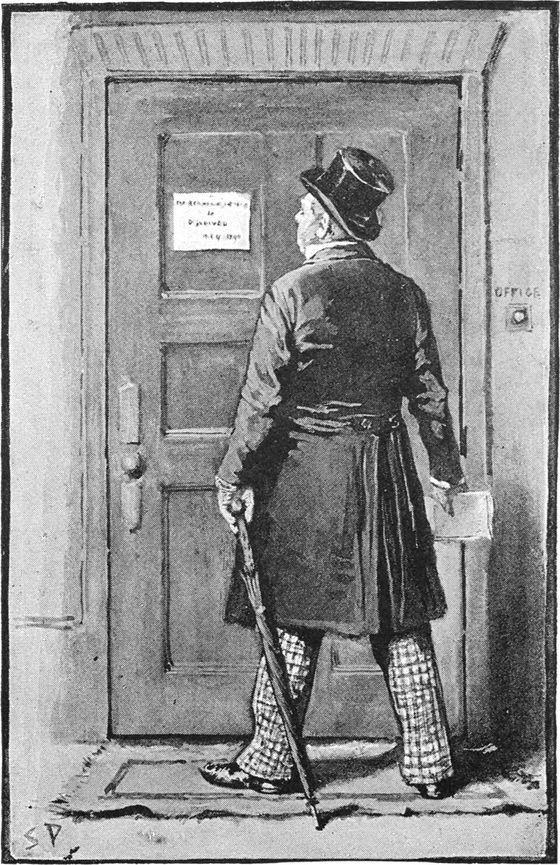
Illustration: Sidney Paget, public domain, via Wikimedia Commons
I called on my friend Mr. Sherlock Holmes one day in the autumn of last year and found him deep in conversation with a very stout, red-faced, elderly gentleman with fiery red hair. I apologized for intruding and was about to back out when Holmes pulled me into the room and shut the door behind me.
“You couldn’t possibly have come at a better time, my dear Watson,” he said warmly.
“I was afraid you were busy.”
“So I am. Very much so.”
“Then I can wait in the next room.”
“Not at all. Mr. Wilson, this gentleman has been my partner and helper in many of my most successful cases, and I have no doubt he’ll be of the greatest use to me in yours as well.”
The stout gentleman half rose from his chair and bobbed a greeting, with a quick, questioning glance from his small eyes, which were set deep in folds of fat.
“Try the settee,” said Holmes. He dropped back into his armchair and put his fingertips together, as he always did when he was in a judging mood. “I know, my dear Watson, that you share my love of everything bizarre, everything outside the dull routine of everyday life. You’ve shown your taste for it by the enthusiasm with which you’ve chronicled, and, if you’ll excuse my saying so, somewhat embellished, so many of my own little adventures.”
“Your cases have certainly been of the greatest interest to me,” I said.
“You’ll remember I said the other day, just before we took up the very simple problem of Miss Mary Sutherland, that for strange effects and extraordinary combinations we must go to life itself, which is always far more daring than any effort of the imagination.”
“A claim I took the liberty of doubting.”
“You did, Doctor. But you’ll have to come round to my view all the same, or I’ll keep piling fact upon fact on you until your reason breaks down under the weight and admits I’m right. Now, Mr. Jabez Wilson here was good enough to call on me this morning and begin a story that promises to be one of the strangest I’ve heard in some time. You’ve heard me say that the strangest and most unique things are very often tied not to the larger crimes but to the smaller ones, and sometimes to cases where it’s doubtful any crime has been committed at all. From what I’ve heard so far, I can’t say whether this is a crime or not. But the course of events is certainly among the most singular I’ve ever listened to. Mr. Wilson, would you be kind enough to start your story again? Partly because my friend Dr. Watson missed the opening, and partly because the story is so peculiar that I want every possible detail from your own lips. As a rule, once I’ve heard a little of how events ran, I can steer by the thousands of similar cases in my memory. This time I have to admit that the facts are, as far as I know, unique.”
Our portly client puffed out his chest with a touch of pride and pulled a dirty, wrinkled newspaper from the inside pocket of his greatcoat. While he ran his eye down the advertisement column, head thrust forward and the paper flattened on his knee, I took a good look at him and tried, in my companion’s fashion, to read what his clothes and appearance might tell me.
I didn’t get very far. Our visitor looked every inch the ordinary British tradesman: fat, pompous, and slow. He wore baggy gray checked trousers, a not-too-clean black frock coat hanging open, and a drab vest with a heavy brassy watch chain, from which dangled a square bit of metal with a hole in it, as an ornament. A frayed top hat and a faded brown overcoat with a wrinkled velvet collar lay on a chair beside him. Look as I might, there was nothing remarkable about the man except his blazing red head and the look of deep annoyance and gloom on his face.
Sherlock Holmes’ quick eye caught what I was doing, and he shook his head at me with a smile. “Beyond the obvious facts that he has at some time done manual labor, that he takes snuff, that he is a Freemason, that he has been in China, and that he has done a great deal of writing lately, I can deduce nothing else.”
Mr. Jabez Wilson sat bolt upright, his forefinger still on the paper but his eyes on my companion.
“How in the name of good fortune did you know all that, Mr. Holmes?” he asked. “How did you know I did manual labor, for one? It’s true as gospel. I started out as a ship’s carpenter.”
“Your hands, my dear sir. Your right hand is a full size larger than your left. You’ve worked with it, and the muscles have grown.”
That one, at least, I could follow as a doctor. Muscle answers to work: years of swinging an adze or a mallet with the same hand thicken it, palm, fingers, and all, and the other hand never catches up. A man’s body keeps a ledger of his labor, and Holmes had simply read it.
“Well, the snuff, then, and the Freemasonry?”
“I won’t insult your intelligence by explaining how I read that, especially since, rather against the strict rules of your order, you wear an arc-and-compass breastpin.”
“Ah, of course, I forgot that. But the writing?”
“What else could explain that right cuff, so very shiny for five inches, and the left one with a smooth patch near the elbow, where you rest it on the desk?”
I glanced at the cuff and saw it at once, now that I’d been told. Cloth is a tangle of tiny fibers sticking out every which way, and that’s why it looks dull: it scatters light in all directions. Rub it along a desk for hours a day and you press those fibers flat and smooth, until the surface throws much of the light back in one direction and gleams. A shine on a sleeve is the mark of friction, and friction is the mark of a man at a desk.
“Well, but China?”
“The fish tattooed just above your right wrist could only have been done in China. I’ve made a small study of tattoo marks, and have even contributed to the literature of the subject. That trick of staining the fish scales a delicate pink is quite peculiar to China. And when I also see a Chinese coin hanging from your watch chain, the matter becomes even simpler.”
So that was the square-holed bit of metal I had taken for a mere ornament. I had seen it, and not thought about it at all.
Mr. Jabez Wilson laughed heavily. “Well, I never!” said he. “I thought at first you’d done something clever, but I see there was nothing in it after all.”
“I begin to think, Watson,” said Holmes, “that I make a mistake in explaining. ‘Omne ignotum pro magnifico,’ you know (everything unknown is taken to be magnificent), and my poor little reputation, such as it is, will be shipwrecked if I’m so candid. Can you find the advertisement, Mr. Wilson?”
“Yes, I’ve got it now,” he answered, with his thick red finger planted halfway down the column. “Here it is. This is what started it all. You just read it for yourself, sir.”
I took the paper from him and read:

Illustration: Sidney Paget, public domain, via Wikimedia Commons
“TO THE RED-HEADED LEAGUE: On account of the bequest of the late Ezekiah Hopkins, of Lebanon, Pennsylvania, U.S.A., there is now another vacancy open which entitles a member of the League to a salary of £4 a week for purely nominal services. All red-headed men who are sound in body and mind and above the age of twenty-one years, are eligible. Apply in person on Monday, at eleven o’clock, to Duncan Ross, at the offices of the League, 7 Pope’s Court, Fleet Street.”
“What on earth does this mean?” I exclaimed, after I’d read the extraordinary notice twice.
Holmes chuckled and wriggled in his chair, as he did when he was in high spirits. “It’s a little off the beaten track, isn’t it?” he said. “Now, Mr. Wilson, start from scratch and tell us all about yourself, your household, and what this advertisement did to your fortunes. Doctor, first make a note of the paper and the date.”
“It’s The Morning Chronicle of April 27, 1890. Just two months ago.”
“Very good. Now, Mr. Wilson?”
“Well, it’s just as I’ve been telling you, Mr. Sherlock Holmes,” said Jabez Wilson, mopping his forehead. “I have a small pawnbroker’s business at Coburg Square, near the City. It’s not a big affair, and lately it hasn’t done more than give me a living. I used to be able to keep two assistants, but now I keep only one, and I’d struggle to pay him if he weren’t willing to come for half wages so he can learn the business.”
“And what’s the name of this obliging youth?” asked Sherlock Holmes.
“His name is Vincent Spaulding, and he’s not such a youth, either. It’s hard to tell his age. I couldn’t want a smarter assistant, Mr. Holmes. I know very well he could do better for himself and earn twice what I can give him. But if he’s satisfied, why should I put ideas in his head?”
“Why indeed? You seem very lucky to have an employee who works for less than the going rate. That isn’t a common experience among employers these days. I’m not sure your assistant isn’t as remarkable as your advertisement.”
“Oh, he has his faults, too,” said Mr. Wilson. “Never was there such a fellow for photography. Snapping away with a camera when he ought to be improving his mind, and then diving down into the cellar like a rabbit into its hole to develop his pictures. That’s his main fault, but on the whole he’s a good worker. There’s no vice in him.”
I remember thinking it a harmless enough hobby, and a tidy one. A photographic plate is coated with silver salts so sensitive that a moment's stray light will fog it until it has been developed; that’s the whole trick of the thing. So a man developing plates needs real darkness, and nobody with any manners flings open the door on him. It struck me only much later what a perfect excuse that makes for a closed cellar door.
“He’s still with you, I take it?”
“Yes, sir. He and a girl of fourteen, who does a bit of plain cooking and keeps the place clean. That’s all I have in the house, for I’m a widower and never had any family. We live very quietly, sir, the three of us. We keep a roof over our heads and pay our debts, if nothing more.
“The first thing that put us out was that advertisement. Spaulding came down into the office just eight weeks ago today, with this very paper in his hand, and he says:
“‘I wish to the Lord, Mr. Wilson, that I was a red-headed man.’
“‘Why’s that?’ I asks.
“‘Why,’ says he, ‘here’s another vacancy on the League of the Red-headed Men. It’s worth quite a little fortune to any man who gets it, and I understand there are more vacancies than there are men, so the trustees are at their wits’ end what to do with the money. If my hair would only change color, here’s a nice little job all ready for me to step into.’
“‘Why, what is it, then?’ I asked. You see, Mr. Holmes, I’m a very stay-at-home man. My business comes to me instead of me going to it, so I often went weeks without setting foot past the doormat. I didn’t know much of what went on outside, and I was always glad of a bit of news.
“‘Have you never heard of the League of the Red-headed Men?’ he asked, wide-eyed.
“‘Never.’
“‘Well, I’m surprised, because you’re eligible yourself for one of the vacancies.’
“‘And what are they worth?’ I asked.
“‘Oh, merely a couple of hundred a year, but the work is light, and it needn’t interfere much with a man’s other business.’
“Well, you can imagine that made me prick up my ears, for business hasn’t been too good for some years, and an extra couple of hundred would have come in very handy.
“‘Tell me all about it,’ said I.

Illustration: Sidney Paget, public domain, via Wikimedia Commons
“‘Well,’ said he, showing me the advertisement, ‘you can see for yourself the League has a vacancy, and there’s the address where you apply. As far as I can make out, the League was founded by an American millionaire, Ezekiah Hopkins, who was very peculiar in his ways. He was red-headed himself, and he had great sympathy for all red-headed men. So when he died, it turned out he’d left his enormous fortune with trustees, with instructions to use the interest to provide easy jobs for men whose hair is that color. From all I hear, it’s splendid pay and very little to do.’
“‘But,’ said I, ‘there must be millions of red-headed men who’d apply.’
“‘Not as many as you’d think,’ he answered. ‘You see, it’s really limited to Londoners, and to grown men. This American started out from London when he was young, and he wanted to do the old town a good turn. Then, too, I’ve heard there’s no use applying if your hair is light red, or dark red, or anything but real bright, blazing, fiery red. Now, if you cared to apply, Mr. Wilson, you’d just walk in. But maybe it’s hardly worth your while to put yourself out for a few hundred pounds.’
“Now, gentlemen, it’s a fact, as you can see for yourselves, that my hair is a very full, rich shade, so it seemed to me that if there was to be any competition, I stood as good a chance as any man I’d ever met. Vincent Spaulding seemed to know so much about it that I thought he might be useful, so I told him to put up the shutters for the day and come with me. He was very glad of a holiday, so we shut up the business and set off for the address in the advertisement.
“I never hope to see a sight like that again, Mr. Holmes. From north, south, east, and west, every man with a shade of red in his hair had tramped into the City to answer that advertisement. Fleet Street was choked with red-headed folk, and Pope’s Court looked like a street seller’s orange cart. I wouldn’t have thought there were that many in the whole country. Every shade they were: straw, lemon, orange, brick, Irish setter, liver, clay. But, as Spaulding said, there weren’t many with the real vivid, flame-colored tint. When I saw how many were waiting, I’d have given up in despair, but Spaulding wouldn’t hear of it. How he did it I can’t imagine, but he pushed and pulled and butted until he got me through the crowd and right up to the steps of the office. There was a double stream on the stairs, some going up in hope and some coming down dejected, but we wedged ourselves in and soon found ourselves in the office.”
“Your experience has been a most entertaining one,” said Holmes, as his client paused to refresh his memory with a huge pinch of snuff. “Please go on with your very interesting statement.”
“There was nothing in the office but a couple of wooden chairs and a plain pine table, and behind it sat a small man with a head even redder than mine. He said a few words to each candidate as he came up, and then he always managed to find some fault that disqualified them. Getting a vacancy didn’t seem so easy after all. But when our turn came, the little man was far more taken with me than with any of the others, and he closed the door as we came in so he could have a private word with us.
“‘This is Mr. Jabez Wilson,’ said my assistant, ‘and he’s willing to fill a vacancy in the League.’
“‘And he’s admirably suited for it,’ the other answered. ‘He meets every requirement. I can’t remember when I’ve seen anything so fine.’ He took a step back, cocked his head to one side, and stared at my hair until I felt quite bashful. Then all of a sudden he plunged forward, wrung my hand, and congratulated me warmly on my success.
“‘It would be an injustice to hesitate,’ said he. ‘But I’m sure you’ll excuse me for taking an obvious precaution.’ With that he grabbed my hair in both hands and tugged until I yelled with the pain. ‘There’s water in your eyes,’ said he as he let go. ‘I see all is as it should be. But we have to be careful, for we’ve twice been fooled by wigs and once by paint. I could tell you tales of cobbler’s wax that would disgust you with human nature.’ He stepped over to the window and shouted down at the top of his voice that the vacancy was filled. A groan of disappointment came up from below, and the crowd trooped off in all directions until there wasn’t a red head to be seen except mine and the manager’s.
“‘My name,’ said he, ‘is Mr. Duncan Ross, and I’m one of the pensioners on the fund left by our noble benefactor myself. Are you a married man, Mr. Wilson? Have you a family?’
“I told him I hadn’t.
“His face fell at once.
“‘Dear me!’ he said gravely. ‘That’s very serious indeed! I’m sorry to hear it. The fund was meant, of course, for the spreading and multiplying of red-heads as well as for their support. It’s extremely unfortunate that you should be a bachelor.’
“My face fell too, Mr. Holmes, for I thought I wasn’t going to get the vacancy after all. But after thinking it over for a few minutes he said it would be all right.
“‘In anyone else’s case,’ said he, ‘the objection might be fatal, but we must stretch a point for a man with a head of hair like yours. When can you start your new duties?’
“‘Well, it’s a little awkward, because I already have a business,’ said I.
“‘Oh, never mind about that, Mr. Wilson!’ said Vincent Spaulding. ‘I can look after that for you.’
“‘What would the hours be?’ I asked.
“‘Ten to two.’
“Now, a pawnbroker’s business is mostly done in the evening, Mr. Holmes, especially Thursday and Friday evenings, just before payday. So it would suit me very well to earn a bit in the mornings. Besides, I knew my assistant was a good man and would see to anything that came up.
“‘That would suit me very well,’ said I. ‘And the pay?’
“‘Is £4 a week.’
“‘And the work?’
“‘Is purely nominal.’
“‘What do you call purely nominal?’
“‘Well, you have to be in the office, or at least in the building, the whole time. If you leave, you lose your position forever. The will is very clear on that point. You don’t meet the conditions if you budge from the office during those hours.’
“‘It’s only four hours a day, and I wouldn’t think of leaving,’ said I.
“‘No excuse will do,’ said Mr. Duncan Ross. ‘Not sickness, not business, not anything. There you must stay, or you lose your place.’
“‘And the work?’
“‘Is to copy out the Encyclopædia Britannica. There’s the first volume, in that cupboard. You supply your own ink, pens, and blotting paper, but we provide this table and chair. Will you be ready tomorrow?’
“‘Certainly,’ I answered.
“‘Then goodbye, Mr. Jabez Wilson, and let me congratulate you once more on the important position you’ve been lucky enough to win.’ He bowed me out of the room, and I went home with my assistant hardly knowing what to say or do, I was so pleased at my good fortune.
“Well, I thought it over all day, and by evening my spirits were low again. I’d quite persuaded myself the whole thing must be some great hoax or fraud, though what it was for I couldn’t imagine. It seemed past belief that anyone would make such a will, or pay such a sum for anything as simple as copying out the Encyclopædia Britannica. Vincent Spaulding did what he could to cheer me up, but by bedtime I’d reasoned myself out of the whole thing. Still, in the morning I decided to have a look anyhow. So I bought a penny bottle of ink, and with a quill pen and seven sheets of foolscap paper, I set off for Pope’s Court.
“Well, to my surprise and delight, everything was just as it should be. The table was set out ready for me, and Mr. Duncan Ross was there to see that I got properly started. He set me going on the letter A, and then he left me, though he’d drop in now and then to see that all was right. At two o’clock he wished me good day, complimented me on how much I’d written, and locked the office door behind me.
“This went on day after day, Mr. Holmes, and on Saturday the manager came in and planked down four gold sovereigns for my week’s work. It was the same the next week, and the week after. Every morning I was there at ten, and every afternoon I left at two. Little by little Mr. Duncan Ross took to coming in only once a morning, and then after a while he didn’t come in at all. Still, of course, I never dared leave the room for an instant, for I couldn’t be sure when he might turn up, and the job was such a good one, and suited me so well, that I wouldn’t risk losing it.
“Eight weeks went by like that. I had written about Abbots and Archery and Armor and Architecture and Attica, and I hoped, with hard work, to get on to the B’s before too long. It cost me something in foolscap, and I had pretty nearly filled a shelf with my writing. And then, all of a sudden, the whole business came to an end.”
“To an end?”
“Yes, sir. This very morning. I went to work as usual at ten o’clock, but the door was shut and locked, with a little square of cardboard tacked to the middle of the panel. Here it is. You can read it for yourself.”
He held up a piece of white cardboard about the size of a sheet of notepaper. It read:
“THE RED-HEADED LEAGUE IS DISSOLVED. October 9, 1890.”
Sherlock Holmes and I looked at this curt announcement, and at the sorrowful face behind it, until the comedy of the thing overwhelmed every other consideration and we both burst out laughing.
“I can’t see that there’s anything so funny,” cried our client, flushing to the roots of his flaming head. “If you can’t do better than laugh at me, I can go elsewhere.”
“No, no,” cried Holmes, shoving him back into the chair he’d half risen from. “I really wouldn’t miss your case for the world. It’s most refreshingly unusual. But there is, if you’ll excuse my saying so, something just a little funny about it. Tell me, what did you do when you found the card on the door?”
“I was staggered, sir. I didn’t know what to do. I called at the offices round about, but none of them seemed to know anything about it. Finally I went to the landlord, who’s an accountant living on the ground floor, and asked him what had become of the Red-headed League. He said he’d never heard of any such body. Then I asked him who Mr. Duncan Ross was. He said the name was new to him.
“‘Well,’ said I, ‘the gentleman at No. 4.’
“‘What, the red-headed man?’
“‘Yes.’
“‘Oh,’ said he, ‘his name was William Morris. He was a lawyer, and he was using my room as a temporary convenience until his new offices were ready. He moved out yesterday.’
“‘Where can I find him?’
“‘Oh, at his new offices. He did tell me the address. Yes, 17 King Edward Street, near St. Paul’s.’
“I set off, Mr. Holmes, but when I got to that address it was a factory making artificial kneecaps, and no one there had ever heard of either Mr. William Morris or Mr. Duncan Ross.”
“And what did you do then?” asked Holmes.
“I went home to Saxe-Coburg Square and took my assistant’s advice. But he couldn’t help me in any way. All he could say was that if I waited, I’d hear by post. That wasn’t good enough for me, Mr. Holmes. I didn’t want to lose such a place without a fight, so, since I’d heard you were good enough to give advice to poor folk who needed it, I came straight to you.”
“And you were very wise to,” said Holmes. “Your case is an exceedingly remarkable one, and I’ll be happy to look into it. From what you’ve told me, I think it’s possible that graver matters hang on it than might first appear.”
“Grave enough!” said Mr. Jabez Wilson. “Why, I’ve lost four pound a week.”
“As far as you personally are concerned,” said Holmes, “I don’t see that you have any grievance against this extraordinary league. On the contrary, you are, as I understand it, richer by some £30, to say nothing of the detailed knowledge you’ve gained on every subject under the letter A. You’ve lost nothing by them.”
“No, sir. But I want to find out about them, and who they are, and what they meant by playing this prank, if it was a prank, on me. It was a pretty expensive joke for them, for it cost them thirty-two pounds.”
“We’ll try to clear up these points for you. And first, Mr. Wilson, one or two questions. This assistant of yours who first showed you the advertisement: how long had he been with you?”
“About a month, then.”
“How did he come to you?”
“In answer to an advertisement.”
“Was he the only applicant?”
“No, I had a dozen.”
“Why did you pick him?”
“Because he was handy and would come cheap.”
“At half wages, in fact.”
“Yes.”
“What’s he like, this Vincent Spaulding?”
“Small, stoutly built, very quick in his ways, no hair on his face, though he’s not far off thirty. Has a white splash of acid on his forehead.”
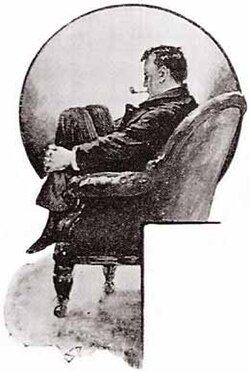
Illustration: Sidney Paget, public domain, via Wikimedia Commons
Holmes sat up in his chair in considerable excitement. “I thought as much,” said he. “Have you ever noticed that his ears are pierced for earrings?”
“Yes, sir. He told me a gipsy did it for him when he was a lad.” (Wilson meant one of the Romani travelers, whom Londoners then called gipsies; it was, I suspect, the first explanation that came to the young man’s lips.)
“Hum!” said Holmes, sinking back in deep thought. “He’s still with you?”
“Oh, yes, sir. I’ve only just left him.”
“And your business has been looked after while you were away?”
“Nothing to complain of, sir. There’s never much to do in the morning.”
“That will do, Mr. Wilson. I’ll be happy to give you my opinion in a day or two. Today is Saturday, and I hope that by Monday we may come to a conclusion.”
“Well, Watson,” said Holmes when our visitor had gone, “what do you make of it all?”
“I make nothing of it,” I answered frankly. “It’s a most mysterious business.”
“As a rule,” said Holmes, “the more bizarre a thing is, the less mysterious it proves to be. It’s your commonplace, featureless crimes that are really puzzling, just as a commonplace face is the hardest to identify. But I must move quickly on this.”
“What are you going to do, then?” I asked.
“To smoke,” he answered. “It is quite a three pipe problem, and I beg that you won’t speak to me for fifty minutes.” He curled up in his chair with his thin knees drawn up to his hawk-like nose, and there he sat with his eyes closed and his black clay pipe sticking out like the beak of some strange bird. I had decided he’d fallen asleep, and was nodding off myself, when he suddenly sprang out of his chair like a man who has made up his mind, and put his pipe down on the mantelpiece.
“Sarasate plays at St. James’s Hall this afternoon,” he said. “What do you think, Watson? Could your patients spare you for a few hours?”
“I have nothing to do today. My practice never keeps me very busy.”
“Then put on your hat and come. I’m going through the City first, and we can have lunch on the way. I see there’s a good deal of German music on the program, which is more to my taste than Italian or French. It’s introspective, and I want to introspect. Come along!”
We took the Underground as far as Aldersgate, and a short walk brought us to Saxe-Coburg Square, the scene of the strange story we’d heard that morning. It was a cramped, shabby-genteel little place, where four rows of grimy two-story brick houses looked out on a small railed-in patch of ground. There a lawn of weedy grass and a few clumps of faded laurel bushes fought a hard battle against the smoky air. Three gilt balls, the pawnbroker’s sign, and a brown board reading “JABEZ WILSON” in white letters on a corner house marked where our red-headed client did business. Sherlock Holmes stopped in front of it with his head on one side and looked it all over, his eyes bright between narrowed lids. Then he walked slowly up the street and back down to the corner, still studying the houses. Finally he came back to the pawnbroker’s, thumped hard on the pavement with his stick two or three times, went up to the door, and knocked. It was opened at once by a bright-looking, clean-shaven young fellow, who asked him to step inside.
“Thank you,” said Holmes. “I only wanted to ask how you would get from here to the Strand.”
“Third right, fourth left,” the assistant answered promptly, and shut the door.
“Smart fellow, that,” Holmes said as we walked away. “He is, in my judgment, the fourth smartest man in London, and for daring I’m not sure he hasn’t a claim to be third. I’ve known something of him before.”
“Clearly,” I said, “Mr. Wilson’s assistant counts for a good deal in this mystery of the Red-headed League. I’m sure you only asked the way so you could see him.”
“Not him.”
“What, then?”
“The knees of his trousers.”
“And what did you see?”
“What I expected to see.”
“Why did you beat the pavement?”
“My dear doctor, this is a time for observation, not for talk. We are spies in an enemy’s country. We know something of Saxe-Coburg Square. Let’s explore the parts that lie behind it.”
The road we came out on, when we turned the corner from that quiet square, was as different from it as the front of a painting is from the back. It was one of the main arteries carrying the City’s traffic north and west. The roadway was jammed with a huge double tide of commerce flowing in and out, and the sidewalks were black with hurrying crowds. Looking at the line of fine shops and grand business buildings, it was hard to believe that their backs pressed right up against the faded, stagnant square we’d just left.
“Let me see,” said Holmes, standing at the corner and looking along the row. “I’d just like to remember the order of the houses here. It’s a hobby of mine to know London exactly. There’s Mortimer’s, the tobacconist; the little newspaper shop; the Coburg branch of the City and Suburban Bank; the Vegetarian Restaurant; and McFarlane’s carriage-building depot. That takes us right to the next block. And now, Doctor, we’ve done our work, so it’s time for some play. A sandwich and a cup of coffee, and then off to violin-land, where all is sweetness and delicacy and harmony, and there are no red-headed clients to pester us with their puzzles.”
My friend loved music. He was not only a very capable player but a composer of real merit. All afternoon he sat in the stalls wrapped in perfect happiness, gently waving his long, thin fingers in time to the music. His softly smiling face and his dreamy, languid eyes were as unlike those of Holmes the bloodhound, Holmes the relentless, sharp-witted, quick-handed hunter of criminals, as anything could be. His odd character had two sides that took turns ruling him. His extreme precision and shrewdness were, I often thought, the swing of the pendulum away from the poetic, brooding mood that sometimes took hold of him. His nature swung him from utter idleness to devouring energy, and I knew well that he was never so truly dangerous as when he had spent days lounging in his armchair among his musical improvisations and his old books. That was when the thrill of the chase would suddenly seize him, and his brilliant reasoning would rise to the level of intuition, until people who didn’t know his methods looked at him sideways, as at a man whose knowledge was not that of other mortals. Watching him so lost in the music at St. James’s Hall that afternoon, I felt that a bad time might be coming for whoever he had set out to hunt.
“You’ll want to go home, no doubt, Doctor,” he said as we came out.
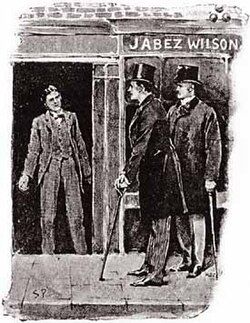
Illustration: Sidney Paget, public domain, via Wikimedia Commons
“Yes, I may as well.”
“And I have some business that will take a few hours. This business at Coburg Square is serious.”
“Why serious?”
“A considerable crime is being planned. I have every reason to believe we’ll be in time to stop it. But today being Saturday rather complicates things. I’ll want your help tonight.”
“At what time?”
“Ten will be early enough.”
“I’ll be at Baker Street at ten.”
“Very well. And, I say, Doctor, there may be a little danger, so please put your army revolver in your pocket.” He waved, turned on his heel, and vanished into the crowd in an instant.
I trust I’m no denser than my neighbors, but I always felt weighed down by my own stupidity in dealing with Sherlock Holmes. Here I’d heard what he heard and seen what he saw, and yet it was plain from his words that he saw clearly not only what had happened but what was about to happen, while to me the whole thing was still a confused and grotesque muddle. Driving home to my house in Kensington, I went over it all again: the extraordinary story of the red-headed copier of the Encyclopædia, the visit to Saxe-Coburg Square, and the ominous words Holmes had parted with. What was this night expedition, and why should I go armed? Where were we going, and what were we going to do? Holmes had hinted that this smooth-faced pawnbroker’s assistant was a formidable man, a man who might be playing a deep game. I tried to puzzle it out, gave up in despair, and set it aside until the night should explain it.
It was a quarter past nine when I left home and made my way across the Park and through Oxford Street to Baker Street. Two hansoms, those quick two-wheeled cabs, were waiting at the door, and as I came into the passage I heard voices upstairs. In his room I found Holmes in lively conversation with two men. One I recognized as Peter Jones, the police detective. The other was a long, thin, sad-faced man with a very shiny hat and an oppressively respectable frock coat.
“Ha! Our party is complete,” said Holmes, buttoning his short pea jacket and taking his heavy hunting crop from the rack. “Watson, I think you know Mr. Jones, of Scotland Yard? Let me introduce Mr. Merryweather, who is to be our companion in tonight’s adventure.”
“We’re hunting in pairs again, Doctor, you see,” said Jones, in his self-important way. “Our friend here is a wonderful man for starting a chase. All he needs is an old dog to help him run it down.”
“I hope a wild goose won’t turn out to be the end of our chase,” said Mr. Merryweather gloomily.
“You may put considerable trust in Mr. Holmes, sir,” said the police detective grandly. “He has his own little methods, which are, if he won’t mind my saying so, just a little too theoretical and fanciful, but he has the makings of a detective in him. It isn’t too much to say that once or twice, as in that business of the Sholto murder and the Agra treasure, he’s been closer to the truth than the official force.”
Holmes bore this praise with the expression of a man being complimented on his handwriting by a parrot.
“Oh, if you say so, Mr. Jones, it’s all right,” said the stranger respectfully. “Still, I confess I miss my rubber.” (He meant his weekly rubber of whist, a match of several games at cards.) “It’s the first Saturday night in twenty-seven years that I haven’t had my rubber.”
“I think you’ll find,” said Sherlock Holmes, “that you’ll play for a higher stake tonight than you ever have before, and that the game will be more exciting. For you, Mr. Merryweather, the stake will be some £30,000; and for you, Jones, it will be the man you’ve been wanting to get your hands on.”
“John Clay, the murderer, thief, coin forger, and swindler. He’s a young man, Mr. Merryweather, but he’s at the head of his profession, and I’d rather have my handcuffs on him than on any criminal in London. He’s a remarkable man, is young John Clay. His grandfather was a royal duke, and he himself has been to Eton and Oxford. His brain is as cunning as his fingers, and though we see signs of him at every turn, we never know where to find the man himself. He’ll break into a house in Scotland one week and be raising money to build an orphanage in Cornwall the next. I’ve been on his track for years and have never laid eyes on him.”
“I hope I may have the pleasure of introducing you tonight. I’ve had one or two little run-ins with Mr. John Clay myself, and I agree he’s at the head of his profession. But it’s past ten, and high time we started. If you two take the first hansom, Watson and I will follow in the second.”
Sherlock Holmes said little during the long drive. He lay back in the cab humming the tunes he’d heard that afternoon. We rattled through an endless maze of gaslit streets until we came out into Farrington Street.
“We’re close now,” my friend said. “This fellow Merryweather is a bank director, and has a personal interest in the matter. I thought it best to have Jones along too. He’s not a bad fellow, though an absolute imbecile in his profession. He has one real virtue. He’s as brave as a bulldog and as tenacious as a lobster once he gets his claws into anyone. Here we are, and they’re waiting for us.”
We had come back to the same busy thoroughfare we’d stood in that morning. We dismissed the cabs and, following Mr. Merryweather, went down a narrow passage and through a side door, which he unlocked for us. Inside was a short corridor ending in a massive iron gate. This too was opened, and led down a flight of winding stone steps to another formidable gate. Mr. Merryweather stopped to light a lantern and then led us down a dark passage that smelled of earth, and so, after a third door, into a huge vault, or cellar, piled all around with crates and heavy boxes.
“You’re not very vulnerable from above,” Holmes remarked, holding up the lantern and looking around.
“Nor from below,” said Mr. Merryweather, striking his stick on the flagstones of the floor. “Why, dear me, it sounds quite hollow!” he said, looking up in surprise.
And there, I realized with a jolt, was the meaning of Holmes’ thumping in the square that morning. Strike a stone laid on solid packed earth and the blow has nowhere to go; it dies in a dull, dead thud. Strike one with empty space beneath it and the slab rings, and the hollow under it booms like the body of a drum. Holmes had been listening to the ground.
“I really must ask you to be a little quieter!” said Holmes sharply. “You’ve already put the whole success of our expedition at risk. May I beg you to be good enough to sit down on one of those boxes and not interfere?”
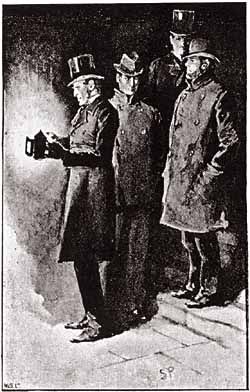
Illustration: Sidney Paget, public domain, via Wikimedia Commons
The solemn Mr. Merryweather perched himself on a crate with a deeply injured expression, while Holmes dropped to his knees on the floor and, with the lantern and a magnifying lens, began to examine the cracks between the stones in minute detail. A few seconds satisfied him. He sprang up again and put his glass in his pocket.
“We have at least an hour,” he said, “because they can hardly do anything until the good pawnbroker is safely in bed. Then they won’t lose a minute, for the sooner they finish, the more time they’ll have to escape. We are at present, Doctor, as you’ve no doubt guessed, in the cellar of the City branch of one of the chief London banks. Mr. Merryweather is the chairman of the directors, and he’ll explain to you why the more daring criminals of London should be taking a considerable interest in this cellar just now.”
“It’s our French gold,” whispered the director. “We’ve had several warnings that an attempt might be made on it.”
“Your French gold?”
“Yes. Some months ago we had occasion to strengthen our reserves, and for that purpose we borrowed 30,000 napoleons, French gold coins, from the Bank of France. It has become known that we’ve never had occasion to unpack the money, and that it’s still lying in our cellar. The crate I’m sitting on holds 2,000 napoleons packed between layers of lead foil. Our reserve of bullion is far larger at present than is usually kept in a single branch, and the directors have had misgivings about it.”
“Which were very well justified,” said Holmes. “And now it’s time to arrange our little plans. I expect things to come to a head within the hour. In the meantime, Mr. Merryweather, we must close the shutter on that dark lantern.”
“And sit in the dark?”
“I’m afraid so. I brought a pack of cards in my pocket, and I thought, since there are four of us, you might have your rubber after all. But I see the enemy’s preparations have gone so far that we can’t risk a light. And first of all we must choose our positions. These are daring men, and though we’ll take them by surprise, they may do us some harm unless we’re careful. I’ll stand behind this crate, and you hide behind those. Then, when I flash a light on them, close in quickly. If they fire, Watson, don’t hesitate to shoot them down.”
I set my revolver, cocked, on top of the wooden case I crouched behind. Holmes slid the shutter across the front of his lantern and left us in pitch darkness, a darkness more absolute than any I had ever known. Only the smell of hot metal told us the flame was still burning inside the closed tin, ready to blaze out at a moment’s notice. To me, with my nerves strung tight with expectation, there was something crushing in the sudden blackness and the cold, damp air of the vault.
“They have only one way out,” whispered Holmes. “That’s back through the house into Saxe-Coburg Square. I hope you’ve done what I asked, Jones?”
“I have an inspector and two officers waiting at the front door.”
“Then we’ve stopped up every hole. And now we must be silent and wait.”
How long it seemed! When we compared notes afterward it was only an hour and a quarter, yet it felt to me that the night must be nearly over and dawn breaking above us. My limbs grew stiff and tired, for I was afraid to shift my position. My nerves were wound to the highest pitch, and my hearing grew so sharp that I could hear not only my companions’ gentle breathing but could tell the deeper, heavier breath of the bulky Jones from the thin, sighing note of the bank director. My eyes, too, had been at work. A doctor knows that the eye in darkness is not idle; over many minutes it slowly gathers sensitivity, until it can see by a glimmer that it would have missed entirely on first coming in from a lit room. From where I crouched I could look over the case toward the floor. Suddenly my eyes caught the glint of a light.
At first it was only a dull red spark on the stone floor. Then it stretched into a yellow line, and then, without warning or sound, a gash seemed to open and a hand appeared: a white, almost womanly hand, which felt about in the middle of the little patch of light. For a minute or more the hand, with its writhing fingers, stuck out of the floor. Then it was pulled back as suddenly as it had come, and all was dark again except for that one dull spark marking a chink between the stones.
It was gone only for a moment. With a rending, tearing sound, one of the broad white stones tipped over onto its side and left a square, gaping hole, through which streamed the light of a lantern. Over the edge peeped a clean-cut, boyish face, which looked sharply about. Then, with a hand on either side of the opening, the man drew himself up shoulder-high, then waist-high, until one knee rested on the edge. In another instant he stood beside the hole and was hauling up a companion, lithe and small like himself, with a pale face and a shock of very red hair.
“It’s all clear,” he whispered. “Have you the chisel and the bags? Great Scott! Jump, Archie, jump, and I’ll swing for it!”
Sherlock Holmes had sprung out and seized the intruder by the collar. The other dived back down the hole, and I heard cloth tear as Jones grabbed at his coattails. The light flashed on the barrel of a revolver, but Holmes’ hunting crop came down on the man’s wrist, and the pistol clinked onto the stone floor.
“It’s no use, John Clay,” said Holmes calmly. “You have no chance at all.”
“So I see,” the other answered, perfectly cool. “I fancy my pal is all right, though I see you’ve got his coattails.”
“There are three men waiting for him at the door,” said Holmes.
“Oh, indeed! You seem to have done the thing very thoroughly. I must compliment you.”
“And I you,” Holmes answered. “Your red-headed idea was very new and effective.”
“You’ll see your pal again soon,” said Jones. “He’s quicker at climbing down holes than I am. Just hold still while I fix the handcuffs.”
“I beg you not to touch me with your filthy hands,” said our prisoner, as the cuffs clattered onto his wrists. “You may not be aware that I have royal blood in my veins. Be good enough, also, always to say ‘sir’ and ‘please’ when you address me.”
“All right,” said Jones, with a stare and a snigger. “Well, would you please, sir, march upstairs, where we can get a cab to carry your Highness to the police station?”
“That’s better,” said John Clay serenely. He made a sweeping bow to the three of us and walked quietly off in the detective’s custody.
“Really, Mr. Holmes,” said Mr. Merryweather as we followed them out of the cellar, “I don’t know how the bank can thank you or repay you. There’s no doubt that you’ve detected and defeated, in the most complete way, one of the most determined attempts at bank robbery I have ever known.”
“I’ve had one or two little scores of my own to settle with Mr. John Clay,” said Holmes. “I’ve been put to some small expense over this matter, which I’ll expect the bank to refund, but beyond that I’m amply repaid by an experience that is in many ways unique, and by hearing the very remarkable story of the Red-headed League.”
“You see, Watson,” he explained in the early hours of the morning, as we sat over a glass of whisky and soda in Baker Street, “it was perfectly obvious from the start that the only possible purpose of this rather fantastic business of the League’s advertisement and the copying of the Encyclopædia must be to get this not-too-bright pawnbroker out of the way for several hours every day. It was an odd way to manage it, but really, it would be hard to suggest a better one. No doubt the method was suggested to Clay’s ingenious mind by the color of his accomplice’s hair. The £4 a week was bait that was bound to draw him, and what was that to them, when they were playing for thousands? They put in the advertisement; one rogue takes the temporary office; the other rogue urges the man to apply; and together they make sure he’s gone every morning of the week. From the moment I heard the assistant had come for half wages, it was obvious he had some strong motive for getting the job.”
“But how could you guess what the motive was?”
“If there had been women in the house, I might have suspected nothing worse than some ordinary love affair. That, however, was out of the question. The man’s business was a small one, and there was nothing in his house that could account for such elaborate preparations, or for the money they were spending. It had to be something outside the house. What could it be? I thought of the assistant’s fondness for photography, and his trick of vanishing into the cellar. The cellar! There was the end of this tangled thread. Then I made inquiries about this mysterious assistant and found I was dealing with one of the coolest and most daring criminals in London. He was doing something in the cellar, something that took many hours a day for months on end. What could it be, once again? I could think of nothing but that he was driving a tunnel to some other building.
“That’s as far as I’d got when we went to visit the scene. I surprised you by beating on the pavement with my stick. I was finding out whether the cellar stretched out in front of the house or behind it. It wasn’t in front.”
“The sound,” I said. “Solid ground gives a dead thud; a hollow underneath rings. I worked that out in the vault, when Merryweather’s stick boomed on the flags.”
“Excellent, Watson! You’re improving. Then I rang the bell, and, as I’d hoped, the assistant answered. We’ve had some skirmishes, but we had never actually seen each other before. I hardly looked at his face. His knees were what I wanted to see. You must have noticed yourself how worn, wrinkled, and stained they were. They spoke of those hours of burrowing. The only remaining question was what they were burrowing toward. I walked round the corner, saw that the City and Suburban Bank backed onto our friend’s premises, and felt I had solved my problem. When you drove home after the concert, I called at Scotland Yard and on the chairman of the bank directors, with the result you’ve seen.”
So there it was, laid out like a sum, and every figure in it had been in front of me from the first hour: half wages, the cellar, the photography, the hollow pavement, the bank around the corner. I had held each of them in my hand. Holmes had simply added them up.
“And how could you tell they would make their attempt tonight?” I asked.
“Well, when they closed their League offices, that was a sign they no longer cared whether Mr. Jabez Wilson was at home. In other words, they had finished their tunnel. But they had to use it soon, before it was discovered or the gold was moved. Saturday would suit them better than any other day, since the bank stays shut on Sunday and they’d have two days for their escape before anyone noticed. For all these reasons, I expected them tonight.”
“You reasoned it out beautifully,” I exclaimed, in honest admiration. “It’s such a long chain, and yet every link rings true.”
“It saved me from ennui,” he answered, yawning. “Alas! I can already feel it closing in on me. My life is spent in one long effort to escape from the commonplaces of existence. These little problems help me do it.”
“And you’re a benefactor of the human race,” said I.
He shrugged. “Well, perhaps, after all, it’s of some little use,” he said. “‘L’homme c’est rien—l’œuvre c’est tout’ (the man is nothing, the work is everything), as Gustave Flaubert wrote to George Sand.”