The Adventure of the Noble Bachelor
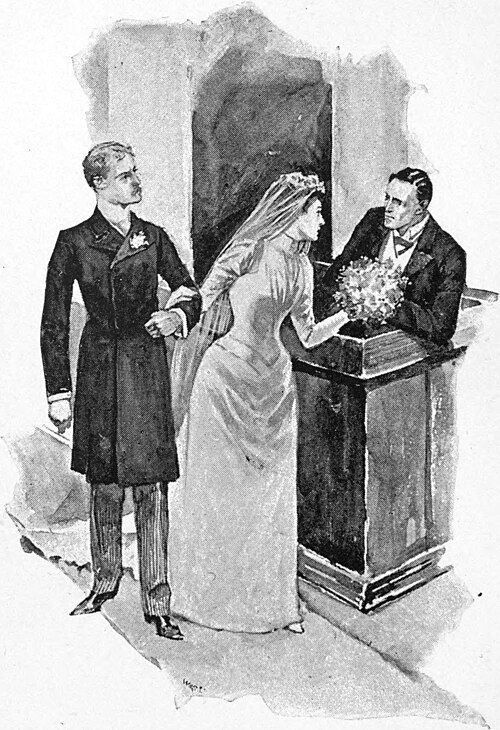
Illustration: Sidney Paget, public domain, via Wikimedia Commons
The Lord St. Simon marriage, and the strange way it ended, stopped being interesting long ago in the lofty circles where the unlucky bridegroom moves. Fresher scandals have pushed it aside, and their juicier details have drawn the gossips away from a four-year-old drama. But I have reason to believe the full facts were never made public, and since my friend Sherlock Holmes had a large share in clearing the matter up, no memoir of him would be complete without a short sketch of this remarkable episode.
It was a few weeks before my own marriage, while I was still sharing rooms with Holmes in Baker Street, that he came in from an afternoon walk to find a letter waiting for him on the table. I had stayed indoors all day. The weather had turned suddenly to rain and high autumn winds, and the jezail bullet I had brought home in one of my limbs from the Afghan campaign throbbed with dull persistence. With my body in one easy-chair and my legs on another, I had buried myself in newspapers until, saturated with the news of the day, I tossed them all aside and lay there listlessly, staring at the huge crest and monogram on the envelope and wondering lazily who my friend’s noble correspondent could be.
“Here’s a very fashionable letter,” I said as he came in. “Your morning letters, if I remember right, were from a fishmonger and a tide-waiter.” (A tide-waiter, for those who have never met one, is the customs man who boards ships as they come in on the tide.)
“Yes, my correspondence has the charm of variety,” he said, smiling, “and the humbler ones are usually the more interesting. This looks like one of those unwelcome social summonses that call on a man either to be bored or to lie.”
He broke the seal and glanced over the contents.
“Oh, come. It may prove to be something of interest after all.”
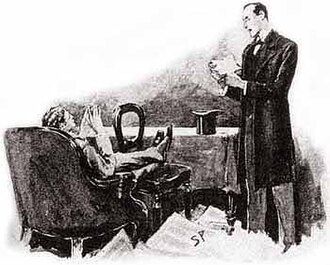
Illustration: Sidney Paget, public domain, via Wikimedia Commons
“Not social, then?”
“No. Distinctly professional.”
“And from a noble client?”
“One of the highest in England.”
“My dear fellow, I congratulate you.”
“I assure you, Watson, without any affectation, that my client’s rank matters less to me than the interest of his case. It’s just possible, though, that this one won’t be lacking in that either. You’ve been reading the papers diligently lately, haven’t you?”
“It looks like it,” I said ruefully, pointing to a huge bundle in the corner. “I’ve had nothing else to do.”
“Lucky for me, because you can bring me up to date. I read nothing except the criminal news and the agony column, those personal notices at the front of the paper. The latter is always instructive. But if you’ve followed things so closely, you must have read about Lord St. Simon and his wedding?”
“Oh, yes, with the deepest interest.”
“Good. The letter in my hand is from Lord St. Simon. I’ll read it to you, and in return you’ll go through those papers and give me whatever bears on the matter. Here’s what he says:
“‘MY DEAR MR. SHERLOCK HOLMES,—Lord Backwater tells me that I may place complete reliance on your judgment and discretion. I have decided, therefore, to call on you and consult you about the very painful event which has occurred in connection with my wedding. Mr. Lestrade, of Scotland Yard, is already acting in the matter, but he assures me that he sees no objection to your co-operation, and that he even thinks it might be of some help. I will call at four o’clock in the afternoon, and should you have any other engagement at that time, I hope you will postpone it, as this matter is of paramount importance. Yours faithfully,
“‘ROBERT ST. SIMON.’
“It’s dated from Grosvenor Mansions, written with a quill pen, and the noble lord has had the misfortune to get a smear of ink on the outer side of his right little finger,” Holmes remarked as he folded it up.
I worked that last one out for myself a moment later, and felt rather pleased. A right-handed writer’s hand rests just below the line being written, and the outer edge of the little finger can brush words still wet as it sweeps back to start the next line. A quill has to be dipped often and lays its ink on heavy, so the fresh strokes dry slowly. Smear the ink, and your finger carries the smear wherever it goes next. The letter itself had testified against its author.
“He says four o’clock. It’s three now. He’ll be here in an hour.”
“Then with your help I have just time to get clear on the subject. Go through those papers and put the extracts in order of date, while I take a look at who our client is.” He took a red-covered volume from the row of reference books beside the mantelpiece. “Here he is,” he said, sitting down and flattening it on his knee. “‘Lord Robert Walsingham de Vere St. Simon, second son of the Duke of Balmoral.’ Hum! ‘Arms: Azure, three caltrops in chief over a fess sable. Born in 1846.’ He’s forty-one years old, which is mature for marriage. Was Under-Secretary for the colonies in a recent government. The Duke, his father, was at one time Secretary for Foreign Affairs. They inherit Plantagenet blood by direct descent, and Tudor on the mother’s side. Ha! Well, nothing very instructive in all that. I think I must turn to you, Watson, for something more solid.”
The caltrop, I reflected, was a fitting badge for an old fighting family: four iron spikes set so cleverly that however the thing falls, three make a stand and the fourth points straight up, waiting for a horse’s hoof. Geometry in the service of spite.
“I have very little trouble finding what I want,” I said, “because the facts are quite recent, and the matter struck me as remarkable. I was afraid to bring it up, though, since I knew you had an inquiry on hand and disliked having other matters intrude.”
“Oh, you mean the little problem of the Grosvenor Square furniture van. That’s quite cleared up now, though it was obvious from the first. Please, give me the results of your newspaper selections.”
“Here’s the first notice I can find. It’s in the personal column of the Morning Post, from some weeks back: ‘A marriage has been arranged,’ it says, ‘and will, if rumor is correct, very shortly take place, between Lord Robert St. Simon, second son of the Duke of Balmoral, and Miss Hatty Doran, the only daughter of Aloysius Doran, Esq., of San Francisco, Cal., U.S.A.’ That’s all.”
“Short and to the point,” said Holmes, stretching his long, thin legs toward the fire.
“There was a paragraph expanding on it in one of the society papers the same week. Ah, here it is: ‘There will soon be a call for protection in the marriage market, for the present free-trade principle appears to tell heavily against our home product. One by one the management of the noble houses of Great Britain is passing into the hands of our fair cousins from across the Atlantic. Lord St. Simon, who has shown himself for over twenty years proof against the little god’s arrows, has now definitely announced his approaching marriage with Miss Hatty Doran, the fascinating daughter of a California millionaire. Miss Doran, whose graceful figure and striking face attracted much attention at the Westbury House festivities, is an only child, and it is currently reported that her dowry will run to considerably over six figures, with expectations for the future. As it is an open secret that the Duke of Balmoral has been compelled to sell his pictures within the last few years, and as Lord St. Simon has no property of his own save the small estate of Birchmoor, it is obvious that the Californian heiress is not the only gainer by an alliance which will enable her to make the easy and common transition from a Republican lady to a British peeress.’”
The writer had plainly thought every word of it a jewel.
“Anything else?” asked Holmes, yawning.
“Oh, yes, plenty. There’s another note in the Morning Post saying the marriage would be absolutely quiet, at St. George’s, Hanover Square, with only half a dozen close friends invited, and that the party would return to the furnished house at Lancaster Gate that Mr. Aloysius Doran has taken. Two days later, that is, last Wednesday, there’s a curt announcement that the wedding had taken place and that the honeymoon would be spent at Lord Backwater’s place, near Petersfield. Those are all the notices that appeared before the disappearance of the bride.”
“Before the what?” asked Holmes, sitting up with a start.
“The vanishing of the lady.”
“When did she vanish, then?”
“At the wedding breakfast.”
“Indeed. This is more interesting than it promised to be. Quite dramatic, in fact.”
“Yes. It struck me as a little out of the common.”
“They often vanish before the ceremony, and occasionally during the honeymoon, but I can’t call to mind anything quite so prompt as this. Please, let me have the details.”
“I warn you, they’re very incomplete.”
“Perhaps we can make them less so.”
“Such as they are, they’re in a single article in yesterday’s morning paper. It’s headed ‘Singular Occurrence at a Fashionable Wedding’:
“‘The family of Lord Robert St. Simon has been thrown into the greatest consternation by the strange and painful events connected with his wedding. The ceremony, as briefly announced in yesterday’s papers, took place on the previous morning, but only now has it been possible to confirm the strange rumors which have been floating about so persistently. In spite of the attempts of friends to hush the matter up, so much public attention has been drawn to it that nothing is gained by pretending to ignore it.
“‘The ceremony, performed at St. George’s, Hanover Square, was a very quiet one, no one being present save the father of the bride, Mr. Aloysius Doran, the Duchess of Balmoral, Lord Backwater, Lord Eustace and Lady Clara St. Simon (the younger brother and sister of the bridegroom), and Lady Alicia Whittington. The whole party then went to the house of Mr. Aloysius Doran, at Lancaster Gate, where breakfast had been prepared. It appears that some trouble was caused by a woman, whose name has not been learned, who tried to force her way into the house after the bridal party, claiming that she had some claim upon Lord St. Simon. Only after a painful and prolonged scene was she put out by the butler and the footman. The bride, who had fortunately entered the house before this unpleasant interruption, had sat down to breakfast with the rest when she complained of a sudden illness and went to her room. Her long absence having caused some comment, her father followed her, but learned from her maid that she had only come up to her room for an instant, caught up an ulster and bonnet, and hurried down to the passage. One of the footmen declared that he had seen a lady leave the house dressed so, but had refused to believe it was his mistress, thinking her to be with the company. On finding that his daughter had disappeared, Mr. Aloysius Doran, together with the bridegroom, at once contacted the police, and very energetic inquiries are being made, which will probably soon clear up this very singular business. Up to a late hour last night, however, nothing had been learned of the missing lady’s whereabouts. There are rumors of foul play, and it is said that the police have arrested the woman who caused the original disturbance, in the belief that, from jealousy or some other motive, she may have been concerned in the bride’s strange disappearance.’”
An ulster, I should say, is a long, heavy traveling coat that falls nearly to the ankles: the very garment for hiding a wedding dress.
“And is that all?”

Illustration: Sidney Paget, public domain, via Wikimedia Commons
“Only one little item in another of the morning papers, but it’s a suggestive one.”

Illustration: Sidney Paget, public domain, via Wikimedia Commons
“And it is—”
“That Miss Flora Millar, the lady who caused the disturbance, has actually been arrested. It seems she was formerly a dancer at the Allegro, and that she’s known the bridegroom for some years. There are no further particulars, and the whole case is in your hands now, so far as the public press has set it out.”
“And an exceedingly interesting case it appears to be. I wouldn’t have missed it for worlds. But there’s a ring at the bell, Watson, and as the clock makes it a few minutes past four, I have no doubt this will prove to be our noble client. Don’t dream of going, Watson. I much prefer having a witness, if only as a check on my own memory.”
“Lord Robert St. Simon,” announced our page-boy, throwing open the door.
A gentleman came in with a pleasant, cultured face, high-nosed and pale, with perhaps something petulant about the mouth, and the steady, wide-open eye of a man whose happy lot it had always been to command and be obeyed. His manner was brisk, yet he looked older than his years, for he had a slight forward stoop and a little bend of the knees as he walked. His hair, too, as he swept off his very curly-brimmed hat, was grizzled around the edges and thin on top. His dress was careful to the edge of foppishness: high collar, black frock-coat, white waistcoat, yellow gloves, patent-leather shoes and light-colored gaiters. He came slowly into the room, turning his head from left to right and swinging from his right hand the cord of his golden eyeglasses.
“Good day, Lord St. Simon,” said Holmes, rising and bowing. “Please, take the basket-chair. This is my friend and colleague, Dr. Watson. Draw up a little to the fire, and we’ll talk the matter over.”
“A most painful matter for me, as you can readily imagine, Mr. Holmes. I have been cut to the quick. I understand you have already handled several delicate cases of this sort, sir, though I presume they were hardly from the same class of society.”
“No, I am descending.”
“I beg your pardon?”
“My last client of the sort was a king.”
“Oh, really! I had no idea. And which king?”
“The King of Scandinavia.”
“What! Had he lost his wife?”
“You can understand,” said Holmes smoothly, “that I extend to the affairs of my other clients the same secrecy I promise you in yours.”
“Of course! Very right! Very right! I’m sure I beg your pardon. As to my own case, I’m ready to give you any information that may help you form an opinion.”
“Thank you. I have already learned everything in the public prints, nothing more. I take it this is correct—this article, for example, about the disappearance of the bride?”
Lord St. Simon glanced over it. “Yes, it’s correct, as far as it goes.”
“But it needs a great deal of filling in before anyone could offer an opinion. I think I’ll reach my facts most directly by questioning you.”
“Please do.”
“When did you first meet Miss Hatty Doran?”
“In San Francisco, a year ago.”
“You were traveling in the States?”
“Yes.”
“Did you become engaged then?”
“No.”
“But you were on friendly terms?”
“I was amused by her company, and she could see that I was amused.”
“Her father is very rich?”
“He is said to be the richest man on the Pacific slope.”
“And how did he make his money?”
“In mining. He had nothing a few years ago. Then he struck gold, invested it, and rose by leaps and bounds.”
“Now, what is your own impression of the young lady’s—your wife’s—character?”
The nobleman swung his glasses a little faster and stared down into the fire. “You see, Mr. Holmes,” he said, “my wife was twenty before her father became a rich man. Until then she ran free in a mining camp and wandered through woods and mountains, so her education has come from Nature rather than the schoolmaster. She is what we call in England a tomboy, with a strong nature, wild and free, unbound by any sort of tradition. She is impetuous—volcanic, I was about to say. She is swift to make up her mind and fearless in carrying out her decisions. On the other hand, I would not have given her the name I have the honor to bear”—he gave a small, stately cough—“had I not thought her at bottom a noble woman. I believe she is capable of heroic self-sacrifice, and that anything dishonorable would be repugnant to her.”
“Have you her photograph?”
“I brought this with me.” He opened a locket and showed us the full face of a very lovely woman. It was not a photograph but an ivory miniature, and the artist had brought out the full effect of the lustrous black hair, the large dark eyes and the exquisite mouth. Holmes gazed long and earnestly at it. Then he closed the locket and handed it back.
“The young lady came to London, then, and you renewed your acquaintance?”
“Yes. Her father brought her over for this last London season. I met her several times, became engaged to her, and have now married her.”
“She brought, I understand, a considerable dowry?”
“A fair dowry. Not more than is usual in my family.”
“And this, of course, stays with you, since the marriage is an accomplished fact?”
“I really have made no inquiries on the subject.”
“Very naturally not. Did you see Miss Doran on the day before the wedding?”
“Yes.”
“Was she in good spirits?”
“Never better. She kept talking about what we should do in our future lives.”
“Indeed! That’s very interesting. And on the morning of the wedding?”
“She was as bright as could be—at least until after the ceremony.”
“And did you notice any change in her then?”
“Well, to tell the truth, I saw then the first sign I had ever seen that her temper was just a little sharp. The incident, however, was too trivial to mention and can have no possible bearing on the case.”
“Please let us have it, all the same.”
“Oh, it’s childish. She dropped her bouquet as we went toward the vestry. She was passing the front pew at the time, and it fell over into the pew. There was a moment’s delay, but the gentleman in the pew handed it back up to her, and it didn’t seem any the worse for the fall. Yet when I spoke to her about it, she answered me abruptly, and in the carriage on our way home she seemed absurdly agitated over this trifle.”
“Indeed! You say there was a gentleman in the pew. Some of the general public were present, then?”
“Oh, yes. It’s impossible to keep them out when the church is open.”
“This gentleman was not one of your wife’s friends?”
“No, no. I call him a gentleman out of courtesy, but he was quite a common-looking person. I hardly noticed his appearance. But really, I think we are wandering rather far from the point.”
Holmes did not look as if he were wandering. He looked like a man who had just been handed a coin he’d been expecting.
“Lady St. Simon, then, came back from the wedding in a less cheerful frame of mind than she went to it. What did she do on reentering her father’s house?”
“I saw her talking with her maid.”
“And who is her maid?”
“Alice is her name. She is an American and came from California with her.”
“A confidential servant?”
“A little too much so. It seemed to me that her mistress allowed her to take great liberties. Still, of course, in America they look at these things differently.”
“How long did she speak to this Alice?”
“Oh, a few minutes. I had something else to think about.”
“You didn’t overhear what they said?”
“Lady St. Simon said something about ‘jumping a claim.’ She was in the habit of using slang of that kind. I have no idea what she meant.”
“American slang is very expressive sometimes. And what did your wife do when she finished speaking to her maid?”
“She walked into the breakfast-room.”
“On your arm?”
“No, alone. She was very independent in little matters like that. Then, after we had sat down for ten minutes or so, she rose hurriedly, muttered a few words of apology, and left the room. She never came back.”
“But this maid, Alice, as I understand it, states that she went to her room, covered her bride’s dress with a long ulster, put on a bonnet, and went out.”
“Quite so. And she was afterward seen walking into Hyde Park with Flora Millar, a woman who is now in custody, and who had already made a disturbance at Mr. Doran’s house that morning.”
“Ah, yes. I’d like a few particulars about this young lady, and your relations with her.”
Lord St. Simon shrugged and raised his eyebrows. “We have been on friendly terms for some years—I may say on very friendly terms. She used to be at the Allegro. I have not treated her ungenerously, and she had no just cause of complaint against me, but you know what women are, Mr. Holmes. Flora was a dear little thing, but exceedingly hot-headed and devotedly attached to me. She wrote me dreadful letters when she heard I was about to be married, and, to tell the truth, the reason I had the wedding so quiet was that I feared there might be a scandal in the church. She came to Mr. Doran’s door just after we returned and tried to push her way in, saying very abusive things about my wife and even threatening her. But I had foreseen something of the sort, and I had two police fellows there in plain clothes, who soon pushed her out again. She was quiet once she saw there was no good in making a row.”
“Did your wife hear all this?”
“No, thank goodness, she did not.”
“And she was seen walking with this very woman afterward?”
“Yes. That is what Mr. Lestrade, of Scotland Yard, looks on as so serious. It is thought that Flora lured my wife out and laid some terrible trap for her.”
“Well, it’s a possible supposition.”
“You think so too?”
“I didn’t say a probable one. But you don’t think it likely yourself?”
“I don’t think Flora would hurt a fly.”
“Still, jealousy is a strange transformer of characters. Please, what is your own theory of what took place?”
“Well, really, I came to seek a theory, not to offer one. I have given you all the facts. Since you ask, though, it has occurred to me as possible that the excitement of the affair, the awareness that she had made so immense a social stride, caused some little nervous disturbance in my wife.”
“In short, that she had suddenly lost her mind?”
“Well, really, when I consider that she has turned her back—I will not say on me, but on so much that so many have aspired to without success—I can hardly explain it any other way.”
“Well, certainly that is also a conceivable hypothesis,” said Holmes, smiling. “And now, Lord St. Simon, I think I have nearly all my data. May I ask whether you were seated at the breakfast-table so that you could see out of the window?”
“We could see the other side of the road and the Park.”
“Quite so. Then I don’t think I need keep you any longer. I’ll be in touch.”
“Should you be fortunate enough to solve this problem,” said our client, rising—
“I have solved it.”
“Eh? What was that?”
“I say that I have solved it.”
“Where, then, is my wife?”
“That is a detail I shall shortly supply.”
Lord St. Simon shook his head. “I’m afraid it will take wiser heads than yours or mine,” he remarked, and, bowing in a stately, old-fashioned way, he left.
“It’s very good of Lord St. Simon to honor my head by putting it on a level with his own,” said Sherlock Holmes, laughing. “I think I’ll have a whisky and soda and a cigar after all that cross-questioning. I had formed my conclusions about the case before our client came into the room.”
“My dear Holmes!”
“I have notes of several similar cases, though none, as I said, quite so prompt. My whole examination served only to turn my guess into a certainty. Circumstantial evidence is occasionally very convincing, as when you find a trout in the milk, to quote Thoreau’s example.”
I knew the example. A dairyman suspected of watering his milk may deny it all day, but a trout in the milk can tells you, beyond argument, where the water came from.
“But I’ve heard everything you’ve heard.”
“Without, however, the knowledge of earlier cases that serves me so well. There was a parallel instance in Aberdeen some years back, and something along very much the same lines in Munich the year after the Franco-Prussian War. It’s one of those cases—but, hullo, here is Lestrade! Good afternoon, Lestrade! You’ll find an extra tumbler on the sideboard, and there are cigars in the box.”
The official detective wore a pea-jacket, the short, thick wool coat of a sailor, and a cravat, which gave him a decidedly nautical look, and he carried a black canvas bag. With a short greeting he sat down and lit the cigar offered to him.
“What’s up, then?” asked Holmes with a twinkle in his eye. “You look dissatisfied.”
“And I feel dissatisfied. It’s this infernal St. Simon marriage case. I can make neither head nor tail of the business.”
“Really! You surprise me.”
“Who ever heard of such a muddled affair? Every clue seems to slip through my fingers. I’ve been at work on it all day.”
“And very wet it seems to have made you,” said Holmes, laying his hand on the arm of the pea-jacket.
“Yes, I’ve been dragging the Serpentine.”
“In heaven’s name, what for?”
“In search of the body of Lady St. Simon.”
Sherlock Holmes leaned back in his chair and laughed heartily.
“Have you dragged the basin of the Trafalgar Square fountain?” he asked.
“Why? What do you mean?”
“Because you have just as good a chance of finding this lady in the one as in the other.”
Lestrade shot my companion an angry look. “I suppose you know all about it,” he snarled.
“Well, I’ve only just heard the facts, but my mind is made up.”
“Oh, indeed! Then you think the Serpentine plays no part in the matter?”
“I think it very unlikely.”
“Then perhaps you’ll kindly explain how we came to find this in it?” He opened his bag and tumbled onto the floor a wedding dress of watered silk, a pair of white satin shoes, and a bride’s wreath and veil, all stained and soaked through. “There,” he said, putting a new wedding ring on top of the pile. “There’s a little nut for you to crack, Master Holmes.”
“Oh, indeed!” said my friend, blowing blue smoke rings into the air. “You dragged them from the Serpentine?”
“No. They were found floating near the edge by a park-keeper. They’ve been identified as her clothes, and it seemed to me that if the clothes were there, the body wouldn’t be far off.”
“By the same brilliant reasoning, every man’s body is to be found near his wardrobe. And please, what did you hope to arrive at through this?”
“At some evidence implicating Flora Millar in the disappearance.”
“I’m afraid you’ll find that difficult.”
The doctor in me agreed with him. Silk and satin trap air in their folds and will float for a while, which is why a park-keeper could spot them at the margin. A drowned body is another matter: it usually sinks at first and rises only days later. Clothes bobbing near the bank proved only that someone had put clothes in the water.
“Are you, indeed?” cried Lestrade with some bitterness. “I’m afraid, Holmes, you’re not very practical with your deductions and your inferences. You’ve made two blunders in as many minutes. This dress does implicate Miss Flora Millar.”
“And how?”
“In the dress is a pocket. In the pocket is a card-case. In the card-case is a note. And here is the very note.” He slapped it down on the table in front of him. “Listen to this: ‘You will see me when all is ready. Come at once. F. H. M.’ Now, my theory all along has been that Lady St. Simon was lured away by Flora Millar, and that she, with accomplices no doubt, was responsible for her disappearance. Here, signed with her initials, is the very note that was quietly slipped into her hand at the door and drew her within their reach.”
“Very good, Lestrade,” said Holmes, laughing. “You really are very fine indeed. Let me see it.” He picked up the paper idly, but his attention was instantly riveted, and he gave a little cry of satisfaction. “This is indeed important,” he said.
“Ha! You find it so?”
“Extremely so. I congratulate you warmly.”
Lestrade rose in triumph and bent his head to look. “Why,” he shrieked, “you’re looking at the wrong side!”
“On the contrary, this is the right side.”
“The right side? You’re mad! Here’s the note, written in pencil over here.”
“And over here is what appears to be a fragment of a hotel bill, which interests me deeply.”
“There’s nothing in it. I looked at it before,” said Lestrade. “‘Oct. 4th, rooms 8s., breakfast 2s. 6d., cocktail 1s., lunch 2s. 6d., glass sherry, 8d.’ I see nothing in that.”
For the reader who has never handled the coins: twelve pence (d.) made a shilling (s.), and twenty shillings made a pound. I put the figures away in my memory, though I confess I saw no more in them than Lestrade did.
“Very likely not. It’s most important all the same. As for the note, it’s important too, or at least the initials are, so I congratulate you again.”
“I’ve wasted enough time,” said Lestrade, rising. “I believe in hard work, not in sitting by the fire spinning fine theories. Good day, Mr. Holmes, and we’ll see which of us gets to the bottom of the matter first.” He gathered up the clothes, thrust them into the bag and made for the door.
“Just one hint, Lestrade,” Holmes drawled before his rival vanished. “I’ll tell you the true solution of the matter. Lady St. Simon is a myth. There is not, and there never has been, any such person.”
Lestrade looked sadly at my companion. Then he turned to me, tapped his forehead three times, shook his head solemnly, and hurried away.
He had hardly shut the door when Holmes rose to put on his overcoat. “There’s something in what the fellow says about outdoor work,” he remarked, “so I think, Watson, I must leave you to your papers for a little while.”
It was after five o’clock when Sherlock Holmes left me, but I had no time to be lonely, for within an hour a confectioner’s man arrived with a very large flat box. He unpacked it with the help of a youth he had brought along, and presently, to my great astonishment, a quite luxurious little cold supper began to appear on our humble lodging-house mahogany. There were a couple of brace of cold woodcock, a pheasant, a pâté de foie gras pie, and a group of ancient, cobwebby bottles. Having laid out all these delicacies, my two visitors vanished as neatly as a pair of stage conjurers, with no explanation except that everything had been paid for and was ordered to this address.
Just before nine o’clock Sherlock Holmes stepped briskly into the room. His face was grave, but there was a light in his eye that told me he had not been disappointed in his conclusions.
“They’ve laid the supper, then,” he said, rubbing his hands.
“You seem to expect company. They’ve laid for five.”
I had counted the places twice. Holmes and I made two. Our noble client, presumably, made three. The other two chairs sat there like a riddle.
“Yes, I fancy we may have some company dropping in,” he said. “I’m surprised Lord St. Simon hasn’t already arrived. Ha! I think I hear his step on the stairs now.”
It was indeed our visitor of the afternoon who came bustling in, swinging his glasses more vigorously than ever, with a very troubled look on his aristocratic features.
“My messenger reached you, then?” asked Holmes.
“Yes, and I confess the contents startled me beyond measure. Have you good authority for what you say?”
“The best possible.”
Lord St. Simon sank into a chair and passed his hand over his forehead.
“What will the Duke say,” he murmured, “when he hears that one of the family has been subjected to such humiliation?”
“It is the purest accident. I can’t agree that there is any humiliation.”
“Ah, you look at these things from another standpoint.”
“I fail to see that anyone is to blame. I can hardly see how the lady could have acted otherwise, though her abrupt way of doing it was certainly to be regretted. Having no mother, she had no one to advise her in such a crisis.”
“It was a slight, sir, a public slight,” said Lord St. Simon, drumming his fingers on the table.
“You must make allowances for this poor girl, placed in so unheard-of a position.”
“I will make no allowances. I am very angry indeed, and I have been shamefully used.”
“I think I heard a ring,” said Holmes. “Yes, there are steps on the landing. If I can’t persuade you to take a lenient view of the matter, Lord St. Simon, I’ve brought an advocate who may have more success.” He opened the door and showed in a lady and a gentleman. “Lord St. Simon,” he said, “allow me to introduce you to Mr. and Mrs. Francis Hay Moulton. The lady, I think, you have already met.”
Francis Hay Moulton. F. H. M. The initials on Lestrade’s note dropped into place with an almost audible click, and Holmes’s riddle with them. There was no Lady St. Simon because this woman had been Mrs. Moulton before she ever walked up the aisle at St. George’s. A wife cannot marry twice. The second ceremony, for all its lords and ladies, had married nobody at all.
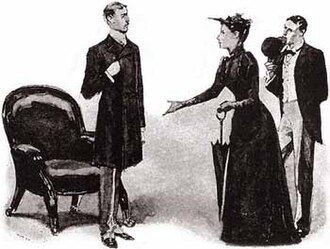
Illustration: Sidney Paget, public domain, via Wikimedia Commons
At the sight of the newcomers our client had sprung from his seat and stood very straight, eyes cast down, hand thrust into the breast of his frock-coat: a portrait of offended dignity. The lady had taken a quick step forward and held out her hand to him, but he still refused to raise his eyes. Perhaps that was as well for his resolve, for her pleading face was hard to resist.
“You’re angry, Robert,” she said. “Well, I guess you have every cause to be.”
“Please, make no apology to me,” said Lord St. Simon bitterly.
“Oh, yes, I know I’ve treated you real bad and that I should have spoken to you before I went, but I was kind of rattled, and from the time I saw Frank here again I just didn’t know what I was doing or saying. I only wonder I didn’t fall down and faint right there in front of the altar.”
“Perhaps, Mrs. Moulton, you’d like my friend and me to leave the room while you explain?”
“If I may give an opinion,” said the strange gentleman, “we’ve had just a little too much secrecy in this business already. For my part, I’d like all Europe and America to hear the rights of it.” He was a small, wiry, sunburned man, clean-shaven, with a sharp face and an alert manner.
“Then I’ll tell our story right away,” said the lady. “Frank here and I met in ’84, in McQuire’s camp, near the Rockies, where Pa was working a claim. We were engaged, Frank and I. But then one day Pa struck a rich pocket and made a pile, while poor Frank’s claim petered out to nothing. The richer Pa grew, the poorer Frank was, so at last Pa wouldn’t hear of our engagement going on any longer, and he took me away to ’Frisco. Frank wouldn’t throw up his hand, though. He followed me there, and he saw me without Pa knowing anything about it. It would only have made Pa mad to know, so we just fixed it all up for ourselves. Frank said he would go and make his pile too, and never come back to claim me until he had as much as Pa. So I promised to wait for him to the end of time, and pledged myself not to marry anyone else while he lived. ‘Why shouldn’t we be married right away, then,’ he said, ‘and then I’ll feel sure of you, and I won’t claim to be your husband until I come back?’ Well, we talked it over, and he’d fixed it all up so nicely, with a clergyman all ready and waiting, that we just did it right there. Then Frank went off to seek his fortune, and I went back to Pa.
“The next I heard of Frank, he was in Montana, and then he went prospecting in Arizona, and then I heard of him from New Mexico. After that came a long newspaper story about a miners’ camp being attacked by Apaches—the camps were pushing into Apache country then—and there was my Frank’s name among the killed. I fainted dead away, and I was very sick for months after. Pa thought I was in a decline and took me to half the doctors in ’Frisco. Not a word of news came for a year and more, so I never doubted Frank was really dead. Then Lord St. Simon came to ’Frisco, and we came to London, and a marriage was arranged, and Pa was very pleased. But I felt all the time that no man on this earth would ever take the place in my heart that I’d given to my poor Frank.
“Still, if I had married Lord St. Simon, of course I’d have done my duty by him. We can’t command our love, but we can our actions. I went to the altar meaning to make him just as good a wife as was in me. But you can imagine what I felt when, just as I came to the altar rails, I glanced back and saw Frank standing in the first pew, looking at me. I thought it was his ghost at first. But when I looked again, there he still was, with a kind of question in his eyes, as if asking whether I was glad or sorry to see him. I wonder I didn’t drop. Everything was turning round, and the clergyman’s words were like the buzz of a bee in my ear. I didn’t know what to do. Should I stop the service and make a scene in the church? I glanced at him again, and he seemed to know what I was thinking, for he raised his finger to his lips to tell me to be still. Then I saw him scribble on a piece of paper, and I knew he was writing me a note. As I passed his pew on the way out, I dropped my bouquet over to him, and he slipped the note into my hand when he gave me back the flowers. It was only a line asking me to join him when he made the sign. Of course I never doubted for a moment that my first duty was now to him, and I made up my mind to do whatever he said.
“When I got back, I told my maid, who had known him in California and had always been his friend. I told her to say nothing, but to get a few things packed and my ulster ready. I know I ought to have spoken to Lord St. Simon, but it was dreadful hard in front of his mother and all those great people. I just made up my mind to run away and explain afterward. I hadn’t been at the table ten minutes before I saw Frank out of the window, on the other side of the road. He beckoned to me and then started walking into the Park. I slipped out, put on my things, and followed him. Some woman came up talking something or other about Lord St. Simon—it seemed to me, from the little I heard, as if he’d had a little secret of his own before marriage too—but I managed to get away from her and soon caught up with Frank. We got into a cab together and drove off to some lodgings he’d taken in Gordon Square, and that was my true wedding after all those years of waiting. Frank had been a prisoner among the Apaches, had escaped, came on to ’Frisco, found I’d given him up for dead and gone to England, followed me here, and found me at last on the very morning of my second wedding.”
“I saw it in a paper,” the American explained. “It gave the name and the church, but not where the lady lived.”

Illustration: Sidney Paget, public domain, via Wikimedia Commons
“Then we talked over what we should do, and Frank was all for being open, but I was so ashamed of it all that I felt I’d like to vanish and never see any of them again—just sending a line to Pa, perhaps, to show him I was alive. It was awful to think of all those lords and ladies sitting round that breakfast-table waiting for me to come back. So Frank took my wedding clothes and things and made a bundle of them, so I couldn’t be traced, and dropped them somewhere no one would find them. Most likely we’d have gone on to Paris tomorrow, only this good gentleman, Mr. Holmes, came round to us this evening—though how he found us is more than I can think—and he showed us very clearly and kindly that I was wrong and Frank was right, and that we’d be putting ourselves in the wrong if we stayed so secret. Then he offered us a chance of talking to Lord St. Simon alone, and so we came straight round to his rooms. Now, Robert, you’ve heard it all, and I’m very sorry if I’ve given you pain, and I hope you don’t think very meanly of me.”
Lord St. Simon had not relaxed his rigid pose in the least, but had listened to this long story with a frowning brow and a tight-pressed lip.
“Excuse me,” he said, “but it is not my custom to discuss my most intimate personal affairs in this public manner.”
“Then you won’t forgive me? You won’t shake hands before I go?”
“Oh, certainly, if it would give you any pleasure.” He put out his hand and coldly took the one she offered.
“I had hoped,” said Holmes, “that you would join us in a friendly supper.”
“I think there you ask a little too much,” replied his lordship. “I may be forced to accept these recent developments, but I can hardly be expected to make merry over them. With your permission, I will now wish you all a very good night.” He included us all in one sweeping bow and stalked out of the room.
“Then I trust that you, at least, will honor me with your company,” said Sherlock Holmes. “It is always a joy to meet an American, Mr. Moulton, for I am one of those who believe that the folly of a monarch and the blundering of a minister in far-gone years will not prevent our children from being some day citizens of the same world-wide country under a flag which shall be a quartering of the Union Jack with the Stars and Stripes.”
“The case has been an interesting one,” Holmes remarked when our visitors had left us, “because it shows very clearly how simple the explanation of an affair may be that at first sight seems almost inexplicable. Nothing could be more natural than the sequence of events as this lady told it, and nothing stranger than the result when viewed, for instance, by Mr. Lestrade of Scotland Yard.”
“You weren’t at fault at all yourself, then?”
“From the first, two facts were very obvious to me: one, that the lady had been quite willing to go through the wedding ceremony; the other, that she had regretted it within a few minutes of getting home. Obviously, then, something had happened during the morning to change her mind. What could that be? She couldn’t have spoken to anyone while she was out, for she had been with the bridegroom the whole time. Had she seen someone, then? If so, it must have been someone from America, because she had been in this country so short a time that she could hardly have let anyone gain so deep an influence over her that the mere sight of him would make her change her plans completely. You see, we’ve already arrived, by a process of exclusion, at the idea that she might have seen an American. Then who could this American be, and why should he have so much influence over her? It might be a lover; it might be a husband. Her young womanhood, I knew, had been spent in rough places and under strange conditions. I had got that far before I ever heard Lord St. Simon’s story. When he told us of a man in a pew, of the change in the bride’s manner, of so transparent a trick for getting a note as dropping a bouquet, of her turning to her confidential maid, and of her very significant mention of claim-jumping—which in miners’ talk means taking possession of something another person has a prior claim to—the whole situation became absolutely clear. She had gone off with a man, and the man was either a lover or a previous husband, the odds being on the latter.”
It was, I saw, a kind of sieve. Each fact shook out a whole family of possibilities, and what stayed in the mesh at the end had to be the truth.
“And how in the world did you find them?”
“It might have been difficult, but friend Lestrade held information in his hands whose value he didn’t know himself. The initials were of course of the highest importance, but more valuable still was knowing that within the week this man had settled his bill at one of the most select hotels in London.”
“How did you deduce the select?”
“By the select prices. Eight shillings for a bed and eightpence for a glass of sherry pointed to one of the most expensive hotels. There aren’t many in London that charge at that rate. At the second one I visited, in Northumberland Avenue, I learned from the register that Francis H. Moulton, an American gentleman, had left only the day before, and when I looked over the charges against him, I found the very items I had seen on the duplicate bill. His letters were to be forwarded to 226 Gordon Square, so there I went, and being lucky enough to find the loving couple at home, I ventured to give them some fatherly advice and to point out that it would be better in every way to make their position a little clearer, both to the general public and to Lord St. Simon in particular. I invited them to meet him here, and, as you see, I made him keep the appointment.”
The arithmetic was its own kind of fingerprint. A decent lodging might be had for a shilling or two a night, and a pub would pour sherry for a few pence; a man paying eight shillings for his bed was paying for marble and a liveried porter, and only a handful of buildings in London could have given him either.
“But with no very good result,” I said. “His conduct was certainly not very gracious.”
“Ah, Watson,” said Holmes, smiling, “perhaps you wouldn’t be very gracious either if, after all the trouble of wooing and wedding, you found yourself robbed in an instant of wife and fortune. I think we may judge Lord St. Simon very mercifully and thank our stars that we are never likely to find ourselves in the same position. Draw your chair up and hand me my violin, for the only problem we still have to solve is how to while away these bleak autumn evenings.”