The Adventure of the Blue Carbuncle
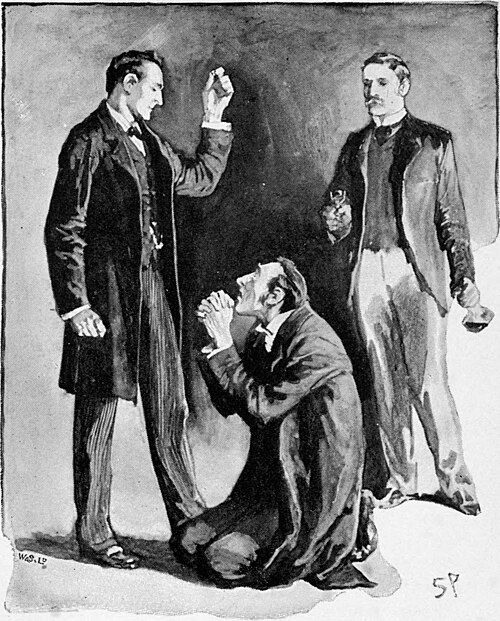
Illustration: Sidney Paget, public domain, via Wikimedia Commons
I called on my friend Sherlock Holmes on the second morning after Christmas to wish him the compliments of the season. He was lounging on the sofa in a purple dressing gown, a pipe rack within reach on his right and a pile of crumpled morning papers, clearly just read, close at hand. Beside the couch stood a wooden chair, and on the corner of its back hung a very shabby hard felt hat, much the worse for wear and cracked in several places. A magnifying lens and a pair of forceps lay on the seat, so the hat had obviously been hung there to be examined.
“You’re busy,” I said. “Perhaps I’m interrupting.”
“Not at all. I’m glad to have a friend I can talk my results over with. The matter is perfectly trivial”—he jerked his thumb at the old hat—“but some points about it are not entirely without interest, and even a little instruction.”
I settled into his armchair and warmed my hands at the crackling fire. A sharp frost had set in, and the windows were thick with ice crystals: the damp of the warm room meeting cold glass and freezing straight into feathery ferns, skipping the water stage entirely. “I suppose,” I said, “that homely as it looks, this thing has some deadly story attached to it. It’s the clue that will lead you to solve some mystery and punish some crime.”
“No, no. No crime,” said Sherlock Holmes, laughing. “Only one of those whimsical little incidents that will happen when you have four million human beings all jostling each other within a few square miles. In so dense a swarm of humanity, every possible combination of events can be expected, and plenty of little problems turn up that are striking and bizarre without being criminal. We’ve had some experience of those already.”
“So much,” I said, “that of the last six cases I’ve added to my notes, three involved no legal crime at all.”
“Exactly. You mean my attempt to recover the Irene Adler papers, the curious case of Miss Mary Sutherland, and the adventure of the man with the twisted lip. Well, I have no doubt this small matter will fall into the same innocent category. You know Peterson, the commissionaire?”
Peterson was a uniformed porter and messenger, the sort of reliable man who stands at a door and runs errands for a fee. “Yes.”
“This trophy belongs to him.”
“It’s his hat.”
“No, no, he found it. The owner is unknown. Please look at it not as a battered bowler but as an intellectual problem. First, how it got here. It arrived on Christmas morning together with a good fat goose, which is, I have no doubt, roasting in front of Peterson’s fire at this moment. Here are the facts. Around four o’clock on Christmas morning, Peterson, who as you know is a thoroughly honest fellow, was walking home from some small celebration down Tottenham Court Road. Ahead of him in the gaslight he saw a tallish man, walking with a slight stagger and carrying a white goose over his shoulder. At the corner of Goodge Street a fight broke out between this stranger and a little knot of roughs. One of them knocked the man’s hat off. He raised his stick to defend himself, swung it over his head, and smashed the shop window behind him. Peterson rushed forward to protect him, but the man, shocked at breaking the window and seeing an official-looking person in uniform charging toward him, dropped his goose, took to his heels, and vanished into the maze of little streets behind Tottenham Court Road. The roughs had fled too at the sight of Peterson, so he was left holding the field of battle, along with the spoils of victory: this battered hat and a most respectable Christmas goose.”
“Which he surely returned to their owner?”
“My dear fellow, that’s the problem. True, ‘For Mrs. Henry Baker’ was printed on a small card tied to the bird’s left leg, and true, the initials ‘H. B.’ can be read on the lining of this hat. But there are some thousands of Bakers, and some hundreds of Henry Bakers, in this city of ours. It isn’t easy to return lost property to any one of them.”
“So what did Peterson do?”
“He brought both hat and goose to me on Christmas morning, knowing that even the smallest problems interest me. We kept the goose until this morning, when there were signs that, frost or no frost, it had better be eaten without delay. So its finder has carried it off to fulfill the ultimate destiny of a goose, while I keep the hat of the unknown gentleman who lost his Christmas dinner.”
“Didn’t he advertise?”
“No.”
“Then what clue could you have to who he is?”
“Only as much as we can deduce.”
“From his hat?”
“Precisely.”
“You’re joking. What can you get from this old battered felt?”
“Here’s my lens. You know my methods. What can you tell for yourself about the man who wore this thing?”
I took the tattered object and turned it over rather ruefully. It was a very ordinary black hat of the usual round shape, hard and well worn. The lining had been red silk but was badly discolored. There was no maker’s name, but, as Holmes had said, the initials “H. B.” were scrawled on one side. The brim was pierced for a hat-securer, a little cord that clips to the coat to keep the hat from blowing away, but the elastic was missing. Otherwise it was cracked, extremely dusty, and spotted in several places, though someone had tried to hide the stained patches by smearing ink over them.
“I can see nothing,” I said, handing it back.
“On the contrary, Watson, you can see everything. You fail, however, to reason from what you see. You’re too timid in drawing your inferences.”
“Then tell me, please, what you can infer from this hat.”
He picked it up and gazed at it in that peculiar inward-looking way of his. “It’s perhaps less suggestive than it might have been,” he said, “and yet a few inferences are very distinct, and a few others are at least a strong balance of probability. That the man was highly intellectual is of course obvious at a glance, and also that he was fairly well-off within the last three years, though he has now fallen on hard times. He had foresight, but has less now than he did, which points to a moral decline. Taken with the decline in his fortunes, that suggests some bad influence at work on him, probably drink. That may also explain the obvious fact that his wife has stopped loving him.”
“My dear Holmes!”
“He has, however, kept some degree of self-respect,” he went on, ignoring my protest. “He leads a sedentary life, goes out little, is completely out of condition, is middle-aged, and has grizzled hair that he had cut within the last few days and that he slicks with lime-cream. Those are the more obvious facts to be deduced from his hat. Also, by the way, it is extremely unlikely that he has gas laid on in his house.”
“You’re certainly joking, Holmes.”
“Not in the least. Is it possible that even now, when I give you the results, you can’t see how they were reached?”
“No doubt I’m very stupid, but I have to admit I can’t follow you. For example, how did you deduce that this man was intellectual?”
For an answer Holmes clapped the hat on his head. It came right down over his forehead and settled on the bridge of his nose. “It’s a question of cubic capacity,” he said. “A man with so large a brain must have something in it.”
I let that one pass. Head size, I suspected as a medical man, tells you more about a man’s hatter than his intellect, but I had a feeling the rest of his chain was stronger.
“The decline in his fortunes, then?”
“This hat is three years old. These flat brims curled at the edge came in then. It’s a hat of the very best quality. Look at the band of ribbed silk and the excellent lining. If this man could afford so expensive a hat three years ago and has had no hat since, then he has certainly gone down in the world.”
“Well, that’s clear enough. But what about the foresight and the moral decline?”
Sherlock Holmes laughed. “Here’s the foresight,” he said, putting his finger on the little disc and loop of the hat-securer. “They’re never sold on hats. If this man ordered one, that shows a certain foresight, since he went out of his way to guard against the wind. But he has broken the elastic and not bothered to replace it, so he obviously has less foresight now than before, which is clear proof of a weakening character. On the other hand, he has tried to hide some of these stains on the felt by dabbing them with ink, a sign that he hasn’t lost his self-respect entirely.”
“Your reasoning is certainly plausible.”
“The further points, that he’s middle-aged, that his hair is grizzled, that it was cut recently, and that he uses lime-cream, all come from a close look at the lower part of the lining. The lens shows a large number of hair ends, cut clean by a barber’s scissors. They’re all sticky, and there’s a distinct smell of lime-cream. This dust, you’ll notice, isn’t the gritty gray dust of the street but the fluffy brown dust of the house, so the hat has hung indoors most of the time. And the marks of moisture inside are proof positive that the wearer sweated very freely, and so could hardly be in the best of condition.”
I saw it then, and it pleased me. Street dust is ground-up road: stone, grit, dried mud, heavy mineral bits that settle hard. House dust is soft stuff, much of it fiber, lint shed from carpets, wool and clothing, so it gathers soft and brown, like felt. The kind of dust tells you where the hat has been sitting.
“But his wife. You said she had stopped loving him.”
“This hat hasn’t been brushed for weeks. When I see you, my dear Watson, with a week’s dust piled on your hat, and your wife letting you go out like that, I shall fear that you too have had the misfortune to lose your wife’s affection.”
“But he might be a bachelor.”
“No, he was bringing the goose home as a peace offering to his wife. Remember the card on the bird’s leg.”
“You have an answer for everything. But how on earth do you deduce that he has no gas in his house?”
“One tallow stain, or even two, might come by chance. But when I see no fewer than five, there can be little doubt that this man is often in close contact with burning tallow. He probably walks upstairs at night with his hat in one hand and a guttering candle in the other. Anyway, he never got tallow stains from a gas jet. Are you satisfied?”
That one was simple chemistry once said aloud. A tallow candle is made of animal fat, which melts at a low temperature; when the flame flickers, a pool of liquid fat spills over the rim and drips, then sets again as a waxy spot on whatever is underneath. A gas jet burns a vapor. It has nothing to melt and nothing to drip.
“Well, it’s very ingenious,” I said, laughing. “But since, as you said, no crime has been committed, and no harm done except the loss of a goose, all this seems a bit of a waste of energy.”
Sherlock Holmes had opened his mouth to reply when the door flew open and Peterson, the commissionaire, rushed into the room with flushed cheeks and the face of a man dazed with astonishment.
“The goose, Mr. Holmes! The goose, sir!” he gasped.

Illustration: Sidney Paget, public domain, via Wikimedia Commons
“Eh? What about it? Has it come back to life and flapped off through the kitchen window?” Holmes twisted round on the sofa to get a better look at the man’s excited face.
“Look here, sir! Look what my wife found in its crop!” He held out his hand. In the center of his palm lay a brilliantly sparkling blue stone, a little smaller than a bean, but of such purity and radiance that it twinkled like an electric light in the dark hollow of his hand.
The crop, I should explain, is a pouch in a bird’s throat (in a goose, strictly just a stretchy widening of the gullet) where swallowed food waits before going on to be ground up. Anything small enough to be gulped down can sit there, quite safe, until the cook finds it.
Sherlock Holmes sat up with a whistle. “By Jove, Peterson!” he said. “This is treasure trove indeed. I suppose you know what you’ve got?”
“A diamond, sir? A precious stone. It cuts into glass as if it were putty.”
“It’s more than a precious stone. It is *the* precious stone.”
“Not the Countess of Morcar’s blue carbuncle!” I exclaimed.
“Exactly that. I ought to know its size and shape, since I’ve read the advertisement about it in *The Times* every day lately. It is absolutely unique and its value can only be guessed at, but the reward of £1,000 is certainly not a twentieth of the market price.”
“A thousand pounds! Great Lord of mercy!” The commissionaire plumped down into a chair and stared from one of us to the other. I didn’t blame him. A thousand pounds was more than a man in his position might earn in twenty years.
“That’s the reward, and I have reason to know there are sentimental considerations in the background that would make the Countess part with half her fortune to get the gem back.”
“It was lost, if I remember rightly, at the Hotel Cosmopolitan,” I said.
“Exactly, on December 22nd, just five days ago. John Horner, a plumber, was accused of taking it from the lady’s jewel-case. The evidence against him was so strong that the case has been sent up to the Assizes,” the higher criminal court. “I have an account of it here, I think.” He rummaged through his newspapers, checking the dates, until at last he smoothed one out, folded it over, and read the following paragraph:
“Hotel Cosmopolitan Jewel Robbery. John Horner, 26, plumber, was brought up on the charge of having, on the 22nd of this month, taken from the jewel-case of the Countess of Morcar the valuable gem known as the blue carbuncle. James Ryder, upper-attendant at the hotel, testified that he had shown Horner up to the Countess of Morcar’s dressing room on the day of the robbery so that he could solder the second bar of the grate, which was loose. He had stayed with Horner for some time but was finally called away. On his return, he found that Horner had gone, that the bureau had been forced open, and that the small leather casket in which, as it later turned out, the Countess kept her jewel was lying empty on the dressing table. Ryder at once raised the alarm, and Horner was arrested the same evening; but the stone could not be found on him or in his rooms. Catherine Cusack, maid to the Countess, testified that she heard Ryder’s cry of dismay on discovering the robbery and rushed into the room, where she found things as the last witness described. Inspector Bradstreet, B Division, gave evidence of the arrest of Horner, who struggled frantically and protested his innocence in the strongest terms. Evidence of a previous conviction for robbery having been given against the prisoner, the magistrate refused to deal with the case himself and referred it to the Assizes. Horner, who had shown signs of intense emotion throughout, fainted at the close and was carried out of court.”
“Hm! So much for the police court,” said Holmes thoughtfully, tossing the paper aside. “The question for us now is the chain of events running from a rifled jewel-case at one end to the crop of a goose in Tottenham Court Road at the other. You see, Watson, our little deductions have suddenly become much more important and much less innocent. Here’s the stone. The stone came from the goose, and the goose came from Mr. Henry Baker, the gentleman with the bad hat and all the other features I’ve bored you with. So now we must set about finding this gentleman in earnest and learning what part he has played in this little mystery. We’ll try the simplest means first, and those are undoubtedly an advertisement in all the evening papers. If that fails, I’ll turn to other methods.”
“What will you say?”
“Give me a pencil and that slip of paper. Now: ‘Found at the corner of Goodge Street, a goose and a black felt hat. Mr. Henry Baker can have the same by applying at 6:30 this evening at 221B, Baker Street.’ Clear and concise.”
“Very. But will he see it?”
“Oh, he’s sure to watch the papers, since for a poor man the loss was a heavy one. He was so scared by breaking the window and by Peterson charging at him that he thought of nothing but running, but he must have bitterly regretted dropping his bird ever since. Besides, his name in print will make him see it, because everyone who knows him will point it out. Here you are, Peterson. Run down to the advertising agency and have this put in the evening papers.”
“Which ones, sir?”
“Oh, the *Globe*, *Star*, *Pall Mall*, *St. James’s Gazette*, *Evening News*, *Standard*, *Echo*, and any others that occur to you.”
“Very well, sir. And this stone?”
“Ah, yes, I’ll keep the stone. Thank you. And, Peterson, buy a goose on your way back and leave it here with me. We need one to give this gentleman in place of the one your family is now devouring.”

Illustration: Sidney Paget, public domain, via Wikimedia Commons
When the commissionaire had gone, Holmes picked up the stone and held it to the light. “It’s a bonny thing,” he said. “Just see how it glints and sparkles. Of course, it’s a nucleus and focus of crime. Every good stone is. They’re the devil’s pet baits. In the larger and older jewels every facet may stand for a bloody deed. This stone isn’t yet twenty years old. It was found on the banks of the Amoy River in southern China, and it’s remarkable for having every characteristic of the carbuncle except that it’s blue instead of ruby red. Young as it is, it already has a sinister history. Two murders, an acid-throwing, a suicide, and several robberies, all for the sake of this forty-grain weight of crystallized charcoal. Who would think so pretty a toy would supply the gallows and the prison? I’ll lock it in my strongbox now and drop the Countess a line to say we have it.”
Crystallized charcoal, I thought, was a nice way to put it. Soot and diamond are the same element, carbon, and the whole difference is how the atoms are stacked: loosely in charcoal, which crumbles in your fingers, and locked into a rigid lattice in diamond. A carbuncle, though, is a garnet, not carbon at all; it scratched glass like putty simply because it is harder. The hardest stones win any scratching contest against anything softer, and window glass is a good deal softer.
“Do you think this man Horner is innocent?”
“I can’t tell.”
“Well, then, do you imagine this other man, Henry Baker, had anything to do with it?”
“I think it far more likely that Henry Baker is an absolutely innocent man, who had no idea that the bird he was carrying was worth a great deal more than if it had been made of solid gold. But I’ll settle that with a very simple test if we get an answer to our advertisement.”
“And until then you can do nothing?”
“Nothing.”
“In that case I’ll go on with my rounds. But I’ll come back this evening at the hour you named. I’d like to see the answer to so tangled a business.”
“Very glad to see you. I dine at seven. There’s a woodcock, I believe. By the way, given recent events, perhaps I should ask Mrs. Hudson to examine its crop.”
I was held up by a case, and it was a little after half past six when I reached Baker Street again. As I came up to the house I saw a tall man in a Scotch bonnet, with his coat buttoned to the chin, waiting outside in the bright half-circle of light thrown by the fanlight over the door. Just as I arrived, the door opened, and we were shown up together to Holmes’s room.
“Mr. Henry Baker, I believe,” said Holmes, rising from his armchair and greeting his visitor with the easy friendliness he could put on so readily. “Please, take this chair by the fire, Mr. Baker. It’s a cold night, and I see your circulation is better suited to summer than to winter. Ah, Watson, you’ve come at just the right time. Is that your hat, Mr. Baker?”
“Yes, sir, that is undoubtedly my hat.”
He was a large man with rounded shoulders, a massive head, and a broad, intelligent face that tapered to a pointed beard of grizzled brown. A touch of red in his nose and cheeks, and a slight tremor in his outstretched hand, reminded me of Holmes’s guess about his habits. His rusty black frock coat was buttoned right up, with the collar turned up, and his thin wrists stuck out of his sleeves without a sign of cuff or shirt. He spoke slowly, in short bursts, choosing his words with care, and gave the general impression of a man of learning and letters who had been treated badly by fortune.
“We’ve kept these things for some days,” said Holmes, “because we expected to see an advertisement from you giving your address. I’m at a loss to know why you didn’t advertise.”
Our visitor gave a rather shamefaced laugh. “Shillings haven’t been as plentiful with me as they once were,” he said. “I had no doubt the gang of roughs who attacked me had carried off both my hat and the bird. I didn’t care to spend more money on a hopeless attempt to get them back.”
“Very natural. By the way, about the bird, we were forced to eat it.”
“To eat it!” Our visitor half rose from his chair in his excitement.
“Yes, it would have been no use to anyone if we hadn’t. But I take it this other goose on the sideboard, which is about the same weight and perfectly fresh, will serve your purpose just as well?”
“Oh, certainly, certainly,” said Mr. Baker with a sigh of relief.
“Of course, we still have the feathers, legs, crop, and so on of your own bird, so if you wish—”
The man burst into a hearty laugh. “They might be useful as relics of my adventure,” he said, “but beyond that I can hardly see what use the scattered remains of my late acquaintance would be to me. No, sir, with your permission I’ll confine my attention to the excellent bird I see on the sideboard.”
Sherlock Holmes shot me a sharp glance with a slight shrug. That was the test, and Mr. Baker had passed it. A man who knew what had been in that crop would have begged for it.
“There’s your hat, then, and there’s your bird,” said Holmes. “By the way, would it bore you to tell me where you got the other one? I’m something of a fowl fancier, and I’ve seldom seen a better-grown goose.”

Illustration: Sidney Paget, public domain, via Wikimedia Commons
“Certainly, sir,” said Baker, who had risen and tucked his newly won property under his arm. “A few of us frequent the Alpha Inn, near the Museum. We’re to be found in the Museum itself during the day, you understand. This year our good host, Windigate by name, started a goose club: for a few pence every week, we were each to receive a bird at Christmas. My pence were duly paid, and you know the rest. I’m much obliged to you, sir, for a Scotch bonnet suits neither my years nor my dignity.” With comical pomposity he bowed solemnly to us both and strode off on his way.
“So much for Mr. Henry Baker,” said Holmes when he had shut the door behind him. “It’s quite certain he knows nothing whatever about the matter. Are you hungry, Watson?”
“Not particularly.”
“Then I suggest we turn our dinner into a supper and follow up this clue while it’s still hot.”
“By all means.”
It was a bitter night, so we pulled on our heavy overcoats and wrapped scarves round our throats. Outside, the stars shone coldly in a cloudless sky, and the breath of passersby puffed out like the smoke of so many pistol shots: warm, damp air from the lungs hitting the frost and condensing at once into tiny droplets, a little cloud made fresh with every word. Our footsteps rang out crisp and loud as we swung through the doctors’ quarter, Wimpole Street, Harley Street, and on through Wigmore Street into Oxford Street. In a quarter of an hour we were in Bloomsbury at the Alpha Inn, a small pub on the corner of one of the streets that run down into Holborn. Holmes pushed open the door of the private bar and ordered two glasses of beer from the ruddy-faced, white-aproned landlord.
“Your beer should be excellent if it’s as good as your geese,” he said.
“My geese!” The man seemed surprised.
“Yes. I was talking only half an hour ago to Mr. Henry Baker, who was a member of your goose club.”
“Ah! Yes, I see. But you see, sir, them’s not *our* geese.”
“Really! Whose, then?”
“Well, I got the two dozen from a salesman in Covent Garden.”
“Really? I know some of them. Which one?”
“Breckinridge is his name.”
“Ah! I don’t know him. Well, here’s to your good health, landlord, and prosperity to your house. Good night.”
“Now for Mr. Breckinridge,” he went on, buttoning his coat as we stepped out into the frosty air. “Remember, Watson, that though we have so homely a thing as a goose at one end of this chain, at the other we have a man who will certainly get seven years’ penal servitude unless we can prove him innocent. Our inquiry may only confirm his guilt. But either way, we have a line of investigation the police have missed, and that an odd chance has put in our hands. Let’s follow it to the bitter end. Faces to the south, then, and quick march!”
We crossed Holborn, went down Endell Street, and zigzagged through the slums to Covent Garden Market. One of the largest stalls bore the name Breckinridge, and the owner, a horsey-looking man with a sharp face and neat side-whiskers, was helping a boy put up the shutters.
“Good evening. It’s a cold night,” said Holmes.
The salesman nodded and shot my companion a questioning look.
“Sold out of geese, I see,” Holmes went on, pointing at the bare marble slabs.
“Let you have five hundred tomorrow morning.”
“That’s no good.”
“Well, there are some on the stall with the gas flare.”
“Ah, but I was recommended to you.”
“Who by?”
“The landlord of the Alpha.”
“Oh, yes. I sent him a couple of dozen.”
“Fine birds they were, too. Now where did you get them?”
To my surprise, the question set off a burst of anger.
“Now, then, mister,” said the salesman, head cocked and hands on hips, “what are you driving at? Let’s have it straight.”
“It’s straight enough. I’d like to know who sold you the geese you supplied to the Alpha.”
“Well, then, I shan’t tell you. So there!”
“Oh, it’s of no importance. But I don’t see why you should get so warm over such a trifle.”
“Warm! You’d be warm too, maybe, if you were pestered like I am. When I pay good money for a good article, that ought to be the end of it. But it’s ‘Where are the geese?’ and ‘Who did you sell the geese to?’ and ‘What will you take for the geese?’ You’d think they were the only geese in the world, the fuss that’s made over them.”
“Well, I have nothing to do with anyone else who’s been asking,” said Holmes carelessly. “If you won’t tell us, the bet’s off, that’s all. But I’m always ready to back my opinion on a matter of fowls, and I have a fiver on it that the bird I ate was country-bred.”
“Well, then, you’ve lost your fiver, because it’s town-bred,” snapped the salesman.
“It’s nothing of the kind.”
“I say it is.”
“I don’t believe it.”
“D’you think you know more about fowls than I do, who’ve handled them since I was a nipper? I tell you, all those birds that went to the Alpha were town-bred.”
“You’ll never persuade me of that.”
“Will you bet, then?”
“It’s just taking your money, since I know I’m right. But I’ll put a sovereign on it with you, just to teach you not to be stubborn.”
A sovereign was a gold coin worth a pound. The salesman chuckled grimly. “Bring me the books, Bill,” he said.
The boy brought over a small thin volume and a great greasy-backed one and laid them out together under the hanging lamp.
“Now then, Mr. Cocksure,” said the salesman, “I thought I was out of geese, but before I’m done you’ll find there’s still one left in my shop. See this little book?”
“Well?”

Illustration: Sidney Paget, public domain, via Wikimedia Commons
“That’s the list of the people I buy from. See? Now, on this page are the country folk, and the numbers after their names are where their accounts are in the big ledger. Now then! See this other page in red ink? That’s a list of my town suppliers. Look at that third name. Just read it out to me.”
“Mrs. Oakshott, 117, Brixton Road—249,” read Holmes.
“Right. Now turn that up in the ledger.”
Holmes turned to the page. “Here you are: ‘Mrs. Oakshott, 117, Brixton Road, egg and poultry supplier.’”
“Now then, what’s the last entry?”
“‘December 22nd. Twenty-four geese at 7*s*. 6*d*.’”
Seven shillings and sixpence a bird, I noted.
“Right. There you are. And underneath?”
“‘Sold to Mr. Windigate of the Alpha, at 12*s*.’”
“What do you say now?”
Sherlock Holmes looked deeply chagrined. He took a sovereign from his pocket, threw it down on the slab, and turned away with the air of a man too disgusted for words. A few yards off he stopped under a lamppost and laughed in the hearty, silent way that was all his own.
“When you see a man with whiskers of that cut and the ‘Pink ’Un’ sticking out of his pocket, you can always draw him with a bet,” he said. The *Pink ’Un* was the sporting paper, printed on pink sheets and read by every man who liked a flutter on the horses. “I dare say that if I’d put £100 down in front of him, he wouldn’t have given me such complete information as he gave me for the idea of beating me on a wager. Well, Watson, I think we’re nearing the end of our quest. The only question left is whether we go on to this Mrs. Oakshott tonight or save it for tomorrow. It’s clear from what that surly fellow said that others besides us are anxious about the matter, and I should—”
He was cut short by a loud commotion from the stall we had just left. Turning, we saw a little rat-faced fellow standing in the circle of yellow light from the swinging lamp, while Breckinridge, the salesman, framed in the doorway of his stall, shook his fists fiercely at the cringing figure.
“I’ve had enough of you and your geese,” he shouted. “I wish you were all at the devil together. Come pestering me any more with your silly talk and I’ll set the dog on you. You bring Mrs. Oakshott here and I’ll answer her, but what’s it to do with you? Did I buy the geese off you?”
“No, but one of them was mine all the same,” whined the little man.
“Well, then, ask Mrs. Oakshott for it.”
“She told me to ask you.”
“Well, you can ask the King of Proosia, for all I care. I’ve had enough. Get out of here!” He rushed forward, and the questioner fled into the dark.
“Ha! This may save us a trip to Brixton Road,” whispered Holmes. “Come with me, and we’ll see what can be made of this fellow.” Striding through the scattered knots of people loitering round the flaring stalls, my companion quickly caught up with the little man and touched him on the shoulder. He spun round, and in the gaslight I could see that every trace of color had drained from his face.
“Who are you, then? What do you want?” he asked in a shaky voice.
“Excuse me,” said Holmes blandly, “but I couldn’t help overhearing the questions you put to the salesman just now. I think I could be of help to you.”
“You? Who are you? How could you know anything about it?”
“My name is Sherlock Holmes. It is my business to know what other people don’t know.”
“But you can’t know anything about this?”
“Excuse me, I know everything about it. You’re trying to trace some geese that were sold by Mrs. Oakshott, of Brixton Road, to a salesman named Breckinridge, by him in turn to Mr. Windigate, of the Alpha, and by him to his club, of which Mr. Henry Baker is a member.”
“Oh, sir, you’re the very man I’ve longed to meet,” cried the little fellow, holding out his hands with trembling fingers. “I can hardly tell you how interested I am in this.”
Sherlock Holmes hailed a passing four-wheeler, a closed cab. “In that case we’d better discuss it in a cozy room rather than this windswept marketplace,” he said. “But tell me, please, before we go further, who it is I have the pleasure of helping.”
The man hesitated a moment. “My name is John Robinson,” he said, with a sidelong glance.
“No, no, the real name,” said Holmes sweetly. “It’s always awkward doing business with an alias.”
A flush rose in the stranger’s white cheeks. “Well, then,” he said, “my real name is James Ryder.”
“Exactly. Head attendant at the Hotel Cosmopolitan. Please, step into the cab, and I’ll soon be able to tell you everything you’d like to know.”
The little man stood glancing from one of us to the other with half-frightened, half-hopeful eyes, like someone unsure whether he was on the edge of a windfall or a catastrophe. Then he climbed into the cab, and in half an hour we were back in the sitting room at Baker Street. Nothing was said on the drive, but our new companion’s high, thin breathing, and the clasping and unclasping of his hands, told of the strain inside him.
“Here we are!” said Holmes cheerily as we filed in. “The fire looks very seasonable in this weather. You look cold, Mr. Ryder. Please, take the basket chair. I’ll just put on my slippers before we settle this little matter of yours. Now, then! You want to know what became of those geese?”
“Yes, sir.”
“Or rather, I think, of that goose. It was one bird, I imagine, that interested you: white, with a black bar across the tail.”
Ryder shook with emotion. “Oh, sir,” he cried, “can you tell me where it went?”
“It came here.”
“Here?”
“Yes, and a most remarkable bird it turned out to be. I don’t wonder you take an interest in it. It laid an egg after it was dead, the bonniest, brightest little blue egg that was ever seen. I have it here in my museum.”
Our visitor staggered to his feet and clutched the mantelpiece with his right hand. Holmes unlocked his strongbox and held up the blue carbuncle, which shone like a star with a cold, brilliant, many-pointed light. Ryder stood staring with a drawn face, unsure whether to claim it or disown it.
“The game’s up, Ryder,” said Holmes quietly. “Hold up, man, or you’ll be in the fire! Give him an arm back into his chair, Watson. He hasn’t got the blood to commit a felony and get away with it. Give him a dash of brandy. So! Now he looks a little more human. What a shrimp he is, to be sure!”
He had swayed and nearly fallen, but the brandy brought a little color back to his cheeks, and he sat staring with frightened eyes at his accuser.
“I have almost every link in my hands, and all the proof I could need, so there’s little you need to tell me. Still, that little may as well be cleared up to make the case complete. You had heard, Ryder, of this blue stone of the Countess of Morcar’s?”
“It was Catherine Cusack who told me about it,” he said in a cracked voice.
“I see. Her ladyship’s maid. Well, the temptation of sudden wealth so easily won was too much for you, as it has been for better men before you. But you weren’t very particular about your methods. It seems to me, Ryder, that you have the makings of a very pretty villain. You knew this man Horner, the plumber, had been mixed up in something like this before, and that suspicion would fall on him more readily. So what did you do? You arranged some small repair job in my lady’s room, you and your accomplice Cusack, and you made sure he was the man sent for. Then, when he’d left, you rifled the jewel-case, raised the alarm, and had this unfortunate man arrested. You then—”
There it was, laid out like a sum, and every figure had been in the newspaper paragraph all along. Ryder had brought Horner to the room. Ryder had been “called away.” Ryder had found the empty case and given the alarm. Cusack had come running at Ryder’s cry. The only witnesses against Horner were the two people who knew where the stone was going.

Illustration: Sidney Paget, public domain, via Wikimedia Commons
Ryder suddenly threw himself down on the rug and clutched at my companion’s knees. “For God’s sake, have mercy!” he shrieked. “Think of my father! Of my mother! It would break their hearts. I never went wrong before! I never will again. I swear it. I’ll swear it on a Bible. Oh, don’t take it to court! For Christ’s sake, don’t!”
“Get back in your chair!” said Holmes sternly. “It’s all very well to cringe and crawl now, but you thought little enough of this poor Horner in the dock for a crime he knew nothing about.”
“I’ll run, Mr. Holmes. I’ll leave the country, sir. Then the charge against him will fall apart.”
“Hm! We’ll talk about that. And now let’s have a true account of the next act. How did the stone get into the goose, and how did the goose get into the open market? Tell us the truth, for that’s your only hope.”
Ryder ran his tongue over his dry lips. “I’ll tell you just as it happened, sir,” he said. “When Horner had been arrested, it seemed best to get away with the stone at once, because I didn’t know when the police might take it into their heads to search me and my room. There was nowhere in the hotel it would be safe. I went out, as if on some errand, and made for my sister’s house. She had married a man named Oakshott and lived in Brixton Road, where she fattened fowls for the market. All the way there, every man I met seemed to be a policeman or a detective, and cold as the night was, the sweat was pouring down my face before I reached Brixton Road. My sister asked me what was wrong and why I was so pale, but I told her I’d been upset by the jewel robbery at the hotel. Then I went out to the back yard, smoked a pipe, and wondered what to do.
“I once had a friend called Maudsley who went to the bad and has just finished serving his time in Pentonville prison. One day he met me and got talking about the ways of thieves, and how they get rid of what they steal. I knew he’d be true to me, because I knew one or two things about him. So I decided to go straight on to Kilburn, where he lived, and take him into my confidence. He’d show me how to turn the stone into money. But how to get to him safely? I thought of the agony I’d gone through coming from the hotel. At any moment I might be seized and searched, and there would be the stone in my waistcoat pocket. I was leaning against the wall, looking at the geese waddling round my feet, and suddenly I had an idea that showed me how I could beat the best detective who ever lived.
“My sister had told me a few weeks before that I could have the pick of her geese for a Christmas present, and I knew she always kept her word. I’d take my goose now, and in it I’d carry my stone to Kilburn. There was a little shed in the yard, and I drove one of the birds behind it, a fine big one, white, with a barred tail. I caught it, pried its bill open, and pushed the stone down its throat as far as my finger would reach. The bird gave a gulp, and I felt the stone pass down its gullet into its crop. But the creature flapped and struggled, and out came my sister to see what was the matter. As I turned to speak to her, the brute broke loose and fluttered off among the others.
“‘Whatever were you doing with that bird, Jem?’ says she.
“‘Well,’ I said, ‘you said you’d give me one for Christmas, and I was feeling which was the fattest.’
“‘Oh,’ says she, ‘we’ve set yours aside for you. Jem’s bird, we call it. It’s the big white one over there. There’s twenty-six of them, which makes one for you, one for us, and two dozen for the market.’
“‘Thank you, Maggie,’ says I, ‘but if it’s all the same to you, I’d rather have the one I was handling just now.’
“‘The other’s a good three pounds heavier,’ she said, ‘and we fattened it specially for you.’
“‘Never mind. I’ll have the other, and I’ll take it now,’ I said.
“‘Oh, just as you like,’ she said, a little huffy. ‘Which one is it you want, then?’
“‘That white one with the barred tail, right in the middle of the flock.’
“‘Oh, very well. Kill it and take it with you.’
“Well, I did what she said, Mr. Holmes, and I carried the bird all the way to Kilburn. I told my pal what I’d done, because he was a man you could easily tell a thing like that to. He laughed till he choked, and we got a knife and opened the goose. My heart turned to water, because there was no sign of the stone, and I knew some terrible mistake had happened. I left the bird, rushed back to my sister’s, and hurried into the back yard. There wasn’t a bird to be seen.
“‘Where are they all, Maggie?’ I cried.
“‘Gone to the dealer’s, Jem.’
“‘Which dealer’s?’
“‘Breckinridge, of Covent Garden.’
“‘But was there another with a barred tail?’ I asked. ‘The same as the one I chose?’
“‘Yes, Jem, there were two barred-tailed ones, and I could never tell them apart.’
“Well, then of course I saw it all, and I ran as fast as my feet would carry me to this man Breckinridge. But he’d sold the lot at once, and not one word would he tell me about where they’d gone. You heard him yourselves tonight. He’s always answered me like that. My sister thinks I’m going mad. Sometimes I think so myself. And now—and now I’m a branded thief, without ever having touched the wealth I sold my good name for. God help me! God help me!” He burst into convulsive sobs, his face buried in his hands.
There was a long silence, broken only by his heavy breathing and the steady tapping of Sherlock Holmes’s fingertips on the edge of the table. Then my friend rose and threw open the door.
“Get out!” he said.
“What, sir! Oh, Heaven bless you!”
“No more words. Get out!”
And no more words were needed. There was a rush, a clatter on the stairs, the bang of a door, and the crisp rattle of running feet from the street.
“After all, Watson,” said Holmes, reaching for his clay pipe, “I’m not retained by the police to make up for their shortcomings. If Horner were in danger it would be another thing, but this fellow won’t appear against him, and the case must collapse. I suppose I’m compounding a felony, but it’s just possible I’m saving a soul. This fellow won’t go wrong again; he’s far too frightened. Send him to jail now, and you make him a jailbird for life. Besides, it’s the season of forgiveness. Chance has put a most singular and whimsical problem in our way, and its solution is its own reward. If you’ll be so good as to ring the bell, Doctor, we’ll begin another investigation, in which a bird will also be the chief feature.”