The Adventure of the Speckled Band
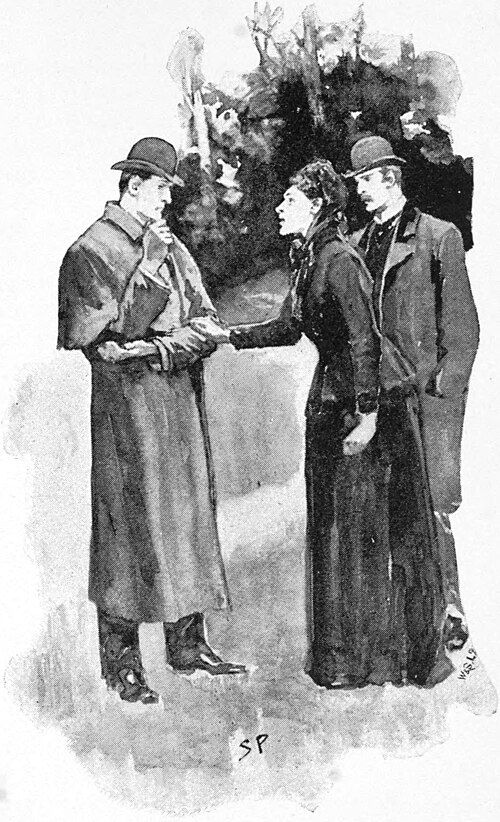
Illustration: Sidney Paget, public domain, via Wikimedia Commons
Looking over my notes on the seventy-odd cases in which I have, over the last eight years, studied the methods of my friend Sherlock Holmes, I find many tragic, some comic, a large number merely strange, but none commonplace. He worked for the love of his art rather than for money, and he refused to touch any investigation that didn’t lean toward the unusual, or even the fantastic. Of all those varied cases, I can’t recall one with more singular features than the one connected with the well-known Surrey family of the Roylotts of Stoke Moran. It happened in the early days of my association with Holmes, when we were sharing rooms as bachelors in Baker Street. I might have put it on record before now, but a promise of secrecy was made at the time, and I was freed from it only last month by the untimely death of the lady to whom I gave it. Perhaps it’s as well that the facts come out now. I have reason to know that there are widespread rumors about the death of Dr. Grimesby Roylott, and they make the matter even more terrible than the truth.
It was early in April of ’83 when I woke one morning to find Sherlock Holmes standing, fully dressed, beside my bed. He was a late riser as a rule, and the clock on the mantelpiece said a quarter past seven, so I blinked up at him in some surprise, and perhaps a little resentment, since I was a man of regular habits myself.
“Very sorry to wake you, Watson,” he said, “but it’s the common lot this morning. Mrs. Hudson was woken, she took it out on me, and now I’m taking it out on you.”
“What is it, then? A fire?”
“No. A client. It seems a young lady has arrived in a considerable state of excitement, and she insists on seeing me. She’s waiting in the sitting-room now. When young ladies wander around London at this hour and drag sleepy people out of bed, I assume they have something very pressing to say. If it turns out to be an interesting case, I’m sure you’d want to follow it from the start. At any rate, I thought I’d give you the chance.”
“My dear fellow, I wouldn’t miss it for anything.”
I had no keener pleasure than following Holmes through his professional investigations and admiring his rapid deductions, quick as intuition yet always built on solid logic, with which he untangled the problems brought to him. I threw on my clothes and in a few minutes was ready to follow him down to the sitting-room. A lady dressed in black and heavily veiled, who had been sitting in the window, rose as we came in.
“Good morning, madam,” said Holmes cheerfully. “My name is Sherlock Holmes. This is my close friend and associate, Dr. Watson. You can speak in front of him as freely as in front of me. Ha! I’m glad to see Mrs. Hudson had the good sense to light the fire. Please, draw up to it, and I’ll order you a cup of hot coffee, because I see you’re shivering.”
“It isn’t the cold that makes me shiver,” the woman said in a low voice, moving her seat as he asked.
“What, then?”
“It’s fear, Mr. Holmes. It’s terror.” She raised her veil as she spoke, and we saw she was truly in a pitiable state. Her face was drawn and gray, and her restless, frightened eyes were like those of a hunted animal. Her face and figure were those of a woman of thirty, but her hair was shot with early gray, and she looked weary and haggard. Sherlock Holmes took her in with one of his quick, all-seeing glances.
“You mustn’t be afraid,” he said gently, leaning forward and patting her forearm. “We’ll soon set things right, I have no doubt. You came in by train this morning, I see.”
“You know me, then?”

Illustration: Sidney Paget, public domain, via Wikimedia Commons
“No, but I see the second half of a return ticket in the palm of your left glove. You must have started early, and yet you had a good drive in a dog-cart, along heavy roads, before you reached the station.”
The lady gave a violent start and stared at my companion in bewilderment.
“There’s no mystery, my dear madam,” he said, smiling. “The left arm of your jacket is spattered with mud in no fewer than seven places. The marks are perfectly fresh. No vehicle but a dog-cart throws up mud like that, and then only when you sit on the left-hand side of the driver.”
I worked it through as she sat there gaping, and it was simple once you saw it. A turning wheel flings mud off its rim in a straight line, the way a stone flies from a released sling, and a dog-cart, a light, high, two-wheeled trap, perches its passengers right beside those wheels. Sit on the left, and the left wheel peppers your left sleeve. As for “fresh,” wet mud is dark and glossy; as the water evaporates it fades to a dull, pale crust. Hers was still dark.
“Whatever your reasons, you’re perfectly right,” she said. “I left home before six, reached Leatherhead at twenty past, and came in on the first train to Waterloo. Sir, I can’t bear this strain any longer. I’ll go mad if it goes on. I have no one to turn to. No one except one man who cares for me, and he, poor fellow, can’t help much. I’ve heard of you, Mr. Holmes. I heard of you from Mrs. Farintosh, whom you helped in her hour of need. She gave me your address. Oh, sir, don’t you think you could help me too, and throw at least a little light into the darkness around me? Right now I can’t pay you for your services, but in a month or six weeks I’ll be married, with control of my own income, and then you won’t find me ungrateful.”
Holmes turned to his desk, unlocked it, and took out a small case-book, which he consulted.
“Farintosh,” he said. “Ah, yes, I remember the case. It concerned an opal tiara. I think it was before your time, Watson. I can only say, madam, that I’ll gladly give your case the same care I gave your friend’s. As to payment, my profession is its own reward. But you’re free to cover whatever expenses I run into, whenever it suits you best. And now, please, tell us everything that might help us form an opinion.”
“Ah!” said our visitor. “The very horror of my situation is that my fears are so vague, and my suspicions rest so entirely on small points that might seem trivial to anyone else. Even the man I have the most right to look to for help and advice treats everything I tell him as the fancies of a nervous woman. He doesn’t say so, but I can read it in his soothing answers and the way he looks away. But I’ve heard, Mr. Holmes, that you can see deep into the wickedness of the human heart. You may be able to tell me how to walk among the dangers around me.”
“I am all attention, madam.”
“My name is Helen Stoner, and I live with my stepfather, who is the last survivor of one of the oldest Saxon families in England, the Roylotts of Stoke Moran, on the western border of Surrey.”
Holmes nodded. “The name is familiar to me,” he said.
“The family was once among the richest in England. Their estates ran over the borders into Berkshire in the north and Hampshire in the west. But in the last century four heirs in a row were wasteful, dissolute men, and a gambler in the days of the Regency finished the family off. Nothing was left but a few acres and the two-hundred-year-old house, and that is buried under a heavy mortgage. The last squire dragged out his life there as an aristocratic pauper. But his only son, my stepfather, saw he would have to adapt. He got an advance from a relative, which let him take a medical degree, and he went out to Calcutta, where his skill and force of character built him a large practice. Then, in a fit of anger over some robberies in his house, he beat his Indian butler to death, and barely escaped being hanged for it. As it was, he served a long prison term, and afterward came back to England a sullen, disappointed man.
“When Dr. Roylott was in India, he married my mother, Mrs. Stoner, the young widow of Major-General Stoner of the Bengal Artillery. My sister Julia and I were twins, only two years old when my mother remarried. She had a considerable fortune, not less than £1,000 a year, and she left it all to Dr. Roylott for as long as we lived with him, with a provision that each of us would be allowed a certain sum every year if we married. Soon after we came back to England, my mother died. She was killed eight years ago in a railway accident near Crewe. Dr. Roylott then gave up trying to set himself up in practice in London and took us to live with him in the old family house at Stoke Moran. My mother’s money was enough for all our needs, and there seemed to be nothing standing in the way of our happiness.
“But a terrible change came over our stepfather around then. Our neighbors had been overjoyed at first to see a Roylott of Stoke Moran back in the old family seat. But instead of making friends and paying visits, he shut himself up in the house and seldom came out except to pick ferocious quarrels with whoever crossed his path. A violent temper close to madness has run in the men of the family, and in my stepfather’s case I believe it was made worse by his long years in the tropics. There was a string of disgraceful brawls, two of which ended in the police court, until he became the terror of the village. People run when they see him coming, because he is a man of immense strength and absolutely uncontrollable when he’s angry.
“Last week he threw the local blacksmith over a bridge wall into a stream, and only by paying over every bit of money I could scrape together did I keep it out of the courts again. He has no friends at all except the wandering gipsies. He lets them camp on the few acres of bramble that are all that’s left of the family estate, and in return he accepts the hospitality of their tents, and sometimes goes off traveling with them for weeks at a time. He also has a passion for Indian animals, which a correspondent sends over to him. Right now he has a cheetah and a baboon, which roam freely over the grounds, and the villagers fear them almost as much as their master.
“You can imagine from all this that my poor sister Julia and I had little pleasure in our lives. No servant would stay with us, and for a long time we did all the work of the house ourselves. She was only thirty when she died, and her hair had already begun to whiten, just as mine has.”
“Your sister is dead, then?”
“She died just two years ago, and it’s her death I want to tell you about. You’ll understand that, living as we did, we hardly ever met anyone our own age and position. But we had an aunt, my mother’s unmarried sister, Miss Honoria Westphail, who lives near Harrow, and now and then we were allowed short visits to her house. Julia went there at Christmas two years ago and met a major of marines on half pay, and they became engaged. My stepfather heard about it when my sister came home and raised no objection. But within two weeks of the wedding day, the terrible thing happened that took my only companion from me.”
Sherlock Holmes had been leaning back in his chair, eyes closed, his head sunk in a cushion. Now he half opened his lids and glanced across at our visitor.
“Please be precise about the details,” he said.
“That’s easy, because every moment of that dreadful time is burned into my memory. As I said, the manor house is very old, and only one wing is lived in now. The bedrooms in this wing are on the ground floor; the sitting-rooms are in the central block. Of the bedrooms, the first is Dr. Roylott’s, the second was my sister’s, and the third is mine. There’s no connection between them, but they all open onto the same corridor. Am I making myself clear?”
“Perfectly.”
“The windows of all three rooms look out on the lawn. That terrible night Dr. Roylott went to his room early, though we knew he hadn’t gone to bed, because my sister was bothered by the smell of the strong Indian cigars he always smokes. So she left her room and came into mine, and sat a while chatting about her wedding. At eleven o’clock she got up to go, but she stopped at the door and looked back.
“‘Tell me, Helen,’ she said, ‘have you ever heard anyone whistle in the dead of night?’
“‘Never,’ I said.
“‘I suppose you couldn’t possibly be whistling yourself, in your sleep?’
“‘Certainly not. Why?’
“‘Because for the last few nights, always around three in the morning, I’ve heard a low, clear whistle. I’m a light sleeper, and it wakes me. I can’t tell where it comes from. Maybe the next room, maybe the lawn. I just thought I’d ask whether you’d heard it.’
“‘No, I haven’t. It must be those wretched gipsies in the plantation.’
“‘Very likely. And yet if it were on the lawn, I wonder you didn’t hear it too.’
“‘Ah, but I sleep more heavily than you.’
“‘Well, it doesn’t matter much, anyway.’ She smiled back at me and closed my door, and a few moments later I heard her key turn in her lock.”
“Indeed,” said Holmes. “Did you always lock yourselves in at night?”
“Always.”
“And why?”
“I think I mentioned that the Doctor keeps a cheetah and a baboon. We didn’t feel safe unless our doors were locked.”
“Quite so. Please go on.”
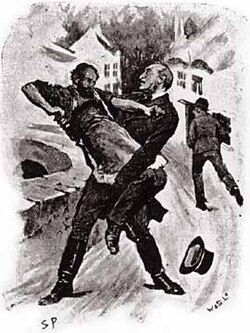
Illustration: Sidney Paget, public domain, via Wikimedia Commons
“I couldn’t sleep that night. I had a vague feeling that something awful was coming. My sister and I were twins, remember, and you know how subtle the links are between two people so close. It was a wild night. The wind was howling, and the rain was beating against the windows. Suddenly, through all the noise of the gale, came the wild scream of a terrified woman. I knew it was my sister’s voice. I jumped out of bed, wrapped a shawl around me, and rushed into the corridor. As I opened my door I thought I heard a low whistle, like the one my sister had described, and a few moments later a clanging sound, as if a heavy piece of metal had fallen. As I ran down the passage, my sister’s door was unlocked, and it swung slowly open on its hinges. I stared at it, horror-stricken, not knowing what was going to come out. By the light of the corridor lamp I saw my sister appear in the doorway, her face white with terror, her hands groping for help, her whole body swaying like a drunkard’s. I ran to her and threw my arms around her, but just then her knees gave way and she fell to the ground. She writhed like someone in terrible pain, and her limbs were dreadfully convulsed. At first I thought she didn’t recognize me, but as I bent over her she suddenly shrieked, in a voice I’ll never forget, ‘Oh, my God! Helen! It was the band! The speckled band!’ There was something else she wanted to say, and she jabbed her finger into the air toward the Doctor’s room, but another convulsion seized her and choked off her words. I rushed out, shouting for my stepfather, and met him hurrying from his room in his dressing-gown. By the time he reached my sister she was unconscious. He poured brandy down her throat and sent to the village for medical help, but it was all in vain. She slowly sank and died without ever coming to. That was the dreadful end of my beloved sister.”
“One moment,” said Holmes. “Are you sure about this whistle and the metallic sound? Could you swear to them?”
“That’s what the county coroner asked me at the inquest. It’s my strong impression that I heard them. And yet, with the crash of the gale and the creaking of an old house, I may have been mistaken.”
“Was your sister dressed?”
“No, she was in her nightgown. In her right hand they found the burned stump of a match, and in her left a matchbox.”
“Showing that she struck a light and looked around her when the alarm came. That’s important. And what did the coroner conclude?”
“He looked into it very carefully, because Dr. Roylott’s conduct had long been notorious in the county, but he couldn’t find any satisfactory cause of death. My evidence showed that her door had been locked from the inside, and the windows were blocked by old-fashioned shutters with broad iron bars, which were fastened every night. The walls were carefully tapped and found to be solid all around, and the floor was examined just as thoroughly, with the same result. The chimney is wide, but it’s barred by four large staples. So it’s certain my sister was completely alone when she died. Besides, there were no marks of violence on her.”
“What about poison?”
“The doctors tested her for it, but found nothing.”
“Then what do you think the poor lady died of?”
“I believe she died of pure fear and nervous shock, though what frightened her I can’t imagine.”
“Were there gipsies in the plantation at the time?”
“Yes. There nearly always are.”
“Ah. And what did you make of her mention of a band, a speckled band?”
“Sometimes I’ve thought it was just the wild talk of delirium. Other times I’ve thought it might mean a band of people, maybe those same gipsies in the plantation. I wonder whether the spotted handkerchiefs so many of them wear over their heads might have put that strange word in her mind.”
Holmes shook his head like a man far from satisfied.
“These are very deep waters,” he said. “Please, go on with your story.”
“Two years have passed since then, and my life has been lonelier than ever, until recently. A month ago a dear friend I’ve known for many years did me the honor of asking me to marry him. His name is Armitage, Percy Armitage, the second son of Mr. Armitage of Crane Water, near Reading. My stepfather hasn’t objected, and we’re to be married this spring. Two days ago some repairs were started in the west wing of the house, and my bedroom wall has been knocked through, so I’ve had to move into the room where my sister died and sleep in the very bed she slept in. So imagine my terror last night when, as I lay awake thinking about her awful fate, I suddenly heard, in the silence of the night, the low whistle that had announced her death. I jumped up and lit the lamp, but there was nothing to be seen in the room. I was too shaken to go back to bed, though, so I dressed, and as soon as it was light I slipped out, got a dog-cart at the Crown Inn across the road, and drove to Leatherhead, and I’ve come here this morning for the sole purpose of seeing you and asking your advice.”
“You’ve done wisely,” said my friend. “But have you told me everything?”
“Yes, everything.”
“Miss Stoner, you haven’t. You’re shielding your stepfather.”
“Why, what do you mean?”
For an answer, Holmes pushed back the frill of black lace at the cuff of the hand resting on her knee. Five small livid spots, the marks of four fingers and a thumb, were printed on the white wrist.
“You have been cruelly used,” said Holmes.
Doctor that I am, I read those marks like a signature. A hard grip crushes the tiny capillaries under the skin, and the blood that leaks from them pools where the pressure was greatest: one spot for each fingertip, and a fifth, opposite, for the thumb. Somebody with a very large hand had held her very hard, very recently.
She flushed deeply and covered her injured wrist. “He is a hard man,” she said, “and perhaps he hardly knows his own strength.”
There was a long silence. Holmes rested his chin on his hands and stared into the crackling fire.
“This is a very deep business,” he said at last. “There are a thousand details I’d like to know before I decide what to do. And yet we haven’t a moment to lose. If we came to Stoke Moran today, could we look over these rooms without your stepfather knowing?”
“As it happens, he talked about coming into town today on some very important business. He’ll probably be gone all day, and nothing would disturb you. We have a housekeeper now, but she’s old and foolish, and I could easily get her out of the way.”
“Excellent. You’re not against the trip, Watson?”
“Not at all.”
“Then we’ll both come. What are you going to do yourself?”
“There are one or two things I want to do while I’m in town. But I’ll go back on the twelve o’clock train, so I’ll be there in time for you.”
“Then expect us early in the afternoon. I have some small business of my own to see to. Won’t you stay for breakfast?”
“No, I must go. My heart is lighter already, now that I’ve told you my trouble. I’ll look forward to seeing you this afternoon.” She dropped her thick black veil over her face and glided out of the room.
“And what do you make of it all, Watson?” asked Sherlock Holmes, leaning back in his chair.
“It seems to me a very dark and sinister business.”
“Dark enough and sinister enough.”
“Yet if the lady is right that the floor and walls are sound, and that the door, window, and chimney can’t be passed, then her sister must have been alone when she met her mysterious end.”
“Then what about these whistles in the night, and the very peculiar words of the dying woman?”
“I can’t think.”
“Put the pieces together: whistles at night; a band of gipsies on close terms with this old doctor; every reason to believe the doctor wants to stop his stepdaughter’s marriage; the dying woman’s mention of a band; and finally, the fact that Miss Helen Stoner heard a metallic clang, which might have been one of those metal shutter bars falling back into place. I think there’s good reason to believe the mystery can be cleared up along those lines.”
“But then what did the gipsies do?”
“I can’t imagine.”
“I see a lot of objections to any theory like that.”
“So do I. That’s exactly why we’re going to Stoke Moran today. I want to see whether the objections are fatal, or whether they can be explained away. But what in the name of the devil—!”
My companion’s outburst came because our door had suddenly been flung open, and a huge man now filled the doorway. His clothes were an odd mix of the professional and the farmyard: a black top hat, a long frock coat, and high gaiters, with a hunting crop swinging in his hand. He was so tall his hat actually brushed the top of the door frame, and so broad he seemed to span it from side to side. His large face was cut with a thousand wrinkles, burned yellow by the sun, and marked with every evil passion. He turned it from one of us to the other, and his deep-set, bloodshot, bilious eyes and his high, thin, fleshless nose gave him something of the look of a fierce old bird of prey.
“Which of you is Holmes?” this apparition demanded.
“That’s my name, sir, but you have the advantage of me,” said my companion quietly.
“I am Dr. Grimesby Roylott, of Stoke Moran.”
“Indeed, Doctor,” said Holmes mildly. “Please, take a seat.”
“I’ll do nothing of the kind. My stepdaughter has been here. I followed her. What has she been telling you?”
“It’s a little cold for the time of year,” said Holmes.
“What has she been telling you?” the old man screamed.
“But I hear the crocuses promise well,” my companion went on, completely unruffled.
“Ha! You put me off, do you?” said our visitor, stepping forward and shaking his hunting crop. “I know you, you scoundrel! I’ve heard of you before. You’re Holmes, the meddler.”
My friend smiled.
“Holmes, the busybody!”
His smile widened.
“Holmes, the Scotland Yard Jack-in-office!”
Holmes chuckled heartily. “Your conversation is most entertaining,” he said. “When you go out, close the door, for there is a decided draft.”

Illustration: Sidney Paget, public domain, via Wikimedia Commons
“I’ll go when I’ve had my say. Don’t you dare meddle in my affairs. I know Miss Stoner has been here. I followed her! I’m a dangerous man to cross! See here.” He stepped swiftly forward, seized the poker, and bent it into a curve with his huge brown hands.
“See that you keep out of my grip,” he snarled, and hurling the twisted poker into the fireplace, he strode out of the room.
“He seems a very amiable person,” said Holmes, laughing. “I’m not quite so bulky, but if he had stayed, I might have shown him that my grip isn’t much weaker than his.” As he spoke, he picked up the steel poker and, with one sudden effort, straightened it out again.
I confess that impressed me more than the bending. Bend a bar of steel and the metal at the bend is worked and hardened, the same way a wire grows harder at the spot where you’ve bent it back and forth. To straighten it you have to fight that hardened kink, not just the original bar. Roylott had done the easy half.
“Imagine the nerve of the man, lumping me in with the official police! Still, this gives our investigation some zest, though I only hope our young friend doesn’t suffer for letting that brute follow her. And now, Watson, we’ll order breakfast, and afterward I’ll walk down to Doctors’ Commons, where the wills are kept. I hope to get some data there that may help us.”
It was nearly one o’clock when Sherlock Holmes returned from his errand. He held a sheet of blue paper scrawled over with notes and figures.
“I’ve seen the dead wife’s will,” he said. “To work out exactly what it means, I had to figure out the current prices of the investments involved. When the wife died, the total income was a little short of £1,100. Now, thanks to the fall in agricultural prices, it’s no more than £750. Each daughter can claim an income of £250 if she marries. So it’s plain that if both girls had married, this beauty would have been left with a mere pittance, and even one marriage would cripple him badly. My morning wasn’t wasted. It proves he has the very strongest motive for standing in the way of any such thing. And now, Watson, this is too serious for dawdling, especially since the old man knows we’re taking an interest in his affairs. So if you’re ready, we’ll call a cab and drive to Waterloo. I’d be very much obliged if you’d slip your revolver into your pocket. An Eley’s No. 2 is an excellent argument with gentlemen who can twist steel pokers into knots. That and a toothbrush are, I think, all we need.”
The arithmetic was grimly neat. For years cheap grain from the American prairies had been flooding into English markets, and as prices fell, so did rents and everything tied to the land. Two marriages at £250 apiece would take £500 out of £750. One would take a third of everything the man had.
At Waterloo we were lucky enough to catch a train for Leatherhead, where we hired a trap, a small two-wheeled carriage, at the station inn and drove four or five miles through the lovely Surrey lanes. It was a perfect day, with bright sun and a few fleecy clouds. The trees and hedges were just putting out their first green shoots, and the air was full of the pleasant smell of damp earth. To me, at least, there was a strange contrast between the sweet promise of spring and the sinister errand we were on. My companion sat in the front of the trap, arms folded, hat pulled down over his eyes, chin sunk on his chest, lost in the deepest thought. Suddenly he started, tapped me on the shoulder, and pointed across the meadows.
“Look there!” he said.
A heavily wooded park sloped gently upward, thickening into a grove at the top. Out of the branches rose the gray gables and high roof-ridge of a very old mansion.
“Stoke Moran?” he said.
“Yes, sir, that be the house of Dr. Grimesby Roylott,” said the driver.
“There’s some building going on there,” said Holmes. “That’s where we’re going.”
“There’s the village,” said the driver, pointing to a cluster of roofs some distance to the left. “But if you want the house, it’s shorter to go over this stile and take the footpath across the fields. There it is, where the lady’s walking.”
“And the lady, I imagine, is Miss Stoner,” said Holmes, shading his eyes. “Yes, I think we’d better do as you suggest.”
We got down, paid our fare, and the trap rattled back toward Leatherhead.
“I thought it just as well,” said Holmes as we climbed the stile, “that the fellow should think we’d come as architects, or on some definite business. It may stop his gossip. Good afternoon, Miss Stoner. You see we’ve been as good as our word.”
Our client of the morning had hurried forward to meet us, her face full of joy. “I’ve been waiting so eagerly for you,” she cried, shaking our hands warmly. “Everything has turned out splendidly. Dr. Roylott has gone to town, and he probably won’t be back before evening.”
“We’ve had the pleasure of meeting the Doctor,” said Holmes, and in a few words he described what had happened. Miss Stoner went white to the lips as she listened.
“Good heavens!” she cried. “He followed me, then.”

Illustration: Sidney Paget, public domain, via Wikimedia Commons
“So it seems.”
“He’s so cunning that I never know when I’m safe from him. What will he say when he gets back?”
“He’d better watch himself, because he may find someone more cunning than he is on his trail. You must lock yourself away from him tonight. If he turns violent, we’ll take you to your aunt’s at Harrow. Now, we must make the most of our time, so please take us straight to the rooms we’re here to examine.”
The building was of gray, lichen-blotched stone, with a high central section and two curving wings thrown out on either side like the claws of a crab. In one wing the windows were broken and boarded up, and the roof had partly caved in, a picture of ruin. The central section was in little better shape, but the right-hand block was fairly modern, and the blinds in its windows and the blue smoke curling from its chimneys showed that this was where the family lived. Some scaffolding had been put up against the end wall, and the stonework had been broken into, but there was no sign of any workmen when we arrived. Holmes walked slowly up and down the badly kept lawn and studied the outsides of the windows with great attention.
“This, I take it, belongs to the room where you used to sleep, the middle one to your sister’s, and the one next to the main building to Dr. Roylott’s?”
“Exactly. But I’m sleeping in the middle one now.”
“Until the alterations are done, I understand. By the way, there doesn’t seem to be any very pressing need for repairs on that end wall.”
“There wasn’t any. I believe it was just an excuse to move me out of my room.”
“Ah! That’s suggestive. Now, on the other side of this narrow wing runs the corridor that the three rooms open onto. There are windows in it, of course?”
“Yes, but very small ones. Too narrow for anyone to get through.”
“And since you both locked your doors at night, your rooms couldn’t be reached from that side. Now, would you be kind enough to go into your room and bar your shutters?”
Miss Stoner did, and Holmes, after a careful look through the open window, tried in every way he could to force the shutter open, without success. There wasn’t a crack wide enough to slip a knife through and lift the bar. Then he tested the hinges with his lens, but they were solid iron, built firmly into the massive stonework. “Hum!” he said, scratching his chin in some puzzlement. “My theory certainly has some difficulties. No one could get past these shutters once they were barred. Well, let’s see whether the inside throws any light on the matter.”
I could see the gipsy theory taking on water. A gang can’t whistle its way through solid iron.
A small side door led into the whitewashed corridor that the three bedrooms opened onto. Holmes declined to examine the third room, so we went straight to the second, the one Miss Stoner was sleeping in now and in which her sister had died. It was a homely little room with a low ceiling and a gaping fireplace, in the style of old country houses. A brown chest of drawers stood in one corner, a narrow bed with a white counterpane in another, and a dressing-table to the left of the window. These, with two small wicker chairs, were all the furniture, apart from a square of Wilton carpet in the middle. The floorboards around it and the wall paneling were of brown, worm-eaten oak, so old and discolored that it might have dated from when the house was built. Holmes pulled one of the chairs into a corner and sat silently, his eyes traveling around and around and up and down, taking in every detail of the room.
“Where does that bell lead to?” he asked at last, pointing to a thick bell-rope that hung beside the bed, its tassel actually lying on the pillow.
“To the housekeeper’s room.”
“It looks newer than everything else?”
“Yes, it was only put there a couple of years ago.”
“Your sister asked for it, I suppose?”
“No, I never heard of her using it. We always got what we wanted for ourselves.”
“Indeed, it seems an unnecessary thing to put in, a nice bell-pull like that. Excuse me for a few minutes while I satisfy myself about this floor.” He threw himself face down with his lens in his hand and crawled rapidly back and forth, examining the cracks between the boards. Then he did the same with the wooden paneling on the walls. Next he went over to the bed and spent some time staring at it and running his eye up and down the wall. Finally he took the bell-rope in his hand and gave it a brisk tug.
“Why, it’s a dummy,” he said.
“Won’t it ring?”
“No, it isn’t even attached to a wire. This is very interesting. You can see now that it’s fastened to a hook just above where the little opening of the ventilator is.”
“How absurd! I never noticed that before.”
“Very strange!” muttered Holmes, pulling at the rope. “There are one or two very odd points about this room. For example, what a fool a builder must be to open a ventilator into another room, when for the same trouble he could have connected it to the outside air!”
He was right, and the reason is simple enough. A ventilator exists to swap stale air for fresh. Cut a hole between two indoor rooms and you merely trade one room’s stale air for the other’s. Worse, as I would realize later, you share the neighbor’s smells.
“That’s quite new as well,” said the lady.
“Done around the same time as the bell-rope?” said Holmes.
“Yes, several small changes were made around then.”
“They seem to have been of a most interesting kind: dummy bell-ropes, and ventilators that don’t ventilate. With your permission, Miss Stoner, we’ll now carry our research into the inner room.”
Dr. Grimesby Roylott’s room was bigger than his stepdaughter’s but just as plainly furnished. A camp bed, a small wooden shelf full of books, mostly technical ones, an armchair beside the bed, a plain wooden chair against the wall, a round table, and a large iron safe were the main things in view. Holmes walked slowly around and examined each of them with the keenest interest.
“What’s in here?” he asked, tapping the safe.
“My stepfather’s business papers.”
“Oh! You’ve seen inside, then?”
“Only once, some years ago. I remember it was full of papers.”
“There isn’t a cat in it, for example?”
“No. What a strange idea!”
“Well, look at this!” He picked up a small saucer of milk that sat on top of the safe.
“No, we don’t keep a cat. But there’s a cheetah and a baboon.”
“Ah, yes, of course! Well, a cheetah is just a big cat, and yet a saucer of milk wouldn’t go very far toward satisfying its wants, I daresay. There’s one point I’d like to settle.” He crouched in front of the wooden chair and examined its seat with the greatest attention.
“Thank you. That’s quite settled,” he said, standing up and putting his lens in his pocket. “Hello! Here’s something interesting!”
What had caught his eye was a small dog leash hanging on one corner of the bed. But the lash was curled back on itself and tied so as to make a loop of whipcord.
“What do you make of that, Watson?”
“It’s a common enough lash. But I don’t know why it should be tied.”
“That isn’t quite so common, is it? Ah, me! It’s a wicked world, and when a clever man turns his brains to crime it is the worst of all. I think I’ve seen enough now, Miss Stoner, and with your permission we’ll walk out on the lawn.”
I had never seen my friend’s face so grim, or his brow so dark, as when we turned away from that room. We walked up and down the lawn several times, and neither Miss Stoner nor I liked to interrupt his thoughts until he roused himself.
“It is absolutely essential, Miss Stoner,” he said, “that you follow my advice in every respect.”
“I certainly will.”
“The matter is too serious for any hesitation. Your life may depend on your doing as I say.”
“I promise you, I’m in your hands.”
“First, both my friend and I must spend the night in your room.”
Miss Stoner and I both stared at him in astonishment.
“Yes, it must be so. Let me explain. I believe that’s the village inn over there?”
“Yes, that’s the Crown.”
“Very good. Can your windows be seen from there?”
“Certainly.”
“When your stepfather comes back, you must keep to your room, saying you have a headache. Then, when you hear him go to bed for the night, you must open the shutters of your window, undo the latch, put your lamp there as a signal to us, and then quietly move, with everything you’re likely to need, into the room you used to sleep in. I’m sure that, in spite of the repairs, you could manage there for one night.”
“Oh, yes, easily.”
“Leave the rest to us.”
“But what will you do?”
“We’ll spend the night in your room, and we’ll investigate the cause of this noise that’s been disturbing you.”
“I believe, Mr. Holmes, that you’ve already made up your mind,” said Miss Stoner, laying her hand on my companion’s sleeve.
“Perhaps I have.”
“Then, for pity’s sake, tell me what caused my sister’s death.”
“I’d rather have clearer proof before I speak.”
“You can at least tell me whether I’m right, and she died of some sudden fright.”
“No, I don’t think so. I think there was probably some more tangible cause. And now, Miss Stoner, we must leave you, because if Dr. Roylott came back and saw us, our journey would be wasted. Goodbye, and be brave. If you do what I’ve told you, you can rest assured we’ll soon drive away the dangers that threaten you.”
Sherlock Holmes and I had no trouble taking a bedroom and sitting-room at the Crown Inn. They were on the upper floor, and from our window we had a view of the avenue gate and the lived-in wing of Stoke Moran Manor House. At dusk we saw Dr. Grimesby Roylott drive past, his huge form towering over the little figure of the boy who drove him. The boy had some trouble opening the heavy iron gates, and we heard the hoarse roar of the Doctor’s voice and saw the fury with which he shook his clenched fists at him. The trap drove on, and a few minutes later we saw a light spring up suddenly among the trees as a lamp was lit in one of the sitting-rooms.
“You know, Watson,” said Holmes as we sat together in the gathering dark, “I really have some qualms about taking you tonight. There is a definite element of danger.”
“Can I be of help?”
“Your presence might be invaluable.”
“Then I’ll certainly come.”
“It’s very kind of you.”
“You talk about danger. You’ve obviously seen more in those rooms than I did.”
“No, but I think I may have deduced a little more. I imagine you saw everything I did.”
“I saw nothing remarkable except the bell-rope, and what purpose that could serve I admit I can’t imagine.”
“You saw the ventilator, too?”
“Yes, but I don’t think it’s so very unusual to have a small opening between two rooms. It was so small a rat could hardly get through.”
“I knew we would find a ventilator before we ever came to Stoke Moran.”
“My dear Holmes!”
“Oh, yes, I did. Remember, in her statement she said her sister could smell Dr. Roylott’s cigar. Of course, that suggested at once that there must be an opening between the two rooms. It could only be a small one, or it would have come up at the coroner’s inquest. I deduced a ventilator.”
I could have kicked myself. Smoke doesn’t pass through solid oak and plaster. It rides the air, and air moves only where there’s a gap to move through. If the smell of the cigar reached Julia’s pillow through walls that the coroner had tapped and found solid, then somewhere there was a hole. The clue had been in Miss Stoner’s very first account, laid out on the table for both of us.
“But what harm could there be in that?”
“Well, there’s at least a curious coincidence of dates. A ventilator is made, a cord is hung, and a lady who sleeps in the bed dies. Doesn’t that strike you?”
“I still can’t see any connection.”
“Did you notice anything very peculiar about that bed?”
“No.”
“It was clamped to the floor. Have you ever seen a bed fastened down like that before?”
“I can’t say I have.”
“The lady couldn’t move her bed. It must always stay in the same position relative to the ventilator and to the rope. Or so we may call it, since it was clearly never meant to be a bell-pull.”
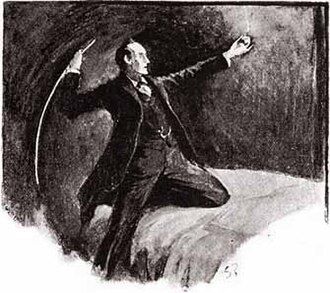
Illustration: Sidney Paget, public domain, via Wikimedia Commons
So there it was, a fixed piece of geometry: a hole high in the wall, a rope hanging from just beneath it, and a bed that could never be moved out from under the rope.
“Holmes,” I cried, “I think I dimly see what you’re hinting at. We’re only just in time to prevent some subtle and horrible crime.”
“Subtle enough and horrible enough. When a doctor does go wrong he is the first of criminals. He has nerve and he has knowledge. Palmer and Pritchard were among the leaders of their profession.” He meant the two doctors of a generation back who had poisoned their victims and been hanged for it. “This man strikes even deeper, but I think, Watson, that we’ll be able to strike deeper still. But we’ll have horrors enough before the night is over. For goodness’ sake, let’s have a quiet pipe and turn our minds to something more cheerful for a few hours.”
At about nine o’clock the light among the trees went out, and everything was dark toward the Manor House. Two hours dragged by, and then, suddenly, right on the stroke of eleven, a single bright light shone out directly ahead of us.
“That’s our signal,” said Holmes, springing to his feet. “It comes from the middle window.”
On the way out, he exchanged a few words with the landlord, explaining that we were paying a late visit to an acquaintance and might spend the night there. A moment later we were out on the dark road, a chill wind blowing in our faces, with one yellow light twinkling ahead of us through the gloom to guide us on our grim errand.
Getting into the grounds was easy, because unrepaired gaps yawned in the old park wall. We made our way through the trees, reached the lawn, crossed it, and were about to climb in through the window when, out of a clump of laurel bushes, darted what looked like a hideous, misshapen child. It threw itself onto the grass, limbs writhing, then ran swiftly across the lawn into the darkness.
“My God!” I whispered. “Did you see it?”
For a moment Holmes was as startled as I was. His hand clamped on my wrist like a vise. Then he broke into a low laugh and put his lips to my ear.
“It’s a nice household,” he murmured. “That’s the baboon.”
I had forgotten the Doctor’s strange pets. There was a cheetah, too; for all I knew, we might find it on our shoulders at any moment. I admit I felt easier in my mind when, after following Holmes’s example and slipping off my shoes, I found myself inside the bedroom. My companion closed the shutters without a sound, moved the lamp onto the table, and looked around the room. Everything was as we had seen it in daylight. Then he crept up to me, cupped his hand like a trumpet, and whispered in my ear so softly that I could barely make out the words:
“The least sound would be fatal to our plans.”
I nodded to show I had heard.
“We must sit without light. He would see it through the ventilator.”
I nodded again.
“Don’t fall asleep. Your very life may depend on it. Have your pistol ready in case we need it. I’ll sit on the side of the bed, and you in that chair.”
I took out my revolver and laid it on the corner of the table.
Holmes had brought a long, thin cane, and he laid it on the bed beside him. Next to it he put a box of matches and the stump of a candle. Then he turned down the lamp, and we were left in darkness.
How could I ever forget that dreadful vigil? I couldn’t hear a sound, not even a breath, and yet I knew my companion was sitting wide-eyed a few feet from me, every nerve as tight as my own. The shutters cut off every ray of light, and we waited in absolute darkness.
From outside came the occasional cry of a night bird, and once, right at our window, a long, drawn-out, catlike whine, which told us the cheetah was indeed loose. Far off we could hear the deep tones of the parish clock booming out every quarter hour. How long they seemed, those quarters! Twelve struck, and one, and two, and three, and still we sat waiting in silence for whatever might happen.
Suddenly there was a brief gleam of light up near the ventilator. It vanished at once, but it was followed by a strong smell of burning oil and hot metal. Someone in the next room had lit a dark-lantern, the kind with a sliding metal shutter that hides its flame until you want the beam. The shutter traps the heat, so the tin warms and gives off that hot, metallic reek, and here it was, drifting through the same hole that had once carried the cigar smoke. I heard a soft sound of movement, and then everything was silent again, though the smell grew stronger. For half an hour I sat with straining ears. Then, suddenly, another sound became audible: a very gentle, soothing sound, like a small jet of steam escaping steadily from a kettle. The instant we heard it, Holmes sprang from the bed, struck a match, and lashed furiously with his cane at the bell-pull.
“You see it, Watson?” he yelled. “You see it?”
But I saw nothing. At the moment Holmes struck the light I heard a low, clear whistle, but the sudden glare flashing into my tired eyes made it impossible to tell what my friend was striking at so savagely. I could see, though, that his face was deathly pale and full of horror and loathing. He had stopped striking and was staring up at the ventilator when suddenly the silence of the night was broken by the most horrible cry I have ever heard. It swelled louder and louder, a hoarse yell of pain and fear and anger all mixed into one dreadful shriek. They say that down in the village, and even in the distant parsonage, that cry raised sleepers from their beds. It struck a chill to our hearts, and I stood staring at Holmes, and he at me, until the last echoes died away into the silence it had risen from.
“What can it mean?” I gasped.
“It means that it’s all over,” Holmes answered. “And perhaps, after all, it’s for the best. Take your pistol, and we’ll go into Dr. Roylott’s room.”
With a grave face he lit the lamp and led the way down the corridor. Twice he knocked on the bedroom door with no answer from inside. Then he turned the handle and went in, with me at his heels, the cocked pistol in my hand.
It was a strange sight that met our eyes. On the table stood a dark-lantern with its shutter half open, throwing a brilliant beam of light onto the iron safe, whose door was ajar. Beside the table, on the wooden chair, sat Dr. Grimesby Roylott, dressed in a long gray dressing-gown, his bare ankles showing beneath it and his feet pushed into red, heelless Turkish slippers. Across his lap lay the short stock with the long lash we had noticed that afternoon. His chin was tilted upward and his eyes were fixed in a dreadful, rigid stare at the corner of the ceiling. Around his forehead was a peculiar yellow band with brownish speckles, which seemed to be bound tightly around his head. As we came in, he made neither sound nor movement.
“The band! The speckled band!” whispered Holmes.
I took a step forward. In an instant his strange headgear began to move, and up from his hair reared the squat, diamond-shaped head and puffed neck of a loathsome snake.
“It’s a swamp adder!” cried Holmes. “The deadliest snake in India. He died within ten seconds of being bitten. Violence does, in truth, recoil upon the violent, and the schemer falls into the pit which he digs for another. Let’s push this creature back into its den, and then we can take Miss Stoner somewhere safe and let the county police know what has happened.”
As he spoke he swiftly drew the dog-whip from the dead man’s lap, threw the noose around the reptile’s neck, pulled it from its horrid perch, and, holding it at arm’s length, flung it into the iron safe and shut the door on it.
Those are the true facts of the death of Dr. Grimesby Roylott, of Stoke Moran. I needn’t stretch out a story that has already run long by telling how we broke the sad news to the terrified girl, how we took her by the morning train to the care of her good aunt at Harrow, or how the slow official inquiry concluded that the doctor met his fate while carelessly playing with a dangerous pet. The little I still had to learn about the case, Sherlock Holmes told me as we traveled back the next day.
“I had,” he said, “come to an entirely wrong conclusion, which shows, my dear Watson, how dangerous it always is to reason from insufficient data. The presence of the gipsies, and the word ‘band,’ which the poor girl no doubt used to describe what she glimpsed in a hurry by the light of her match, were enough to send me down an entirely false trail. My only merit is that I reconsidered at once, as soon as it became clear that whatever threatened the person in that room couldn’t come through either the window or the door. My attention was quickly drawn, as I told you, to the ventilator and to the bell-rope hanging down to the bed. The discovery that the rope was a dummy, and that the bed was clamped to the floor, instantly made me suspect that the rope was there as a bridge for something coming through the hole and down to the bed. The idea of a snake occurred to me at once, and when I put that together with my knowledge that the doctor had a supply of creatures sent to him from India, I felt I was probably on the right track. A poison no chemical test could possibly detect was exactly the kind of idea that would occur to a clever, ruthless man who had learned his medicine in India, where snakebite was an everyday danger. The speed with which such a poison acts would also, from his point of view, be an advantage. It would take a sharp-eyed coroner indeed to spot the two little dark punctures where the fangs had done their work.”
As a medical man, I could vouch for that part. Our chemists could find arsenic with the Marsh test, which turns it into a gas and deposits it as a shining metallic film on cold porcelain, and they could find strychnine and a good many other poisons. But a snake’s venom leaves no metal behind for a reagent to catch, and in our day no laboratory in England had a test that would reveal it in a body. Two pinpricks lost in a frightened woman’s skin were all the evidence there would ever be.
“Then I thought of the whistle,” Holmes went on. “Of course, he had to call the snake back before the morning light showed it to the victim. He had trained it, probably by means of the milk we saw, to come back to him when summoned. He would put it through the ventilator at whatever hour he thought best, certain it would crawl down the rope and land on the bed. It might or might not bite the person sleeping there. Perhaps she might escape every night for a week. But sooner or later she was bound to fall victim.
“I had reached these conclusions before I ever entered his room. Inspecting his chair showed me he was in the habit of standing on it, which of course he would need to do to reach the ventilator. The sight of the safe, the saucer of milk, and the loop of whipcord were enough to clear away any doubts I had left. The metallic clang Miss Stoner heard was obviously her stepfather hurriedly shutting the door of his safe on its terrible occupant. Once I had made up my mind, you know the steps I took to put it to the test. I heard the creature hiss, as I’m sure you did too, and I instantly struck a light and attacked it.”
“With the result of driving it back through the ventilator.”
“And also with the result of making it turn on its master on the other side. Some of the blows from my cane hit home and roused its snakish temper, so that it flew at the first person it saw. In that way I’m no doubt indirectly responsible for Dr. Grimesby Roylott’s death, and I can’t say it is likely to weigh very heavily on my conscience.”