The Man with the Twisted Lip
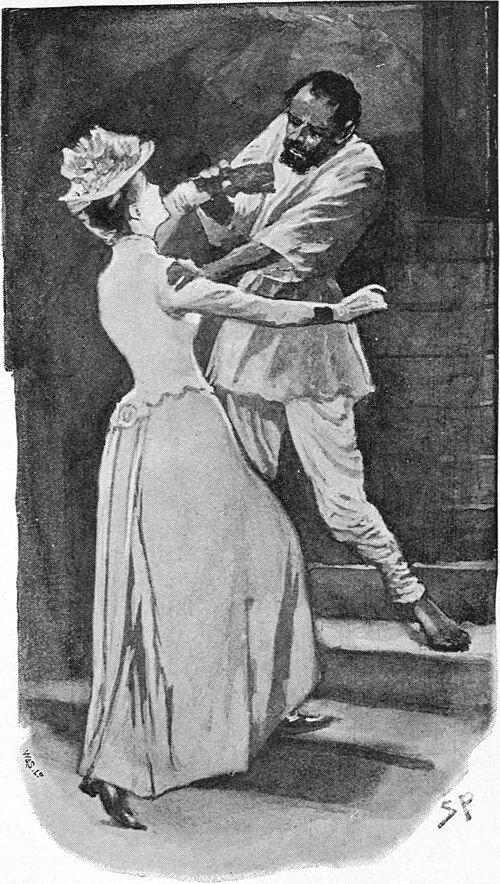
Illustration: Sidney Paget, public domain, via Wikimedia Commons
Isa Whitney, brother of the late Elias Whitney, D.D., Principal of the Theological College of St. George’s, was badly addicted to opium. As I understand it, the habit began with a foolish college prank. He had read De Quincey’s account of his opium dreams and, wanting the same visions, soaked his tobacco in laudanum, which is simply opium dissolved in alcohol. He found, as so many have, that the habit is far easier to pick up than to put down. For years he was a slave to the drug, and his friends and family looked on him with a mix of horror and pity. I can see him now: the yellow, pasty face, the drooping lids, the pupils shrunk to pinpoints. A doctor learns to read that last sign at a glance. The drug excites the nerve that draws the iris tight, so an opium-taker’s pupils stay small even in a dim room, where any honest eye would open wide. He would sit huddled in a chair, the wreck and ruin of a good man.
One night in June of ’89 the bell rang, at about the hour when a man gives his first yawn and glances at the clock. I sat up in my chair. My wife laid her needlework in her lap and made a small face of disappointment.
“A patient!” she said. “You’ll have to go out.”
I groaned. I had only just come home from a long, tiring day.
We heard the front door open, a few hurried words, then quick steps on the linoleum. Our own door flew open, and a lady in dark clothes and a black veil came in.
“Please excuse me for calling so late,” she began. Then her composure broke. She ran forward, threw her arms around my wife’s neck, and sobbed on her shoulder. “Oh, I’m in such trouble!” she cried. “I do so need a little help.”
“Why,” said my wife, lifting the veil, “it’s Kate Whitney. How you startled me, Kate! I had no idea who you were when you came in.”
“I didn’t know what to do, so I came straight to you.” That was always the way. People in grief came to my wife like birds to a lighthouse.
“It was sweet of you to come. Now, you must have some wine and water, sit here comfortably, and tell us everything. Or would you rather I sent James off to bed?”
“Oh, no, no! I want the doctor’s advice and help too. It’s about Isa. He hasn’t been home for two days. I’m so frightened for him!”
It wasn’t the first time she had told us about her husband’s trouble: me as his doctor, my wife as an old school friend. We comforted her as best we could. Did she know where he was? Could we bring him back to her?
It seemed we could. She had reliable word that lately, when the craving took him, he went to an opium den at the far eastern edge of the City. Until now his binges had lasted a single day, and he had come home in the evening, twitching and shattered. But this time it had been forty-eight hours. No doubt he was lying there among the dregs of the docks, breathing in the poison or sleeping it off. She was sure he could be found at the Bar of Gold, in Upper Swandam Lane. But what could she do? How could a young, timid woman walk into a place like that and pull her husband out from among the ruffians around him?
There was the problem, and there was only one way out of it. Might I take her there? Then, on second thought, why should she come at all? I was Isa Whitney’s doctor and had some influence over him. I could manage better alone. I promised her that if he was at that address, I would send him home in a cab within two hours. And so, ten minutes later, I had left my armchair and cheerful sitting room behind and was rattling east in a hansom cab on what seemed a strange errand. Only the future would show how strange it really was.
The first stage of the adventure gave me no trouble. Upper Swandam Lane is a vile alley lurking behind the high wharves on the north bank of the river, east of London Bridge. Between a slop-shop, which sold cheap ready-made clothes, and a gin-shop, a steep flight of steps led down to a black gap like the mouth of a cave. That was the den. I told my cab to wait and went down the steps, worn hollow in the center by the endless tread of drunken feet. By the light of a flickering oil lamp over the door I found the latch and stepped into a long, low room, thick with brown opium smoke and lined with tiers of wooden bunks, like the crew’s quarters of an emigrant ship.
Through the gloom I could make out bodies sprawled in strange poses: shoulders hunched, knees bent, heads thrown back, chins pointing at the ceiling, and here and there a dull eye turned toward the newcomer. Little red circles of light glowed out of the shadows, brightening and fading in the bowls of the metal pipes. Each brightening was a smoker drawing breath. The rush of air fed the glowing drug fresh oxygen, exactly as a blacksmith’s bellows brightens a forge. Most of the men lay silent. Some muttered to themselves. Others talked in a strange, low monotone, the words coming in bursts and then trailing off, each man mumbling his own thoughts and paying no attention to his neighbor’s. At the far end stood a small brazier of burning charcoal. Beside it, on a three-legged wooden stool, sat a tall, thin old man with his jaw resting on his two fists and his elbows on his knees, staring into the fire.
As I came in, a Malay attendant hurried up with a pipe and a supply of the drug and waved me toward an empty bunk.
“Thank you. I haven’t come to stay,” I said. “A friend of mine is here, Mr. Isa Whitney, and I want to speak with him.”
Something stirred on my right, with an exclamation. Peering through the gloom, I saw Whitney, pale, haggard, and unkempt, staring out at me.

Illustration: Sidney Paget, public domain, via Wikimedia Commons
“My God! It’s Watson,” he said. He was in a pitiful state, the drug wearing off and every nerve jangling. “I say, Watson, what time is it?”
“Nearly eleven.”
“Of what day?”
“Friday, June 19th.”
“Good heavens! I thought it was Wednesday. It is Wednesday. Why do you want to frighten a fellow?” He sank his face onto his arms and began to sob in a high, thin voice.
“I tell you it’s Friday, man. Your wife has been waiting two days for you. You should be ashamed of yourself!”
“So I am. But you’ve got mixed up, Watson. I’ve only been here a few hours. Three pipes, four pipes, I forget how many. But I’ll go home with you. I wouldn’t frighten Kate. Poor little Kate. Give me your hand! Have you a cab?”
“Yes, one’s waiting.”
“Then I’ll go in it. But I must owe something. Find out what I owe, Watson. I’m all out of sorts. I can’t do anything for myself.”
I walked down the narrow aisle between the double row of sleepers, holding my breath against the vile, stupefying fumes, and looked for the manager. As I passed the tall man by the brazier, I felt a sudden tug at my coat, and a low voice whispered, “Walk past me, and then look back at me.” The words were perfectly clear. I glanced down. They could only have come from the old man beside me, and yet he sat as absorbed as ever: thin, wrinkled, bent with age, an opium pipe dangling between his knees as if it had slipped from his fingers out of sheer weariness. I took two steps forward and looked back. It took all my self-control not to cry out. He had turned so that no one but me could see his face. His body had filled out, his wrinkles were gone, the dull eyes had their fire back. There, sitting by the brazier and grinning at my astonishment, was none other than Sherlock Holmes. He signaled me closer with the slightest motion. The instant he turned his face back toward the room, he collapsed once more into a doddering, slack-lipped old man.
“Holmes!” I whispered. “What on earth are you doing in this den?”
“As low as you can,” he answered. “I have excellent ears. If you would be so very kind as to get rid of that befuddled friend of yours, I should be extremely glad to have a little talk with you.”
“I have a cab outside.”
“Then please send him home in it. You may safely trust him, for he looks far too limp to get into any mischief. I’d also suggest you send a note with the cabman telling your wife that you’ve thrown in your lot with me. If you’ll wait outside, I’ll be with you in five minutes.”

Illustration: Sidney Paget, public domain, via Wikimedia Commons
It was hard to refuse any request of Sherlock Holmes’s. They were always so exact, and made with such a quiet air of command. Besides, once Whitney was shut in the cab, my mission was as good as done, and I could wish for nothing better than to join my friend in one of the strange adventures that were the normal condition of his life. In a few minutes I had written my note, paid Whitney’s bill, led him out to the cab, and watched him driven off into the dark. Very soon afterward a decrepit figure came out of the opium den, and I was walking down the street with Sherlock Holmes. For two streets he shuffled along, bent-backed and unsteady. Then, with a quick glance around, he straightened up and burst into a hearty laugh.
“I suppose, Watson,” he said, “you imagine I’ve added opium-smoking to cocaine injections and all the other little weaknesses you’ve so kindly favored me with your medical views on.”
“I was certainly surprised to find you there.”
“No more than I was to find you.”
“I came to find a friend.”
“And I to find an enemy.”
“An enemy?”
“Yes. One of my natural enemies. Or shall I say, my natural prey. In short, Watson, I’m in the middle of a very remarkable inquiry, and I hoped to pick up a clue in the rambling talk of those poor sots, as I have done before now. If I had been recognized in that den, my life wouldn’t have been worth an hour’s purchase. I’ve used the place for my own purposes before, and the rascal of a Lascar who runs it has sworn to have his revenge on me. There’s a trapdoor at the back of that building, near the corner of Paul’s Wharf, that could tell some strange tales of what has gone through it on moonless nights.”
Lascar, I should explain, was the word then used on the London docks for seamen from India and the East who served on British ships. In all this affair Holmes never called the man by any other name.
“What! You don’t mean bodies?”
“Ay, bodies, Watson. We’d be rich men if we had a thousand pounds for every poor devil who has been done to death in that den. It is the vilest murder-trap on the whole riverside, and I fear that Neville St. Clair has gone into it and will never come out. But our own trap should be here.” He put two forefingers between his teeth and whistled shrilly. A similar whistle answered from the distance, and soon came the rattle of wheels and the clink of hooves.
“Now, Watson,” said Holmes, as a tall dog-cart, a light, high two-wheeled carriage, dashed up through the gloom, its side lanterns throwing out two golden tunnels of light. “You’ll come with me, won’t you?”
“If I can be of use.”
“Oh, a trusty comrade is always of use, and a chronicler even more so. My room at The Cedars has two beds.”
“The Cedars?”
“Yes, that’s Mr. St. Clair’s house. I’m staying there while I conduct the inquiry.”
“Where is it, then?”
“Near Lee, in Kent. We have a seven-mile drive ahead of us.”
“But I’m completely in the dark.”
“Of course you are. You’ll know all about it presently. Jump up here. All right, John, we shan’t need you. Here’s half a crown. Look out for me tomorrow, about eleven. Give her her head. So long, then!”
He flicked the horse with the whip, and we dashed off through an endless run of somber, deserted streets. Gradually they widened, until we were flying across a broad bridge with a stone balustrade, the murky river sliding sluggishly beneath us. Beyond lay another dull wilderness of brick and mortar. Its silence was broken only by the heavy, regular tread of a policeman, or the songs and shouts of some late party of revelers. Ragged clouds drifted across the sky, with a star or two blinking through the gaps. Holmes drove in silence, head sunk on his chest, lost in thought. I sat beside him, dying to know what quest could tax him so heavily, but afraid to break into his thinking. We had gone several miles and were reaching the fringe of the suburban villas when he shook himself, shrugged, and lit his pipe with the air of a man who has decided he is doing the best he can.
“You have a grand gift of silence, Watson,” he said. “It makes you quite invaluable as a companion. Upon my word, it’s a great thing for me to have someone to talk to, for my own thoughts aren’t very pleasant. I was wondering what I should say to that dear little woman tonight when she meets me at the door.”
“You forget that I know nothing about it.”
“I’ll just have time to tell you the facts before we reach Lee. It seems absurdly simple, and yet somehow I can get nothing to go on. There’s plenty of thread, no doubt, but I can’t get the end of it into my hand. Now, I’ll state the case clearly and briefly, Watson, and maybe you can see a spark where all is dark to me.”
“Go on, then.”
“Some years ago, in May 1884 to be exact, a gentleman named Neville St. Clair came to Lee. He seemed to have plenty of money. He took a large villa, laid out the grounds very nicely, and lived in good style. Little by little he made friends in the neighborhood, and in 1887 he married the daughter of a local brewer. They now have two children. He had no profession, but he was interested in several companies. As a rule he went into town in the morning and came home on the 5:14 from Cannon Street every night. Mr. St. Clair is now thirty-seven, a man of moderate habits, a good husband, a very affectionate father, and popular with everyone who knows him. I may add that his total debts at this moment, as far as we can find, come to eighty-eight pounds ten shillings, while he has two hundred and twenty pounds to his credit in the Capital and Counties Bank. So there’s no reason to think money troubles were weighing on his mind.
“Last Monday Mr. Neville St. Clair went into town rather earlier than usual. Before he left, he mentioned that he had two important errands, and that he would bring his little boy home a box of toy bricks. Now, by pure chance, his wife received a telegram that same Monday, shortly after he left. It said that a small parcel of considerable value, which she had been expecting, was waiting for her at the offices of the Aberdeen Shipping Company. If you know your London, you’ll know that the company’s office is in Fresno Street, which branches off Upper Swandam Lane, where you found me tonight. Mrs. St. Clair had her lunch, went up to the City, did some shopping, went on to the company’s office, collected her package, and at exactly 4:35 found herself walking through Swandam Lane on her way back to the station. Have you followed me so far?”
“It’s very clear.”
“You’ll remember that Monday was a very hot day. Mrs. St. Clair walked slowly, looking about for a cab, since she didn’t like the neighborhood. As she went down Swandam Lane, she suddenly heard a cry. She went cold. Her husband was looking down at her, and, as it seemed to her, beckoning to her from a second-floor window. The window was open, and she clearly saw his face, which she describes as terribly agitated. He waved his hands at her frantically and then vanished from the window so suddenly that it seemed some irresistible force had yanked him back from behind. One odd point caught her quick eye. Although he wore a dark coat, like the one he had gone to town in, he had on neither collar nor necktie.
“Sure that something was wrong, she rushed down the steps, for the house was none other than the opium den where you found me tonight. She ran through the front room and tried to climb the stairs to the first floor. At the foot of the stairs, however, she met this Lascar scoundrel I spoke of. He shoved her back and, with the help of a Dane who works there as his assistant, pushed her out into the street. Half mad with doubt and fear, she ran down the lane and, by rare luck, met a group of constables with an inspector in Fresno Street, on their way to their beat. The inspector and two men went back with her, and despite the proprietor’s continued resistance, they made their way to the room where Mr. St. Clair had last been seen. There was no sign of him. In fact, on that whole floor there was no one at all except a crippled wretch of hideous appearance, who, it seems, made his home there. He and the Lascar both swore stoutly that no one else had been in the front room all afternoon. Their denial was so firm that the inspector was shaken. He had almost come to believe that Mrs. St. Clair had been mistaken when, with a cry, she sprang at a small pine box on the table and tore off the lid. Out tumbled a cascade of children’s bricks. It was the toy he had promised to bring home.
“This discovery, and the cripple’s obvious confusion, made the inspector realize the matter was serious. The rooms were carefully examined, and everything pointed to a horrible crime. The front room was plainly furnished as a sitting room and led into a small bedroom, which looked out on the back of one of the wharves. Between the wharf and the bedroom window is a narrow strip that is dry at low tide but covered at high tide by at least four and a half feet of water. The bedroom window was a wide one and opened from below. On examination, traces of blood were found on the windowsill, and several scattered drops on the wooden floor of the bedroom. Shoved behind a curtain in the front room were all the clothes of Mr. Neville St. Clair, except his coat. His boots, his socks, his hat, and his watch: all were there. None of the garments showed signs of violence, and there was no other trace of Mr. Neville St. Clair. He must have gone out of the window, for no other exit could be found, and the ominous blood on the sill gave little hope that he had saved himself by swimming. The tide was at its very highest at the moment of the tragedy.
“Now for the villains who seemed to be directly involved. The Lascar was known to be a man with the vilest record. But by Mrs. St. Clair’s own account, he was at the foot of the stairs within a few seconds of her husband’s appearance at the window, so he could hardly have been more than an accomplice. His defense was total ignorance. He insisted he knew nothing of what his lodger, Hugh Boone, got up to, and could not account in any way for the missing gentleman’s clothes.
“So much for the Lascar manager. Now for the sinister cripple who lives on the second floor of the opium den, and who was certainly the last human being to set eyes on Neville St. Clair. His name is Hugh Boone, and his hideous face is familiar to every man who goes much to the City. He’s a professional beggar, though to get around the police regulations he pretends to a small trade in wax vestas, little wax matches. A little way down Threadneedle Street, on the left-hand side, there’s a small angle in the wall, as you may have noticed. That’s where this creature takes his seat every day, cross-legged, with his tiny stock of matches in his lap. He is such a pitiful sight that a small rain of charity falls into the greasy leather cap on the pavement beside him. I had watched the fellow more than once before I ever thought of making his professional acquaintance, and I’ve been surprised at the harvest he reaps in a short time. His appearance, you see, is so remarkable that no one can pass without noticing him. A shock of orange hair. A pale face disfigured by a horrible scar, which, as it contracted, has turned up the outer edge of his upper lip. A bulldog chin. And a pair of very penetrating dark eyes, which make an odd contrast with the color of his hair. All of that marks him out from the common crowd of beggars. So does his wit, for he’s always ready with an answer to any jibe the passersby throw at him. This is the man who, we now learn, was the lodger at the opium den, and the last man to see the gentleman we’re looking for.”
Dark eyes under orange hair. I remember noting the pairing, as a doctor notes anything a little out of the common way, and then thinking no more about it.
“But a cripple!” I said. “What could he do on his own against a man in the prime of life?”
“He’s a cripple in the sense that he walks with a limp. In other respects he seems to be a powerful, well-fed man. Surely your medical experience tells you, Watson, that weakness in one limb is often made up for by exceptional strength in the others.”
“Please, go on.”
“Mrs. St. Clair fainted at the sight of the blood on the window, and the police took her home in a cab, since her presence could be of no help to them. Inspector Barton, who had charge of the case, examined the premises very carefully but found nothing that shed any light on the matter. One mistake was made: Boone wasn’t arrested at once, so he had a few minutes in which he might have spoken to his friend the Lascar. But that was soon put right. He was seized and searched, and nothing was found to incriminate him. There were, it’s true, some bloodstains on his right shirt-sleeve. But he pointed to his ring finger, which had been cut near the nail, and explained that the bleeding came from there. He added that he had been to the window not long before, and that the stains found there no doubt came from the same source. He flatly denied ever having seen Mr. Neville St. Clair and swore the clothes in his room were as much a mystery to him as to the police. As for Mrs. St. Clair’s claim that she had actually seen her husband at the window, he declared she must have been mad or dreaming. He was taken off to the police station, loudly protesting, while the inspector stayed on the premises in the hope that the ebbing tide might turn up some fresh clue.
“And it did, though what they found on the mud-bank wasn’t what they had feared to find. It was Neville St. Clair’s coat, and not Neville St. Clair, that lay uncovered as the tide went out. And what do you think they found in the pockets?”
“I can’t imagine.”
“No, I don’t think you’d guess. Every pocket was stuffed with pennies and halfpennies: 421 pennies and 270 halfpennies. No wonder it hadn’t been swept away by the tide. But a human body is a different matter. There’s a fierce eddy between the wharf and the house. It seemed likely enough that the weighted coat had stayed put while the stripped body was sucked away into the river.”
I did the sum in my head, as one does on a dark road. A bronze penny weighs a third of an ounce and a halfpenny a fifth, so the pockets held some twelve pounds of metal. Bronze is nearly nine times as heavy as the same bulk of water. Twelve pounds of it would drag a sodden coat straight to the bottom and pin it there while the current tore past. A man’s body, on the other hand, weighs very nearly what the water it displaces weighs, and an eddy could roll it away like a log.
“Twelve pounds’ weight of coin,” I said, “and hardly more than two pounds of it in money.”
“A poor fortune,” said Holmes, “and an excellent anchor.”
“But I understand that all his other clothes were found in the room. Would the body be dressed in a coat and nothing else?”
“No, sir, but the facts could be explained plausibly enough. Suppose this man Boone pushed Neville St. Clair through the window. No human eye could have seen it. What would he do next? It would strike him at once that he had to get rid of the telltale clothes. He would seize the coat, and be in the act of throwing it out, when it would occur to him that it would float, not sink. He has very little time. He has heard the scuffle downstairs when the wife tried to force her way up, and perhaps his Lascar partner has already told him the police are hurrying up the street. There isn’t an instant to lose. He rushes to some secret hoard where he has piled up the profits of his begging and stuffs every coin he can grab into the pockets, to make sure the coat sinks. He throws it out, and he would have done the same with the other clothes if he hadn’t heard the rush of feet below. He barely had time to shut the window before the police appeared.”
“It certainly sounds possible.”
“Well, we’ll take it as a working hypothesis, for want of a better one. Boone, as I told you, was arrested and taken to the station, but nothing could be shown against him from before. He had been known for years as a professional beggar, but his life seemed to have been a very quiet and innocent one. That’s where things stand now. The questions to be solved are what Neville St. Clair was doing in the opium den, what happened to him there, where he is now, and what Hugh Boone had to do with his disappearance. All four are as far from an answer as ever. I confess I can’t recall any case in my experience that looked so simple at first glance and yet presented such difficulties.”
Four questions. I counted them off on my fingers in the dark and could not answer a single one.
While Holmes was laying out this strange chain of events, we had been whirling through the outskirts of the great city. The last straggling houses fell behind, and we rattled along between country hedges. Just as he finished, we drove through two scattered villages where a few lights still glimmered in the windows.
“We’re on the outskirts of Lee,” said my companion. “We’ve touched three English counties on our short drive, starting in Middlesex, crossing a corner of Surrey, and ending in Kent. See that light among the trees? That’s The Cedars, and beside that lamp sits a woman whose anxious ears, I have no doubt, have already caught the clink of our horse’s hooves.”
“But why aren’t you running the case from Baker Street?” I asked.
“Because there are many inquiries that have to be made out here. Mrs. St. Clair has very kindly put two rooms at my disposal, and you may be sure she’ll have nothing but a welcome for my friend and colleague. I hate to meet her, Watson, when I have no news of her husband. Here we are. Whoa, there, whoa!”
We had pulled up in front of a large villa standing in its own grounds. A stable-boy ran out to the horse’s head. I jumped down and followed Holmes up the small, winding gravel drive to the house. As we came near, the door flew open, and a small blonde woman stood in the doorway, dressed in some light, silky muslin with a touch of fluffy pink chiffon at her neck and wrists. She stood outlined against the flood of light, one hand on the door, the other half raised in her eagerness, her body leaning forward, her face pushed out, eyes eager and lips parted. She was a standing question.
“Well?” she cried. “Well?” Then, seeing there were two of us, she gave a cry of hope that sank into a groan as she saw my companion shake his head and shrug.
“No good news?”
“None.”
“No bad?”
“No.”
“Thank God for that. But come in. You must be tired, for you’ve had a long day.”
“This is my friend, Dr. Watson. He has been of the most vital use to me in several of my cases, and a lucky chance has let me bring him out and involve him in this investigation.”
“I’m delighted to meet you,” she said, pressing my hand warmly. “I’m sure you’ll forgive anything lacking in our arrangements, when you consider the blow that has fallen on us so suddenly.”
“My dear madam,” I said, “I’m an old campaigner, and even if I weren’t, I can see very well that no apology is needed. If I can be of any help to you or to my friend here, I’ll be very glad.”
“Now, Mr. Sherlock Holmes,” said the lady, as we entered a well-lit dining room where a cold supper had been laid out, “I’d very much like to ask you one or two plain questions, and I beg you to give me a plain answer.”
“Certainly, madam.”
“Don’t worry about my feelings. I’m not hysterical, and I’m not given to fainting. I simply want to hear your real, real opinion.”
“On what point?”
“In your heart of hearts, do you think Neville is alive?”
Sherlock Holmes seemed embarrassed by the question. “Frankly, now!” she repeated, standing on the rug and looking keenly down at him as he leaned back in a wicker chair.
“Frankly, then, madam, I do not.”
“You think he’s dead?”
“I do.”
“Murdered?”
“I don’t say that. Perhaps.”
“And on what day did he die?”
“On Monday.”
“Then perhaps, Mr. Holmes, you’ll be good enough to explain how it is that I’ve received a letter from him today.”
Sherlock Holmes sprang out of his chair as if he had been hit by an electric shock.
“What!” he roared.
“Yes, today.” She stood smiling, holding up a little slip of paper.
“May I see it?”
“Certainly.”
He snatched it from her in his eagerness, smoothed it out on the table, drew the lamp over, and examined it intently. I had left my chair and was looking over his shoulder. The envelope was a very coarse one. It bore the Gravesend postmark and the date of that very day, or rather the day before, for it was well past midnight.
“Coarse writing,” murmured Holmes. “Surely this isn’t your husband’s writing, madam.”
“No, but the enclosure is.”
“I see also that whoever addressed the envelope had to go and ask what the address was.”
“How can you tell that?”
“The name, you see, is in perfectly black ink, which has dried by itself. The rest is a grayish color, which shows that blotting paper was used. If it had all been written straight off and then blotted, none of it would be deep black. This man wrote the name, and then there was a pause before he wrote the address, which can only mean he didn’t know it. It is, of course, a trifle. But there is nothing so important as trifles. Now let’s see the letter. Ha! There has been an enclosure here!”
I bent closer, and once I looked, the physics was simple. Fresh ink sits on paper as a thin wet ridge. While it is still wet, the loose fibers of a blotter drink off the top of that ridge, by the same pull that draws tea up into a lump of sugar, and leave a thinner, paler line behind. But leave ink a minute or two in the air and it dries where it lies, at its full depth, and no blotter can lift it then. So the black name had been written and left to dry. The gray address came later and was blotted while still wet. The pause between them was on the page as plainly as a footprint.
“Yes, there was a ring. His signet ring.”
“And you’re sure this is your husband’s hand?”
“One of his hands.”
“One?”
“His hand when he writes in a hurry. It’s very unlike his usual writing, and yet I know it well.”
“‘Dearest do not be frightened. All will come well. There is a huge error which it may take some little time to rectify. Wait in patience.—NEVILLE.’ Written in pencil on the flyleaf of a book, octavo size, no watermark. Hm! Posted today in Gravesend by a man with a dirty thumb. Ha! And the flap has been gummed, if I’m not very much mistaken, by someone who had been chewing tobacco. And you have no doubt it’s your husband’s hand, madam?”
The thumb I could see for myself: a gray whorl printed on one corner. The tobacco took me a moment longer, until I made out the faint brown tint along the gummed edge, where a tobacco-stained tongue had wetted it.
“None. Neville wrote those words.”
“And they were posted today at Gravesend. Well, Mrs. St. Clair, the clouds lighten, though I wouldn’t venture to say the danger is over.”
“But he must be alive, Mr. Holmes.”
“Unless this is a clever forgery to put us on the wrong scent. The ring, after all, proves nothing. It may have been taken from him.”
“No, no. It is, it is his very own writing!”
“Very well. It may, however, have been written on Monday and only posted today.”
“That’s possible.”
“If so, a great deal may have happened in between.”
“Oh, you mustn’t discourage me, Mr. Holmes. I know that all is well with him. There’s such a strong sympathy between us that I’d know if anything bad happened to him. On the very day I last saw him, he cut himself in the bedroom, and I, down in the dining room, rushed upstairs at once, absolutely certain something had happened. Do you think I’d respond to a trifle like that and yet not know if he were dead?”
It was the sort of detail one hears and passes over. I passed over it.
“I have seen too much not to know that the impression of a woman may be more valuable than the conclusion of an analytical reasoner. And in this letter you certainly have a very strong piece of evidence for your view. But if your husband is alive and able to write letters, why should he stay away from you?”
“I can’t imagine. It’s unthinkable.”
“And on Monday he said nothing unusual before leaving you?”
“No.”
“And you were surprised to see him in Swandam Lane?”
“Very much so.”
“Was the window open?”
“Yes.”
“Then he might have called to you?”
“He might.”
“As I understand it, he gave only a wordless cry?”
“Yes.”
“A call for help, you thought?”
“Yes. He waved his hands.”
“But it might have been a cry of surprise. Astonishment at the unexpected sight of you might make him throw up his hands?”
“It’s possible.”
“And you thought he was pulled back?”
“He disappeared so suddenly.”
“He might have jumped back. You didn’t see anyone else in the room?”
“No, but this horrible man admitted being there, and the Lascar was at the foot of the stairs.”
“Quite so. As far as you could see, your husband had his ordinary clothes on?”
“But without his collar or tie. I distinctly saw his bare throat.”
“Had he ever spoken of Swandam Lane?”
“Never.”
“Had he ever shown any signs of having taken opium?”
“Never.”
“Thank you, Mrs. St. Clair. Those are the main points I wanted to be absolutely clear about. Now we’ll have a little supper and then go to bed, for we may have a very busy day tomorrow.”
I had seen the pattern in his questions. He took each of her certainties in turn and set a plainer reading beside it. A cry for help might have been a cry of surprise, and a man dragged back might simply have stepped back. He wasn’t contradicting her. He was clearing the board.

Illustration: Sidney Paget, public domain, via Wikimedia Commons
We were given a large, comfortable room with two beds, and I was soon between the sheets, worn out by my night of adventure. Sherlock Holmes, however, was a man who, with an unsolved problem on his mind, would go for days, even a week, without rest. He would turn it over, rearrange his facts, and look at it from every side until he had either solved it or convinced himself that his data were insufficient. It was soon clear he was settling in for an all-night session. He took off his coat and waistcoat, put on a large blue dressing gown, and wandered around the room collecting pillows from his bed and cushions from the sofa and armchairs. From these he built a kind of low divan, on which he perched cross-legged, with an ounce of shag tobacco and a box of matches laid out in front of him. In the dim lamplight I saw him sitting there, an old briar pipe between his lips and his eyes fixed blankly on a corner of the ceiling. Blue smoke curled up from him as he sat silent and motionless, the light falling on his strong, hawk-like features. So he sat as I fell asleep. And so he sat when a sudden exclamation woke me and I found the summer sun shining into the room. The pipe was still between his lips, the smoke still curled upward, and the room was thick with tobacco haze. But nothing remained of the heap of shag I had seen the night before.
“Awake, Watson?” he asked.
“Yes.”
“Game for a morning drive?”
“Certainly.”
“Then get dressed. No one’s up yet, but I know where the stable-boy sleeps, and we’ll soon have the trap out.” He chuckled as he spoke. His eyes twinkled, and he seemed a different man from the somber thinker of the night before.
As I dressed, I looked at my watch. No wonder no one was up. It was twenty-five minutes past four. I had barely finished when Holmes came back to say the boy was harnessing the horse.
“I want to test a little theory of mine,” he said, pulling on his boots. “I think, Watson, that you are now standing in the presence of one of the most absolute fools in Europe. I deserve to be kicked from here to Charing Cross. But I think I have the key of the affair now.”
“And where is it?” I asked, smiling.
“In the bathroom,” he answered. “Oh, yes, I’m not joking,” he went on, seeing my look of disbelief. “I’ve just been there, and I’ve taken it out, and I’ve got it in this Gladstone bag. Come on, my boy, and we’ll see whether it fits the lock.”
I looked at the bag, an ordinary leather traveling bag that opens wide along the top, and tried to think what in a bathroom could unlock a murder. Nothing came to me.
We went downstairs as quietly as we could and out into the bright morning sun. In the road stood our horse and trap, with the half-dressed stable-boy waiting at its head. We both sprang in and dashed away down the London Road. A few country carts were about, carrying vegetables into the city, but the rows of villas on either side were as silent and lifeless as a city in a dream.
“It has been a singular case in some ways,” said Holmes, flicking the horse on into a gallop. “I confess I’ve been as blind as a mole, but it’s better to learn wisdom late than never to learn it at all.”
In town the earliest risers were just beginning to peer sleepily from their windows as we drove through the streets on the Surrey side. We went down the Waterloo Bridge Road, crossed the river, dashed up Wellington Street, wheeled sharply to the right, and found ourselves in Bow Street, at the police station. Sherlock Holmes was well known to the force, and the two constables at the door saluted him. One held the horse’s head while the other led us in.
“Who’s on duty?” asked Holmes.
“Inspector Bradstreet, sir.”
“Ah, Bradstreet, how are you?” A tall, stout officer had come down the stone-flagged passage in a peaked cap and a braided jacket. “I’d like a quiet word with you, Bradstreet.”
“Certainly, Mr. Holmes. Step into my room here.”
It was a small, office-like room, with a huge ledger on the table and a telephone sticking out from the wall. The inspector sat down at his desk.
“What can I do for you, Mr. Holmes?”
“I’ve come about that beggar, Boone, the one charged with being involved in the disappearance of Mr. Neville St. Clair, of Lee.”
“Yes. He was brought before the magistrate and held over for further inquiries.”
“So I heard. You have him here?”
“In the cells.”
“Is he quiet?”
“Oh, he gives no trouble. But he’s a dirty scoundrel.”
“Dirty?”
“Yes, it’s all we can do to make him wash his hands, and his face is as black as a coal-heaver’s. Well, once his case is settled, he’ll have a regular prison bath, and I think if you saw him you’d agree he needs it.”
Holmes said nothing, but I saw the corner of his mouth move.
“I should like very much to see him.”
“Would you? That’s easily done. Come this way. You can leave your bag.”
“No, I think I’ll take it.”
“Very good. This way, please.” He led us down a passage, opened a barred door, went down a winding stair, and brought us to a whitewashed corridor with a row of doors on each side.
“The third on the right is his,” said the inspector. “Here it is!” He quietly slid back a panel in the upper part of the door and looked through.
“He’s asleep,” he said. “You can see him very well.”
We both put our eyes to the grating. The prisoner lay facing us, deeply asleep, breathing slowly and heavily. He was a middle-sized man, coarsely dressed as suited his trade, with a colored shirt poking through a tear in his ragged coat. He was, as the inspector had said, extremely dirty, but the grime on his face couldn’t hide its repulsive ugliness. A broad welt from an old scar ran right across it from eye to chin. As the scar had contracted, it had pulled up one side of the upper lip, so that three teeth showed in a permanent snarl. A shock of very bright red hair grew low over his eyes and forehead.
“He’s a beauty, isn’t he?” said the inspector.
“He certainly needs a wash,” said Holmes. “I had an idea he might, and I took the liberty of bringing the tools with me.” As he spoke he opened the Gladstone bag and, to my astonishment, took out a very large bath sponge.
“Heh! Heh! You’re a funny one,” chuckled the inspector.
“Now, if you would be so very good as to open that door quietly, we’ll soon make him cut a much more respectable figure.”
“Well, I don’t see why not,” said the inspector. “He doesn’t do the Bow Street cells much credit, does he?” He slipped his key into the lock, and we all crept into the cell. The sleeper half turned, then settled back into a deep sleep. Holmes stooped to the water jug, wet his sponge, and rubbed it twice, hard, across and down the prisoner’s face.
“Let me introduce you,” he shouted, “to Mr. Neville St. Clair, of Lee, in the county of Kent.”
Never in my life have I seen such a sight. The man’s face peeled off under the sponge like bark from a tree. Gone was the coarse brown tint! Gone, too, was the horrible scar that had seamed it, and the twisted lip that had given the face its repulsive sneer! A tug brought away the tangled red hair. There, sitting up in bed, was a pale, sad-faced, refined-looking man, black-haired and smooth-skinned, rubbing his eyes and staring around in sleepy bewilderment. Then, suddenly realizing he had been exposed, he let out a scream and threw himself face down on the pillow.
With that one stroke of a wet sponge, every piece Holmes had handed me in the dog-cart turned over and showed its other side. The dark eyes under the orange hair: the hair was a wig, and the eyes were his own. The cut finger that had bled on the sill: the cut his wife had heard him make in the bedroom that morning. The beggar who wouldn’t wash: of course he wouldn’t. The clothes behind the curtain, the box of bricks, the coat weighed down with a beggar’s coppers. There had never been two men in that room, only one man with two faces. And there was no magic in the sponge. Paint and grime lie on the skin, not in it. A wet sponge and a little elbow lift them off, the way a wet cloth takes soot off a windowpane.
“Great heavens!” cried the inspector. “It is indeed the missing man. I know him from the photograph.”
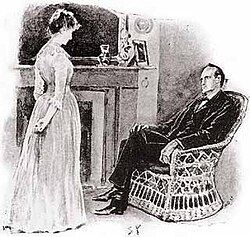
Illustration: Sidney Paget, public domain, via Wikimedia Commons
The prisoner turned with the reckless air of a man who gives himself up to his fate. “So be it,” he said. “And what, may I ask, am I charged with?”
“With doing away with Mr. Neville St.— Oh, come, you can’t be charged with that unless they make a case of attempted suicide of it,” said the inspector with a grin. “Well, I’ve been twenty-seven years on the force, but this really takes the cake.”
“If I am Mr. Neville St. Clair, then it’s obvious that no crime has been committed, and therefore I’m being held illegally.”
“No crime, but a very great error has been committed,” said Holmes. “You would have done better to trust your wife.”
“It wasn’t my wife; it was the children,” groaned the prisoner. “God help me, I wouldn’t have them ashamed of their father. My God! What an exposure! What can I do?”
Sherlock Holmes sat down beside him on the bunk and patted him kindly on the shoulder.
“If you leave it to a court of law to clear the matter up,” he said, “you can hardly avoid publicity. On the other hand, if you convince the police that there’s no possible case against you, I don’t know of any reason the details should find their way into the papers. Inspector Bradstreet would, I’m sure, take notes of anything you might tell us and submit them to the proper authorities. The case would then never go to court at all.”
“God bless you!” cried the prisoner. “I would have endured prison, yes, even execution, rather than leave my miserable secret as a stain on my children’s name.
“You’re the first who have ever heard my story. My father was a schoolmaster in Chesterfield, where I received an excellent education. I traveled in my youth, went on the stage, and finally became a reporter on an evening paper in London. One day my editor wanted a series of articles on begging in the city, and I volunteered to write them. That was where all my adventures began. The only way to get the facts for my articles was to try begging myself, as an amateur. As an actor I had of course learned all the secrets of makeup, and I had been famous backstage for my skill. Now I put it to use. I painted my face, and to look as pitiful as possible I made a good scar and fixed one side of my lip in a twist with a small strip of flesh-colored sticking plaster. Then, with a red wig and suitable clothes, I took my place in the business part of the City, supposedly as a match-seller but really as a beggar. For seven hours I worked at my trade, and when I came home that evening I found, to my surprise, that I had taken in no less than twenty-six shillings and fourpence.
“I wrote my articles and thought little more about it until, some time later, I guaranteed a debt for a friend and had a writ served on me for twenty-five pounds. I was at my wits’ end where to get the money, but a sudden idea came to me. I asked the creditor for two weeks’ grace, asked my employers for a holiday, and spent the time begging in the City in my disguise. In ten days I had the money and had paid the debt.
“Well, you can imagine how hard it was to settle down to hard work at two pounds a week when I knew I could earn as much in a day by smearing my face with a little paint, laying my cap on the ground, and sitting still. It was a long fight between my pride and the money, but the money won in the end. I gave up reporting and sat day after day in the corner I had first chosen, stirring pity with my ghastly face and filling my pockets with coppers. Only one man knew my secret. He was the keeper of a low den in Swandam Lane where I used to lodge. Every morning I could come out of it a squalid beggar, and every evening turn myself back into a well-dressed man about town. This fellow, a Lascar, was well paid by me for his rooms, so I knew my secret was safe with him.

Illustration: Sidney Paget, public domain, via Wikimedia Commons
“Well, I very soon found I was saving considerable sums of money. I don’t mean that any beggar on the streets of London could make seven hundred pounds a year, which is less than my average takings. But I had exceptional advantages in my skill at makeup, and in a gift for quick replies, which improved with practice and made me quite a well-known character in the City. All day a stream of pennies, with some silver mixed in, poured in on me, and it was a very bad day when I failed to take two pounds.”
Two pounds is four hundred and eighty pennies. Spread over an eight-hour day, that is a penny into the cap every single minute, from morning to evening. I had sat in my consulting room through whole afternoons that paid me worse.
“As I grew richer I grew more ambitious. I took a house in the country and eventually married, without anyone suspecting my real occupation. My dear wife knew I had business in the City. She little knew what it was.
“Last Monday I had finished for the day and was dressing in my room above the opium den when I looked out of the window and saw, to my horror and astonishment, my wife standing in the street, her eyes fixed full on me. I gave a cry of surprise, threw up my arms to cover my face, and rushed to my confidant, the Lascar, begging him to keep anyone from coming up to me. I heard her voice downstairs, but I knew she couldn’t get up. Quickly I threw off my clothes, pulled on the beggar’s, and put on my paint and wig. Not even a wife’s eyes could see through so complete a disguise. But then it occurred to me that the room might be searched, and the clothes might give me away. I threw open the window, and in my haste I reopened a small cut I had given myself in the bedroom that morning. Then I seized my coat, which was weighed down by the coppers I had just moved into it from the leather bag I carried my takings in. I hurled it out of the window, and it disappeared into the Thames. The other clothes would have followed, but at that moment constables came rushing up the stairs. A few minutes later I found, rather to my relief, I confess, that instead of being identified as Mr. Neville St. Clair, I was arrested as his murderer.”
So Holmes’s working hypothesis in the dog-cart had every move right: the hurried coins, the coat flung out, the window shut just in time. Only the victim was wrong. There had never been one.
“I don’t know that there’s anything else to explain. I was determined to keep up my disguise as long as I could, and hence my preference for a dirty face. Knowing my wife would be terribly anxious, I slipped off my ring and passed it to the Lascar at a moment when no constable was watching, together with a hurried scrawl telling her she had no cause to fear.”
“That note only reached her yesterday,” said Holmes.
“Good God! What a week she must have spent!”
“The police have been watching this Lascar,” said Inspector Bradstreet, “and I can quite see he might find it hard to post a letter unobserved. He probably handed it to some sailor customer of his, who forgot all about it for several days.”
“That was it,” said Holmes, nodding approvingly. “I have no doubt of it.”
Gravesend, I reflected, is where outbound ships lie at anchor waiting for the tide downriver. It was just the place where a forgetful sailor would at last find a pillar-box and remember his errand.
“But have you never been prosecuted for begging?” Holmes asked.
“Many times. But what was a fine to me?”
“It must stop here, however,” said Bradstreet. “If the police are to hush this thing up, there must be no more Hugh Boone.”
“I have sworn it by the most solemn oaths a man can take.”
“In that case I think it likely that no further steps will be taken. But if you’re found at it again, then everything must come out. I’m sure, Mr. Holmes, that we’re very much obliged to you for clearing the matter up. I wish I knew how you reach your results.”
“I reached this one,” said my friend, “by sitting upon five pillows and consuming an ounce of shag. I think, Watson, that if we drive to Baker Street we shall just be in time for breakfast.”