The Five Orange Pips
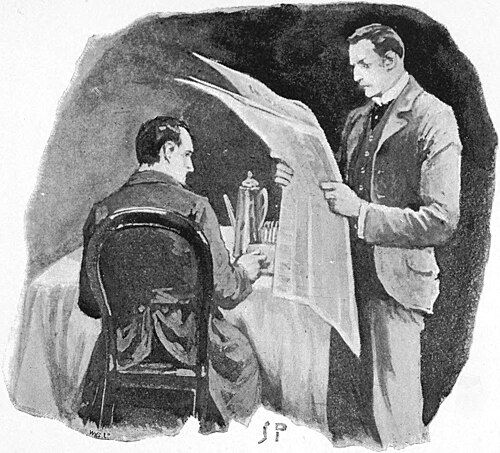
Illustration: Sidney Paget, public domain, via Wikimedia Commons
When I look over my notes on the Sherlock Holmes cases between the years ’82 and ’90, I find so many with strange and interesting features that it’s hard to know which to choose and which to leave. Some have already been written up in the papers. Others gave no room for the particular gifts my friend had in such abundance, the gifts these accounts are meant to show. Some beat even his analytical skill, and would make stories with a beginning and no end. Still others were only partly cleared up, their explanations resting on guesswork rather than the absolute logical proof he loved. One of these last, though, was so remarkable in its details and so startling in its results that I’m tempted to tell it, even though parts of it never have been, and probably never will be, fully explained.
The year ’87 brought us a long run of cases, some more interesting than others, and I still have the records. Under that one twelve months I find the adventure of the Paradol Chamber; the Amateur Mendicant Society, which kept a luxurious club in the lower vault of a furniture warehouse; the loss of the British barque Sophy Anderson; the singular adventures of the Grice Patersons on the island of Uffa; and finally the Camberwell poisoning case. In that last one, as readers may remember, Sherlock Holmes wound up the dead man’s watch and proved that it had been wound two hours before, so the man must have gone to bed within that time. That deduction cracked the case. The trick is plain mechanics. A watch runs on a coiled steel mainspring that gives up its tension at a steady rate as it drives the gears, so the number of turns it takes to wind the spring back to full tells you how long it has been running down. A spring that takes only a few turns was wound recently. I may write up all of these someday, but none of them has anything like the strange chain of events I’m about to describe.
It was late September, and the equinoctial gales, the storms that ride in around the autumn equinox, had set in with unusual violence. All day the wind had screamed and the rain had beaten against the windows, so that even here in the heart of great, hand-made London we had to lift our minds from routine for a moment and recognize those great elemental forces that shriek at mankind through the bars of his civilization, like untamed beasts in a cage. As evening came on, the storm grew higher and louder, and the wind cried and sobbed like a child in the chimney. Sherlock Holmes sat moodily on one side of the fireplace, cross-indexing his records of crime, while I sat on the other, deep in one of Clark Russell’s fine sea-stories, until the howl of the gale outside seemed to blend with the page and the splash of the rain stretched into the long swash of ocean waves. My wife was visiting her mother, and for a few days I was living once more in my old rooms at Baker Street.
“Why,” I said, glancing up at my companion, “that was surely the bell. Who could be coming tonight? A friend of yours, perhaps?”
“Except for you, I have none,” he answered. “I don’t encourage visitors.”
“A client, then?”
“If so, it’s a serious case. Nothing less would bring a man out on such a day and at such an hour. But I expect it’s more likely one of the landlady’s cronies.”
Holmes was wrong, though. There came a step in the passage and a tap at the door. He stretched out his long arm and turned the lamp away from himself and toward the empty chair where a newcomer would have to sit. It was an old habit of his: the visitor’s face in full light, his own in shadow.
“Come in!” he said.
The man who entered was young, twenty-two at the very most, well-groomed and neatly dressed, with something refined and delicate in his bearing. The streaming umbrella in his hand and his long, shining waterproof coat told of the fierce weather he had come through. He looked around anxiously in the glare of the lamp, and I could see that his face was pale and his eyes heavy, like those of a man weighed down by some great worry.
“I owe you an apology,” he said, lifting his gold pince-nez to his eyes. “I hope I’m not intruding. I’m afraid I’ve brought some of the storm into your snug room.”
“Give me your coat and umbrella,” said Holmes. “They can hang here on the hook and will be dry soon enough. You’ve come up from the southwest, I see.”
“Yes, from Horsham.”
“That mixture of clay and chalk on your toe caps is quite distinctive.”
Once he’d said it, I saw it too: a smear of sticky, dun-colored mud on the young man’s boots, flecked with something white and crumbly. I worked it out as I looked. The country south of London lies in bands, like a cut cake: the heavy clay of the Weald around Horsham, ringed by the white chalk of the Downs. Chalk is made of the calcium carbonate shells of countless tiny sea plankton, laid down on an ancient seabed, and it crumbles onto anything that brushes it. Clay is made of mineral grains so fine that it clings like paste when wet. Find both on one toe cap and you’ve as good as read the man’s railway ticket.
“I’ve come for advice,” said the young man.
“That’s easily got.”
“And help.”
“That isn’t always so easy.”
“I’ve heard of you, Mr. Holmes. Major Prendergast told me how you saved him in the Tankerville Club scandal.”
“Ah, of course. He was wrongly accused of cheating at cards.”
“He said you could solve anything.”
“He said too much.”
“That you are never beaten.”
“I have been beaten four times—three times by men, and once by a woman.”
“But what is that compared with the number of your successes?”
“It’s true that I have generally been successful.”
“Then you may be so with me.”
“Please, draw your chair up to the fire and give me some details of your case.”
“It is no ordinary one.”
“None of those that come to me are. I am the last court of appeal.”
“And yet I wonder, sir, whether in all your experience you have ever listened to a more mysterious and inexplicable chain of events than the ones that have happened in my own family.”
“You fill me with interest,” said Holmes. “Give us the essential facts from the beginning, and afterward I can ask about the details that seem most important to me.”
The young man pulled his chair up and pushed his wet feet out toward the blaze.
“My name,” he said, “is John Openshaw, but as far as I can tell, my own affairs have little to do with this awful business. It’s an inherited matter, so to give you the facts I have to go back to the start.
“My grandfather had two sons: my uncle Elias and my father, Joseph. My father had a small factory at Coventry, which he enlarged when bicycling was invented. He held the patent on the Openshaw unbreakable tire, and his business did so well that he was able to sell it and retire on a comfortable fortune.
“My uncle Elias emigrated to America as a young man and became a planter in Florida, where he was said to have done very well. In the war he fought in Jackson’s army, and afterward under Hood, where he rose to be a colonel. When Lee surrendered, my uncle went back to his plantation and stayed there three or four years. Around 1869 or 1870 he came back to Europe and took a small estate in Sussex, near Horsham. He had made a very large fortune in the States, and he left them because he hated Black people and hated the Republican policy of giving them the vote. He was a strange man, fierce and quick-tempered, very foul-mouthed when angry, and extremely private. In all the years he lived at Horsham, I doubt he ever set foot in the town. He had a garden and two or three fields around the house, and he took his exercise there, though often for weeks on end he never left his room. He drank a great deal of brandy and smoked heavily, but he would see no one and wanted no friends, not even his own brother.

Illustration: Sidney Paget, public domain, via Wikimedia Commons
“He didn’t mind me. In fact, he took a liking to me, for when he first saw me I was a youngster of twelve or so. That would have been in 1878, after he’d been eight or nine years in England. He begged my father to let me live with him, and he was very kind to me in his way. When he was sober he liked to play backgammon and draughts—checkers—with me, and he made me his go-between with the servants and the tradespeople, so that by sixteen I was quite the master of the house. I kept all the keys and could go where I liked and do what I liked, as long as I didn’t disturb his privacy. There was one odd exception. He had a single room, a lumber-room up among the attics, which was always locked, and which he would never let me or anyone else enter. With a boy’s curiosity I peeped through the keyhole, but I never saw more than the old trunks and bundles you’d expect in such a room.
“One day—it was in March, 1883—a letter with a foreign stamp lay on the table beside the colonel’s plate. He rarely got letters, since he paid all his bills in cash and had no friends of any kind. ‘From India!’ he said as he picked it up. ‘Pondicherry postmark! What can this be?’ He tore it open, and out jumped five little dried orange pips, which pattered down onto his plate. I started to laugh, but the laugh died on my lips when I saw his face. His jaw had dropped, his eyes were bulging, his skin was the color of putty, and he glared at the envelope still shaking in his hand. ‘K. K. K.!’ he shrieked, and then, ‘My God, my God, my sins have overtaken me!’
“‘What is it, uncle?’ I cried.
“‘Death,’ he said, and he got up from the table and went to his room, leaving me trembling with horror. I picked up the envelope and saw, scrawled in red ink on the inner flap just above the gum, the letter K three times. There was nothing else but the five dried pips. What could explain his terror? I left the breakfast table, and as I went up the stairs I met him coming down, an old rusty key in one hand—it must have been the attic key—and a small brass box, like a cashbox, in the other.
“‘They may do what they like, but I’ll checkmate them still,’ he said, with an oath. ‘Tell Mary I’ll want a fire in my room today, and send for Fordham, the Horsham lawyer.’
“I did as he said, and when the lawyer arrived I was asked to step up to the room. The fire was burning brightly, and in the grate lay a mass of black, fluffy ashes, as if from burned paper. The brass box stood open and empty beside it. As I glanced at the box I noticed, with a start, that the lid was printed with the same treble K I’d seen that morning on the envelope.
“‘John,’ my uncle said, ‘I want you to witness my will. I leave my estate, with all its advantages and all its disadvantages, to my brother, your father, and from him it will no doubt come down to you. If you can enjoy it in peace, well and good! If you find you can’t, take my advice, my boy, and leave it to your deadliest enemy. I’m sorry to hand you such a two-edged thing, but I can’t say what turn things will take. Kindly sign where Mr. Fordham shows you.’
“I signed as directed, and the lawyer took the paper away. As you can imagine, the whole incident made the deepest impression on me. I turned it over every way in my mind and could make nothing of it. I couldn’t shake off the vague dread it left behind, though it faded as the weeks passed and nothing disturbed our usual routine. But I could see a change in my uncle. He drank more than ever, and he wanted company even less. He spent most of his time in his room with the door locked from the inside, but sometimes he would come out in a kind of drunken frenzy, burst out of the house, and tear around the garden with a revolver in his hand, screaming that he was afraid of no man and wouldn’t be penned up like a sheep by man or devil. When these fits passed, he would rush back inside and lock and bar the door behind him, like a man who can’t bluff any longer against the terror at the roots of his soul. At such times I’ve seen his face, even on a cold day, glisten with moisture, as if he’d just lifted it from a basin.

Illustration: Sidney Paget, public domain, via Wikimedia Commons
“To come to the end of it, Mr. Holmes, and not try your patience, there came a night when he went out on one of those drunken rampages and never came back. When we went looking for him, we found him face down in a little green-scummed pool at the foot of the garden. There was no sign of violence, and the water was only two feet deep, so the jury, knowing how eccentric he was, returned a verdict of ‘suicide.’ But I knew how he flinched from the very thought of death, and I could hardly believe he’d gone out of his way to meet it. Still, the matter passed. My father took over the estate, and some £14,000 that lay to his credit at the bank.”
I had seen that cold-day sweat in my own practice, and I knew it for what it was. Fear opens the sweat glands as surely as heat does; the body readies itself to run or fight, and the skin floods whether the room is warm or not. The colonel had been sweating out pure terror.
“One moment,” Holmes broke in. “Your story is, I can see already, one of the most remarkable I have ever heard. Give me the date your uncle received the letter, and the date of his supposed suicide.”
“The letter came on March 10, 1883. He died seven weeks later, on the night of May 2nd.”
“Thank you. Please go on.”
“When my father took over the Horsham property, he made a careful search of the attic that had always been locked, at my request. We found the brass box there, though its contents were gone. Inside the lid was a paper label with the initials K. K. K. on it, and beneath them, written by hand, ‘Letters, memoranda, receipts, and a register.’ We assume that described the papers Colonel Openshaw destroyed. Otherwise there was nothing of much importance in the attic except a great many loose papers and notebooks about my uncle’s life in America. Some were from the war, and showed he had done his duty well and had a name as a brave soldier. Others dated from the Reconstruction of the Southern states and were mostly political, for he had plainly taken a strong part in opposing the Northern politicians who had been sent down South, the ones their enemies called ‘carpet-baggers.’
“It was the beginning of ’84 when my father came to live at Horsham, and everything went as well as could be until January of ’85. On the fourth day after New Year’s, as we sat together at breakfast, I heard my father give a sharp cry of surprise. There he sat, a freshly opened envelope in one hand and five dried orange pips in the outstretched palm of the other. He had always laughed at what he called my cock-and-bull story about the colonel, but he looked scared and puzzled now that the same thing had happened to him.
“‘Why, what on earth does this mean, John?’ he stammered.
“My heart had turned to lead. ‘It is K. K. K.,’ I said.
“He looked inside the envelope. ‘So it is,’ he cried. ‘Here are the very letters. But what’s this written above them?’
“‘Put the papers on the sundial,’ I read, peering over his shoulder.
“‘What papers? What sundial?’ he asked.
“‘The sundial in the garden. There is no other,’ I said. ‘But the papers must be the ones that were destroyed.’
“‘Pooh!’ he said, gripping hard at his courage. ‘This is a civilized country, and we won’t have tomfoolery of this kind. Where does the thing come from?’
“‘From Dundee,’ I answered, looking at the postmark.
“‘Some ridiculous practical joke,’ he said. ‘What do I have to do with sundials and papers? I’ll pay no attention to such nonsense.’
“‘I would certainly speak to the police,’ I said.

Illustration: Sidney Paget, public domain, via Wikimedia Commons
“‘And be laughed at for my trouble. Nothing of the sort.’
“‘Then let me do it?’
“‘No, I forbid it. I won’t have a fuss made over such nonsense.’
“There was no arguing with him; he was a very stubborn man. But I went about with a heart full of dread.
“On the third day after the letter came, my father went to visit an old friend, Major Freebody, who commands one of the forts on Portsdown Hill. I was glad he went, for I thought he was farther from danger away from home. I was wrong. On the second day of his absence I got a telegram from the major begging me to come at once. My father had fallen into one of the deep chalk-pits that are everywhere in that neighborhood, and was lying unconscious with a shattered skull. I hurried to him, but he died without ever waking. He had apparently been walking back from Fareham at dusk, and since he didn’t know the country and the chalk-pit had no fence, the jury had no hesitation in returning a verdict of ‘death from accidental causes.’ I went over every fact of his death as carefully as I could, and I found nothing that pointed to murder. No signs of violence, no footprints, no robbery, no report of strangers seen on the roads. And yet I don’t need to tell you that my mind was far from easy. I was all but certain some foul plot had been woven around him.
“That is the grim way I came into my inheritance. You’ll ask why I didn’t get rid of it. Because I was convinced our troubles came from something in my uncle’s life, and that the danger would follow us to any house we lived in.
“It was in January, ’85, that my poor father died, and two years and eight months have passed since then. In that time I’ve lived happily at Horsham, and I’d begun to hope the curse had left the family and ended with the last generation. I took comfort too soon. Yesterday morning the blow fell, in exactly the shape it took with my father.”
The young man took a crumpled envelope from his waistcoat, turned to the table, and shook out five little dried orange pips.
“This is the envelope,” he went on. “The postmark is London, eastern division. Inside are the very words from my father’s last message: ‘K. K. K.,’ and then ‘Put the papers on the sundial.’”
“What have you done?” asked Holmes.
“Nothing.”
“Nothing?”
“To tell the truth”—he sank his face into his thin, white hands—“I’ve felt helpless. I’ve felt like one of those poor rabbits when the snake is sliding toward it. I seem to be in the grip of some unstoppable, relentless evil that no foresight and no precautions can guard against.”
“Tut! tut!” cried Sherlock Holmes. “You must act, man, or you are lost. Nothing but energy can save you. This is no time for despair.”
“I have seen the police.”
“Ah!”
“But they listened to my story with a smile. I’m sure the inspector thinks the letters are all practical jokes, and that my relatives’ deaths really were accidents, as the juries said, and have nothing to do with the warnings.”
Holmes shook his clenched fists in the air. “Incredible imbecility!” he cried.
“They have, though, given me a policeman, who can stay in the house with me.”
“Did he come with you tonight?”
“No. His orders were to stay in the house.”
Holmes raged at the air again.
“Why did you come to me?” he said. “And above all, why didn’t you come at once?”
“I didn’t know about you. It was only today that I told Major Prendergast about my troubles, and he advised me to come to you.”
“It’s really two days since you got the letter. We should have acted before this. I suppose you have no evidence beyond what you’ve put in front of us? No telling detail that might help us?”
“There is one thing,” said John Openshaw. He rummaged in his coat pocket, drew out a piece of faded, blue-tinted paper, and laid it on the table. “I remember,” he said, “that on the day my uncle burned the papers, I noticed the little unburned margins lying among the ashes were this same color. I found this single sheet on the floor of his room, and I think it may be one of those papers—that it fluttered out from among the others and so escaped the fire. Apart from mentioning pips, I don’t see that it helps us much. I think it’s a page from a private diary. The handwriting is certainly my uncle’s.”
Those unburned margins made sense to me. Fire needs air as much as fuel, and a thick wad of pages pushed into a grate starves its own flame; the outer sheets char and curl while the edges pressed tight together never get enough oxygen to catch. A man burning a whole register in a hurry would leave exactly that kind of blue fringe behind.
Holmes moved the lamp, and we both bent over the sheet. Its ragged edge showed it had indeed been torn from a book. It was headed “March, 1869,” and beneath were these puzzling entries:
“4th. Hudson came. Same old platform.
“7th. Set the pips on McCauley, Paramore, and John Swain of St. Augustine.
“9th. McCauley cleared.
“10th. John Swain cleared.
“12th. Visited Paramore. All well.”
“Thank you!” said Holmes, folding up the paper and handing it back to our visitor. “And now you must not lose another instant. We can’t spare time even to discuss what you’ve told me. You must go home at once and act.”
“What shall I do?”
“There is only one thing to do, and it must be done immediately. Put this piece of paper you’ve shown us into the brass box you described. Put in a note as well, saying that your uncle burned all the other papers and this is the only one left. Say it in words that will carry conviction. Having done that, put the box out on the sundial at once, as directed. Do you understand?”
“Entirely.”
“Don’t think about revenge or anything of the sort for now. I think we may get that through the law, but we have our web to weave, while theirs is already woven. The first thing is to remove the danger hanging over you. The second is to clear up the mystery and punish the guilty.”
“Thank you,” said the young man, standing and pulling on his overcoat. “You’ve given me fresh life and hope. I’ll certainly do as you say.”
“Don’t lose an instant. And above all, take care of yourself in the meantime, for I have no doubt you are threatened by a very real and immediate danger. How are you getting back?”
“By train from Waterloo.”
“It isn’t yet nine. The streets will be crowded, so I hope you’ll be safe. And yet you can’t guard yourself too closely.”
“I am armed.”
“Good. Tomorrow I’ll set to work on your case.”
“I’ll see you at Horsham, then?”
“No, your secret lies in London. That’s where I’ll look for it.”
“Then I’ll call on you in a day or two with news about the box and the papers. I’ll follow your advice in every detail.” He shook hands with us and left. Outside, the wind still screamed and the rain splashed and pattered against the windows. This strange, wild story seemed to have come to us out of the mad elements, blown in on us like a sheet of seaweed in a gale, and now to have been swallowed up by them again.
Sherlock Holmes sat for some time in silence, his head sunk forward, his eyes fixed on the red glow of the fire. Then he lit his pipe, leaned back in his chair, and watched the blue smoke rings chase each other up to the ceiling. Each one held its shape far longer than a puff of smoke had any right to, and I knew why: a smoke ring is air spinning around itself like a rolled-up sleeve, and that spin keeps it together as it drifts, until friction with the still air around it finally wears it out.
“I think, Watson,” he said at last, “that of all our cases we have had none more fantastic than this.”
“Except, perhaps, the Sign of Four.”
“Well, yes. Except, perhaps, that. And yet this John Openshaw seems to me to be walking among even greater dangers than the Sholtos did.”
“But have you,” I asked, “formed any clear idea of what these dangers are?”
“There can be no question about their nature,” he answered.
“Then what are they? Who is this K. K. K., and why does he hound this unhappy family?”
Sherlock Holmes closed his eyes, set his elbows on the arms of his chair, and put his fingertips together. “The ideal reasoner,” he said, “would, once shown a single fact in all its bearings, deduce from it not only the whole chain of events that led up to it, but also all the results that would follow from it. As Cuvier could correctly describe a whole animal by studying a single bone, so the observer who has thoroughly understood one link in a series of incidents should be able to state all the others accurately, both before and after. We have not yet grasped the results that reason alone can reach. Problems may be solved in the study that have baffled everyone who sought a solution with the help of their senses. To carry the art to its highest pitch, though, the reasoner must be able to use every fact he knows, and that, as you’ll readily see, implies possessing all knowledge, which, even in these days of free education and encyclopedias, is a fairly rare accomplishment. It isn’t so impossible, however, for a man to possess all the knowledge likely to be useful to him in his work, and that I have tried to do. If I remember rightly, in the early days of our friendship you once defined my limits very precisely.”
I knew the Cuvier he meant. The great French naturalist held that an animal’s parts must fit together like the parts of a machine: a tooth built to slice meat demands jaws that can bite, claws that can hold prey, and a gut that can digest it. Hand him a fang and he could sketch the beast. Holmes meant to do the same with a crime.
“Yes,” I answered, laughing. “It was a singular document. Philosophy, astronomy, and politics were marked at zero, as I remember. Botany variable, geology profound as regards the mud-stains from any region within fifty miles of town, chemistry eccentric, anatomy unsystematic, sensational literature and crime records unique, violin player, boxer, swordsman, lawyer, and self-poisoner by cocaine and tobacco. Those, I think, were the main points of my analysis.”
Holmes grinned at the last item. “Well,” he said, “I say now, as I said then, that a man should keep his little brain-attic stocked with all the furniture he is likely to use, and the rest he can put away in the lumber-room of his library, where he can get it if he wants it. Now, for a case like the one brought to us tonight, we certainly need to muster all our resources. Kindly hand me down the letter K of the American Encyclopædia on the shelf beside you. Thank you. Now let’s consider the situation and see what can be deduced from it. First, we may start with a strong presumption that Colonel Openshaw had some very strong reason for leaving America. Men his age don’t change all their habits and willingly trade the charming climate of Florida for the lonely life of an English country town. His extreme love of solitude in England suggests he was afraid of someone or something, so we may take it as a working hypothesis that it was fear of someone or something that drove him out of America. As to what he feared, we can only deduce that from the fearsome letters received by him and his heirs. Did you notice the postmarks on those letters?”
“The first was from Pondicherry, the second from Dundee, and the third from London.”
“From East London. What do you deduce from that?”
“They’re all seaports. That the writer was on board a ship.”
“Excellent. We already have a clue. There can be no doubt that the probability—the strong probability—is that the writer was on board a ship. Now consider another point. With Pondicherry, seven weeks passed between the threat and its fulfillment. With Dundee, it was only three or four days. Does that suggest anything?”
“A greater distance to travel.”
“But the letter also had a greater distance to come.”
“Then I don’t see the point.”
“There is at least a presumption that the vessel the man or men are on is a sailing-ship. It looks as if they always send their strange warning or token ahead of them when they set out on their mission. You see how quickly the deed followed the sign when it came from Dundee. If they had come from Pondicherry in a steamer, they would have arrived almost as soon as their letter. But in fact seven weeks went by. I think those seven weeks represent the difference between the mail-boat that brought the letter and the sailing vessel that brought the writer.”

Illustration: Sidney Paget, public domain, via Wikimedia Commons
I turned it over and felt the logic click into place. A mail steamer burns coal and keeps a timetable; from India it runs up through the Suez Canal and the Mediterranean, the short way home. A sailing ship goes only where the wind allows, and the narrow canal is no place for one, so it usually takes the long way around the Cape of Good Hope, at the mercy of calms and headwinds. Post a letter on the steamer and board the sailing ship the same day, and the letter wins by weeks. From Dundee, a short coasting run, there would be hardly any gap at all.
“It’s possible,” I said.
“More than that. It’s probable. And now you see the deadly urgency of this new case, and why I urged young Openshaw to be careful. The blow has always fallen at the end of the time it would take the senders to travel the distance. But this one comes from London, so we can’t count on any delay.”
“Good God!” I cried. “What can it mean, this relentless persecution?”
“The papers Openshaw carried are obviously of vital importance to the person or persons on the sailing-ship. I think it’s quite clear there must be more than one of them. A single man couldn’t have carried out two deaths in a way that fooled a coroner’s jury. There must have been several, and they must have been men of resource and determination. They mean to have their papers, whoever holds them. So you see, K. K. K. stops being the initials of a person and becomes the badge of a society.”
“But what society?”
“Have you never—” said Sherlock Holmes, leaning forward and lowering his voice—“have you never heard of the Ku Klux Klan?”
“I never have.”
Holmes turned the pages of the book on his knee. “Here it is,” he said after a moment:
“‘Ku Klux Klan. A name derived from the fanciful resemblance to the sound produced by cocking a rifle. This terrible secret society was formed by some ex-Confederate soldiers in the Southern states after the Civil War, and it rapidly formed local branches in different parts of the country, notably in Tennessee, Louisiana, the Carolinas, Georgia, and Florida. Its power was used for political purposes, principally for the terrorizing of Black voters and the murdering and driving from the country of those who were opposed to its views. Its outrages were usually preceded by a warning sent to the marked man in some fantastic but generally recognized shape—a sprig of oak leaves in some parts, melon seeds or orange pips in others. On receiving this the victim might either openly renounce his former ways, or might flee the country. If he braved the matter out, death would unfailingly come upon him, and usually in some strange and unforeseen manner. So perfect was the organization of the society, and so systematic its methods, that there is hardly a case on record where any man succeeded in braving it with impunity, or in which any of its outrages were traced home to the perpetrators. For some years the organization flourished in spite of the efforts of the United States government and of the better classes of the community in the South. Eventually, in the year 1869, the movement rather suddenly collapsed, although there have been sporadic outbreaks of the same sort since that date.’”
Let me say plainly what that dry entry only half says. This was a band of masked terrorists. Its purpose was to keep the freed Black people of the South from voting and from living as free citizens, and to kill or drive out anyone, Black or white, who stood with them. Colonel Elias Openshaw had belonged to it.
“You’ll notice,” said Holmes, laying down the volume, “that the sudden breakup of the society came at the same time Openshaw vanished from America with their papers. It may well have been cause and effect. No wonder he and his family have some of the more ruthless members on their trail. You can see that this register and diary may implicate some of the leading men in the South, and that there may be many who won’t sleep easy at night until it’s recovered.”
“Then the page we saw—”
“Is just what we might expect. It ran, if I remember right, ‘sent the pips to A, B, and C’—that is, sent them the society’s warning. Then come entries that A and B cleared, or left the country, and finally that C was visited, with, I fear, a grim result for C. Well, Doctor, I think we may let some light into this dark place, and I believe young Openshaw’s only chance in the meantime is to do what I’ve told him. There’s nothing more to be said or done tonight, so hand me my violin, and let’s try to forget for half an hour the miserable weather and the still more miserable ways of our fellow men.”
By morning it had cleared, and the sun shone with a subdued brightness through the dim veil that hangs over the great city. Sherlock Holmes was already at breakfast when I came down.
“You’ll excuse me for not waiting,” he said. “I foresee a very busy day ahead of me, looking into young Openshaw’s case.”
“What steps will you take?” I asked.
“That depends a great deal on the results of my first inquiries. I may have to go down to Horsham after all.”
“You won’t go there first?”
“No, I’ll start with the City. Just ring the bell, and the maid will bring up your coffee.”
While I waited, I picked up the unopened newspaper from the table and ran my eye over it. It stopped on a headline that sent a chill to my heart.
“Holmes,” I cried, “you’re too late.”
“Ah!” he said, setting down his cup. “I feared as much. How was it done?” He spoke calmly, but I could see he was deeply moved.
“My eye caught the name Openshaw, and the headline ‘Tragedy Near Waterloo Bridge.’ Here’s the account:
“‘Between nine and ten last night Police-Constable Cook, of the H Division, on duty near Waterloo Bridge, heard a cry for help and a splash in the water. The night, however, was extremely dark and stormy, so that, in spite of the help of several passers-by, it was quite impossible to effect a rescue. The alarm was given, however, and with the aid of the water-police the body was eventually recovered. It proved to be that of a young gentleman whose name, as appears from an envelope found in his pocket, was John Openshaw, and whose residence is near Horsham. It is thought that he may have been hurrying to catch the last train from Waterloo Station, and that in his haste and the extreme darkness he missed his path and walked over the edge of one of the small landing-places for river steamboats. The body showed no traces of violence, and there can be no doubt that the deceased was the victim of an unfortunate accident, which should have the effect of calling the attention of the authorities to the condition of the riverside landing-stages.’”

Illustration: Sidney Paget, public domain, via Wikimedia Commons
We sat in silence for some minutes, Holmes more depressed and shaken than I had ever seen him.
“That hurts my pride, Watson,” he said at last. “It’s a petty feeling, no doubt, but it hurts my pride. It’s a personal matter with me now, and if God sends me health, I shall lay my hand on this gang. That he should come to me for help, and that I should send him away to his death—!” He sprang from his chair and paced the room in uncontrollable agitation, a flush on his sallow cheeks, his long thin hands clasping and unclasping.
“They must be cunning devils,” he burst out at last. “How could they have lured him down there? The Embankment isn’t on the direct route to the station. The bridge, no doubt, was too crowded for their purpose, even on such a night. Well, Watson, we’ll see who wins in the long run. I’m going out now!”
“To the police?”
“No. I shall be my own police. When I have spun the web they may take the flies, but not before.”
All day I was busy with my medical practice, and it was late in the evening before I got back to Baker Street. Sherlock Holmes hadn’t returned yet. It was nearly ten o’clock when he came in, looking pale and worn. He went to the sideboard, tore a piece from the loaf, and wolfed it down, washing it down with a long drink of water.
“You’re hungry,” I said.
“Starving. It had slipped my mind. I’ve had nothing since breakfast.”
“Nothing?”
“Not a bite. I had no time to think of it.”
“And how have you done?”
“Well.”
“You have a clue?”
“I have them in the hollow of my hand. Young Openshaw won’t go unavenged for long. Why, Watson, let’s put their own devilish trademark on them. It’s well thought of!”
“What do you mean?”
He took an orange from the cupboard, tore it apart, and squeezed the pips out onto the table. He picked out five and pushed them into an envelope. On the inside of the flap he wrote “S. H. for J. O.” Then he sealed it and addressed it to “Captain James Calhoun, Barque Lone Star, Savannah, Georgia.”
“That will be waiting for him when he makes port,” he said, chuckling. “It may give him a sleepless night. He’ll find it as sure a sign of his fate as Openshaw did before him.”
“And who is this Captain Calhoun?”
“The leader of the gang. I’ll have the others, but him first.”
“How did you trace it, then?”
He took a large sheet of paper from his pocket, covered with dates and names.
“I’ve spent the whole day,” he said, “over Lloyd’s registers and files of old newspapers, following the later career of every vessel that touched at Pondicherry in January and February of ’83.”
I saw the beauty of it at once. Lloyd’s of London is the heart of marine insurance, and so its agents in ports around the world report where ships are seen, when they arrive and when they clear. It is a great ledger of the sea, and Holmes had used it the way an astronomer uses a star catalog: plot each vessel’s track, then look for the one that passes through all your points.
“There were thirty-six ships of fair tonnage reported there in those months,” he went on. “Of these, one, the Lone Star, caught my attention immediately, because although she was reported as having cleared from London, her name is one given to one of the states of the Union.”
“Texas, I think.”
“I wasn’t and am not sure which, but I knew the ship must be of American origin.”
“What then?”
“I searched the Dundee records, and when I found that the barque Lone Star was there in January, ’85, my suspicion became a certainty. Then I asked which vessels are lying in the port of London right now.”
“Yes?”
“The Lone Star arrived here last week. I went down to the Albert Dock and found she had been taken down the river on the early tide this morning, homeward bound for Savannah. I wired Gravesend and learned she had passed some time ago, and since the wind is easterly, I have no doubt she is now past the Goodwins and not far from the Isle of Wight.”
An east wind was exactly what a ship leaving London would pray for. Once past the Goodwin Sands off the Kent coast, she could run west along the Channel toward the open Atlantic with the wind at her back.
“What will you do, then?”
“Oh, I have my hand on him. He and the two mates, I’m told, are the only native-born Americans on the ship. The others are Finns and Germans. I also know all three were away from the ship last night. I had it from the stevedore who’s been loading their cargo. By the time their sailing-ship reaches Savannah, the mail-boat will have carried this letter, and the cable will have told the Savannah police that these three gentlemen are badly wanted here on a charge of murder.”
And there it was, the same trick turned around on them. They had used the gap between steam and sail to send their warnings ahead of them. Now Holmes would use a gap wider still. A steamer would outrun the Lone Star across the Atlantic by weeks, and the telegraph cable on the seabed would outrun them both. A signal through that wire crosses the ocean in a moment, and the police on the far side would have it before the ship had cleared the Channel. The hunters would sail into port with their own warning waiting for them.
But there is always a flaw in the best-laid human plans, and the murderers of John Openshaw were never to receive the orange pips that would have told them someone as cunning and as determined as they were was on their trail. The equinoctial gales that year were very long and very severe. We waited a long time for news of the Lone Star of Savannah, but none ever reached us. At last we did hear that somewhere far out in the Atlantic a shattered stern-post from a boat had been seen swinging in the trough of a wave, with the letters “L. S.” carved on it, and that is all we will ever know of the fate of the Lone Star.