The Adventure of the Engineer’s Thumb
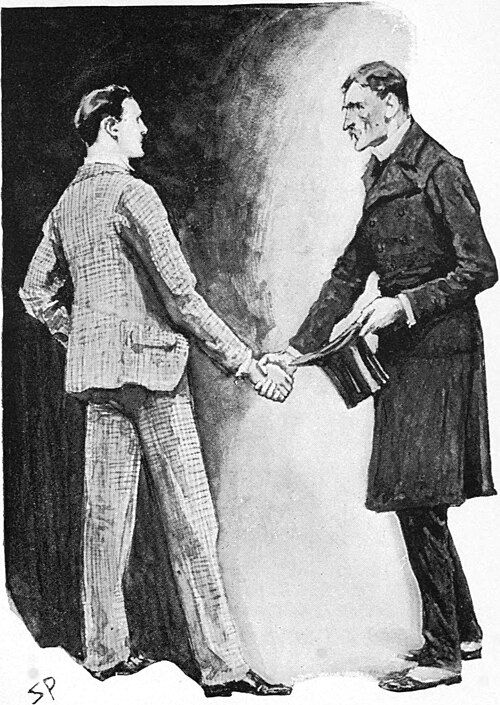
Illustration: Sidney Paget, public domain, via Wikimedia Commons
Of all the problems brought to my friend Mr. Sherlock Holmes in the years we worked together, only two came to him through me: the case of Mr. Hatherley’s thumb, and the case of Colonel Warburton’s madness. The second may have given a sharp, original observer more to work with. But the first began so strangely and played out so dramatically that it may be the more worth putting on record, even though it gave my friend fewer chances to use the methods of deduction that won him such remarkable results. The newspapers have told the story more than once. Like every such account, though, it loses most of its force when it is packed into half a column of print. It hits much harder when the facts unfold in front of you and the mystery clears a little with each new discovery, until each step has led you to the whole truth. It made a deep impression on me at the time, and two years have done little to weaken it.
It was the summer of ’89, not long after my marriage. I had gone back to private practice and had finally left Holmes to his rooms in Baker Street, though I visited him constantly. Now and then I even talked him into setting aside his Bohemian habits long enough to come and see us. My practice had grown steadily, and since I lived not far from Paddington Station, a few of my patients were railway officials. One of these, a guard whom I had cured of a painful, lingering illness, never tired of singing my praises. He sent me every sufferer he could get his hands on.
One morning, a little before seven, the maid tapped on my door to say that two men had come from Paddington and were waiting in the consulting room. I dressed quickly. Experience had taught me that railway cases were seldom trivial. As I came down the stairs, my old ally the guard stepped out of the room and shut the door firmly behind him.
“I’ve got him in there,” he whispered, jerking his thumb over his shoulder. “He’s all right.”
“What is it, then?” I asked. From his manner you would have thought he had caged some strange animal in my room.
“It’s a new patient,” he whispered. “Thought I’d bring him round myself, so he couldn’t slip off. There he is, safe and sound. I have to go now, Doctor. I’ve got my duties, same as you.” And off he went, my faithful recruiter, before I could even thank him.
In the consulting room I found a gentleman sitting by the table. He was quietly dressed in a heather-tweed suit, and he had set his soft cloth cap down on my books. One of his hands was wrapped in a handkerchief blotched all over with blood. He was young, no more than twenty-five, I guessed, with a strong, manly face. But he was very pale, and he looked like a man holding down some violent agitation by sheer force of will.
“I’m sorry to wake you so early, Doctor,” he said, “but I had a very serious accident during the night. I came in by train this morning, and when I asked at Paddington where I might find a doctor, a good fellow kindly walked me here. I gave the maid a card, but I see she’s left it on the side table.”
I picked it up. “Mr. Victor Hatherley, hydraulic engineer, 16A, Victoria Street (3rd floor).” That was my early visitor’s name, profession, and address. “I’m sorry to have kept you waiting,” I said, sitting down in my library chair. “You’ve just come off a night journey, I gather. Those are dull work.”
“Oh, my night couldn’t be called dull,” he said, and laughed. He laughed long and hard, in a high, ringing note, leaning back in his chair and shaking. Every medical instinct I had rose up against that laugh.
“Stop it!” I cried. “Pull yourself together!” And I poured out some water from a carafe.
It was no use. He was in one of those hysterical fits that can seize a strong nature once some great crisis is over. At last he came back to himself, worn out and pale.
“I’ve been making a fool of myself,” he gasped.
“Not at all. Drink this.” I splashed some brandy into the water, and a little color crept back into his bloodless cheeks.
“That’s better!” he said. “And now, Doctor, perhaps you’d be kind enough to see to my thumb. Or rather, to the place where my thumb used to be.”
He unwound the handkerchief and held out his hand. Even my hardened nerves flinched. There were four fingers sticking out, and a horrible red, spongy surface where the thumb should have been. It had been hacked or torn clean out at the root.
“Good heavens!” I cried. “This is a terrible injury. It must have bled a great deal.”
“It did. I fainted when it was done, and I think I must have been out for a long time. When I came to, it was still bleeding, so I tied one end of my handkerchief very tight around the wrist and twisted it up with a twig.”
“Excellent! You should have been a surgeon.”
“It’s a question of hydraulics, you see. It fell within my own line.”

Illustration: Sidney Paget, public domain, via Wikimedia Commons
He was right, and I liked him for it. The heart is a pump. It drives blood through the arteries under pressure, and a severed vessel is simply a burst pipe. Cinch a band around the wrist, use the twig as a lever to wind it tighter and tighter, and you squeeze the artery flat until the pump can no longer force anything past the closure. Any engineer who knew his valves would have reached for the same trick.
“This was done,” I said, examining the wound, “with a very heavy, sharp instrument.”
“Something like a cleaver,” he said.
“An accident, I suppose?”
“Not at all.”
“What! A murderous attack?”
“Very murderous indeed.”
“You horrify me.”
I sponged the wound, cleaned it, dressed it, and covered it with cotton wadding and carbolized bandages, the carbolic acid in them being our best defense against the invisible germs that turn a clean wound septic. He lay back without flinching, though he bit his lip now and then.
“How is that?” I asked when I had finished.
“Capital! Between your brandy and your bandage, I feel like a new man. I was very weak, but I’ve been through a good deal.”
“Perhaps you’d better not talk about it. It’s clearly hard on your nerves.”
“Oh, no, not now. I’ll have to tell the police, of course. But between ourselves, if it weren’t for the convincing evidence of this wound, I’d be surprised if they believed a word. It’s a very extraordinary story, and I have almost no proof to back it up. And even if they do believe me, the clues I can give them are so vague that I doubt justice will ever be done.”
“Ha!” I said. “If it’s a problem you want solved, I strongly recommend that you see my friend Mr. Sherlock Holmes before you go to the official police.”
“Oh, I’ve heard of that fellow,” said my visitor, “and I’d be very glad if he took it up, though of course I must go to the police as well. Would you give me an introduction?”
“I’ll do better. I’ll take you to him myself.”
“I’d be enormously grateful.”
“We’ll call a cab and go together. We’ll be just in time for a bit of breakfast with him. Do you feel up to it?”
“Yes. I won’t feel easy until I’ve told my story.”
“Then my servant will call a cab, and I’ll be with you in a moment.” I dashed upstairs, explained things briefly to my wife, and within five minutes I was in a hansom, one of those quick two-wheeled cabs, rattling with my new acquaintance toward Baker Street.
Sherlock Holmes was, as I had expected, lounging around his sitting room in his dressing gown. He was reading the personal notices in the agony column of *The Times* and smoking his before-breakfast pipe, which he filled with all the half-burned plugs and leftover dottles from the day before, carefully dried and saved on the corner of the mantelpiece. He greeted us in his quiet, genial way, ordered fresh bacon and eggs, and joined us in a hearty meal. When we had finished, he settled our new acquaintance on the sofa, put a pillow under his head, and set a glass of brandy and water within his reach.
“It’s plain your experience has been no ordinary one, Mr. Hatherley,” he said. “Please, lie there and make yourself completely at home. Tell us what you can, but stop when you’re tired, and keep up your strength with a little stimulant.”
“Thank you,” said my patient, “but I’ve felt like another man since the doctor bandaged me, and I think your breakfast has finished the cure. I’ll take as little of your valuable time as I can, so I’ll start straight in on my strange experiences.”
Holmes sat in his big armchair with that weary, heavy-lidded expression that hid how keen and eager he really was. I sat opposite him, and we listened in silence to our visitor’s strange story.
“You should know,” he said, “that I’m an orphan and a bachelor, living alone in lodgings in London. I’m a hydraulic engineer by profession, and I got plenty of experience in my seven years as an apprentice with Venner & Matheson, the well-known firm in Greenwich. Two years ago I finished my time. My poor father had died and left me a fair sum of money, so I decided to set up on my own, and I took offices in Victoria Street.
“I suppose everyone finds his first start in business a dreary time. For me it’s been exceptionally so. In two years I’ve had three consultations and one small job, and that’s absolutely everything my profession has brought me. My total earnings come to twenty-seven pounds ten shillings. Every day from nine in the morning until four in the afternoon I waited in my little den, until my heart began to sink and I came to believe I’d never have any practice at all.
“Yesterday, though, just as I was thinking of leaving, my clerk came in to say a gentleman was waiting to see me on business. He brought up a card engraved with the name ‘Colonel Lysander Stark.’ Close on his heels came the colonel himself. He was a little above middle height, but extraordinarily thin. I don’t think I’ve ever seen so thin a man. His whole face sharpened away into nose and chin, and the skin of his cheeks was stretched tight over the bones. Yet the thinness seemed natural to him rather than any kind of illness, because his eye was bright, his step brisk, and his manner confident. He was plainly but neatly dressed, and I’d have put his age nearer forty than thirty.
“‘Mr. Hatherley?’ he said, with something of a German accent. ‘You have been recommended to me, Mr. Hatherley, as a man who is not only skilled in his profession but also discreet, and able to keep a secret.’
“I bowed, as flattered as any young man would be. ‘May I ask who gave me such a good character?’
“‘Well, perhaps it’s better I don’t tell you that just now. I have it from the same source that you are an orphan and a bachelor, and that you live alone in London.’
“‘That’s quite correct,’ I said. ‘But forgive me, I can’t see what that has to do with my professional qualifications. I understood you wanted to see me on a professional matter?’
“‘Certainly. But you’ll find that everything I say is to the point. I have a professional job for you, but absolute secrecy is essential. Absolute secrecy, you understand. And naturally we can expect that more from a man who lives alone than from one who lives in the bosom of his family.’
“‘If I promise to keep a secret,’ I said, ‘you can depend on it completely.’
“He looked very hard at me as I spoke. I don’t think I’ve ever seen such a suspicious, probing eye.
“‘Do you promise, then?’ he said at last.
“‘Yes, I promise.’
“‘Complete and total silence, before, during, and after? No mention of the matter at all, spoken or written?’
“‘I’ve already given you my word.’
“‘Very good.’ Suddenly he sprang up, shot across the room like lightning, and flung the door open. The passage outside was empty.
“‘That’s all right,’ he said, coming back. ‘I know clerks are sometimes curious about their masters’ affairs. Now we can talk safely.’ He pulled his chair very close to mine and went back to staring at me with that same probing, thoughtful look.
“Something like disgust, and something close to fear, had begun to rise in me at the odd antics of this fleshless man. Even my dread of losing a client couldn’t keep me from showing impatience.
“‘Please state your business, sir,’ I said. ‘My time is valuable.’ Heaven forgive me for that last sentence, but it was out before I could stop it.
“‘How would fifty guineas for a night’s work suit you?’ he asked.”
I may say here that I very nearly whistled. A guinea was a pound and a shilling, so fifty of them came to fifty-two pounds ten shillings: almost twice what the young man had earned in two whole years.
“‘Admirably,’ I said.
“‘I say a night’s work, but an hour’s would be closer. I simply want your opinion of a hydraulic stamping machine that has gone out of order. If you show us what’s wrong, we’ll soon put it right ourselves. What do you think of that?’
“‘The work sounds light and the pay generous.’
“‘Exactly. We’ll want you to come tonight, by the last train.’
“‘Where to?’
“‘To Eyford, in Berkshire. It’s a small place near the Oxfordshire border, within seven miles of Reading. A train from Paddington will get you there at about 11:15.’
“‘Very good.’
“‘I’ll come down with a carriage to meet you.’
“‘There’s a drive, then?’
“‘Yes, our little place is well out in the country. A good seven miles from Eyford Station.’
“‘Then we can hardly get there before midnight. I suppose there’d be no train back. I’d have to stay the night.’
“‘Yes, we can easily make you up a bed.’
“‘That’s very awkward. Couldn’t I come at a more convenient hour?’
“‘We have decided it’s best you come late. It’s to make up for the inconvenience that we’re paying you, a young and unknown man, a fee that would buy an opinion from the very top of your profession. Still, if you’d rather back out, there’s plenty of time.’
“I thought of the fifty guineas, and how very useful they would be. ‘Not at all,’ I said. ‘I’ll be glad to fit in with your wishes. I would like, though, to understand a little more clearly what you want me to do.’
“‘Of course. It’s only natural that our demand for secrecy has made you curious. I have no wish to commit you to anything without laying it all before you. I suppose we’re quite safe from eavesdroppers?’
“‘Entirely.’
“‘Then here is how matters stand. You probably know that fuller’s-earth is a valuable product, and that it’s found in only one or two places in England?’
“‘I’ve heard so.’”
Holmes stirred slightly at this, and I made a note of it. I knew fuller’s-earth myself: a soft, fine clay that soaks up grease, used by the cloth trade to scour the grease out of woolen cloth. Valuable, certainly. But it is dug from the ground with a spade, like any other clay.
“‘Some time ago,’ the colonel went on, ‘I bought a small place, a very small place, within ten miles of Reading. I was lucky enough to discover a deposit of fuller’s-earth in one of my fields. When I examined it, though, I found that it was fairly small, and that it formed a link between two much larger deposits to the right and left, both of them on my neighbors’ land. These good people had no idea that their ground held something as valuable as a gold mine. Naturally it was in my interest to buy their land before they found out what it was worth. Unfortunately, I had no capital to do it with. So I let a few friends into the secret, and they suggested we quietly work our own little deposit and earn the money to buy the neighboring fields that way. We’ve been doing so for some time, and to help us we put up a hydraulic press. That press, as I said, has gone wrong, and we want your advice. But we guard our secret very jealously. If it got out that hydraulic engineers were visiting our little house, people would start asking questions, and if the facts came out, that would be the end of our chance at those fields. That’s why I made you promise not to tell a living soul you’re going to Eyford tonight. I hope I’ve made it all plain?’
“‘I follow you completely,’ I said. ‘The only thing I don’t quite understand is what use a hydraulic press could be in digging fuller’s-earth, which, as I understand it, is dug out of a pit like gravel.’
“‘Ah!’ he said carelessly. ‘We have our own process. We compress the earth into bricks, so we can move them without anyone seeing what they are. But that’s a mere detail. I’ve taken you fully into my confidence now, Mr. Hatherley, and shown you how I trust you.’ He stood up. ‘I’ll expect you at Eyford, then, at 11:15.’
“‘I’ll certainly be there.’
“‘And not a word to a soul.’ He gave me one last long, searching look, pressed my hand in a cold, clammy grip, and hurried out.
“Well, when I thought it over in cold blood, I was very surprised, as you can imagine, at this sudden commission. On one hand, I was glad. The fee was at least ten times what I’d have asked if I’d set my own price, and the job might lead to others. On the other hand, the man’s face and manner had left a nasty impression, and I couldn’t believe his fuller’s-earth story really explained why I had to come at midnight, or why he was so desperate that I tell no one. Still, I threw my fears to the winds, ate a hearty supper, drove to Paddington, and set off, having obeyed his order to hold my tongue to the letter.
“At Reading I had to change not only trains but stations. I made the last train to Eyford, though, and reached the little dimly lit station after eleven. I was the only passenger to get off, and there was no one on the platform except one sleepy porter with a lantern. But as I passed out through the wicket gate, I found my visitor of the morning waiting in the shadows on the other side. Without a word he grabbed my arm and hurried me into a carriage whose door stood open. He pulled up the windows on both sides, rapped on the woodwork, and off we went as fast as the horse could go.”
“One horse?” Holmes interrupted.
“Yes, just one.”
“Did you notice its color?”
“Yes, I saw it by the side lamps as I got in. It was a chestnut.”
“Tired-looking or fresh?”
“Oh, fresh and glossy.”
“Thank you. I’m sorry to interrupt. Please go on with your most interesting statement.”
I glanced at Holmes. He had asked three questions about a horse and then gone back to studying the ceiling. I had learned long ago that when Holmes asks about something that seems beside the point, it is usually the point. I filed the chestnut away, fresh and glossy, and I would advise any reader to do the same.
“So off we went,” Hatherley continued, “and we drove for at least an hour. Colonel Lysander Stark had said it was only seven miles, but from the pace we seemed to be going and the time it took, I’d have said it was nearer twelve. He sat beside me in silence the whole way, and more than once when I glanced at him I found him watching me intently. The country roads in that part of the world can’t be very good, because we lurched and jolted terribly. I tried to look out and get some idea of where we were, but the windows were frosted glass, and I couldn’t make out anything but the odd bright blur of a passing light.”
Frosted glass, I reflected, is a clever jailer. Its roughened surface scatters every ray of light in a hundred directions, so a lamp outside reaches you as a soft glow with no edges and no shape. You know there is light; you can never tell what it belongs to.
“Now and then I tried a remark to break the monotony, but the colonel answered in single words, and the conversation soon died. At last the bumping of the road gave way to the crisp smoothness of a gravel drive, and the carriage stopped. Colonel Lysander Stark sprang out, and as I followed he pulled me swiftly into a porch that gaped in front of us. We stepped, so to speak, straight from the carriage into the hall, so that I didn’t catch even a glimpse of the front of the house. The moment I was over the threshold, the door slammed heavily behind us, and I faintly heard the wheels rattle away as the carriage drove off.
“It was pitch dark inside. The colonel fumbled about for matches, muttering under his breath. Suddenly a door opened at the far end of the passage, and a long golden bar of light shot toward us. It widened, and a woman appeared holding a lamp above her head, pushing her face forward and peering at us. I could see she was pretty, and from the way the light gleamed on her dark dress I knew it was a rich material. She said a few words in a foreign language, as though asking a question, and when my companion answered with a gruff single word, she started so violently that she nearly dropped the lamp. Colonel Stark went to her, whispered something in her ear, pushed her back into the room she’d come from, and walked back toward me carrying the lamp.
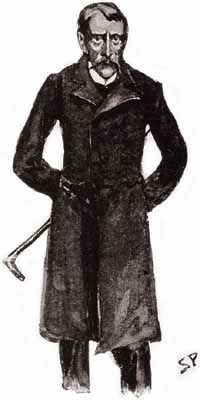
Illustration: Sidney Paget, public domain, via Wikimedia Commons
“‘Perhaps you’ll be kind enough to wait in this room for a few minutes,’ he said, throwing open another door. It was a quiet, small, plainly furnished room with a round table in the center, on which several German books lay scattered. Colonel Stark set the lamp on top of a harmonium by the door. ‘I won’t keep you waiting a moment,’ he said, and vanished into the dark.
“I looked at the books on the table. I don’t read German, but I could see that two were scientific treatises and the rest were poetry. Then I went to the window, hoping for some glimpse of the countryside, but a heavy oak shutter was folded across it and barred. It was an amazingly silent house. An old clock ticked loudly somewhere in the passage, but otherwise everything was deathly still. A vague uneasiness began to creep over me. Who were these German people, and what were they doing living in this strange, out-of-the-way place? And where was it? I was ten miles or so from Eyford; that was all I knew. Whether north, south, east, or west, I had no idea. For that matter, Reading and perhaps other big towns were within that distance, so the place might not be so remote after all. But the dead silence made it certain we were in the country. I paced up and down, humming under my breath to keep up my spirits and feeling that I was thoroughly earning my fifty-guinea fee.
“Suddenly, with no warning sound in all that stillness, the door of my room swung slowly open. The woman stood in the doorway, the dark hall behind her, the yellow light of my lamp falling on her eager, beautiful face. I could see at a glance that she was sick with fear, and the sight chilled my own heart. She held up one shaking finger to warn me to be quiet and whispered a few words of broken English at me, her eyes darting back into the dark behind her like a frightened horse’s.
“‘I would go,’ she said, trying hard, it seemed, to speak calmly. ‘I would go. I should not stay here. There is no good for you to do.’
“‘But, madam,’ I said, ‘I haven’t done what I came for. I can’t possibly leave until I’ve seen the machine.’
“‘It is not worth your while to wait,’ she went on. ‘You can pass through the door; no one hinders.’ Then, seeing me smile and shake my head, she suddenly dropped all restraint and stepped forward, wringing her hands. ‘For the love of Heaven!’ she whispered. ‘Get away from here before it is too late!’
“But I’m a bit headstrong by nature, and all the keener on a thing when someone stands in my way. I thought of my fifty-guinea fee, my tiresome journey, and the unpleasant night that seemed to lie ahead. Was it all to be for nothing? Why should I sneak off without doing my job and without the payment I was owed? For all I knew, the woman was not in her right mind. So, putting a brave face on it, though she’d shaken me more than I liked to admit, I shook my head again and said I meant to stay. She was about to plead with me again when a door slammed overhead and several sets of footsteps sounded on the stairs. She listened for a moment, threw up her hands in despair, and vanished as suddenly and silently as she’d come.
“The newcomers were Colonel Lysander Stark and a short, thick man with a chinchilla beard sprouting from the creases of his double chin. He was introduced to me as Mr. Ferguson.
“‘My secretary and manager,’ said the colonel. ‘By the way, I was under the impression I left this door shut just now. I’m afraid you’ve felt the draft.’
“‘On the contrary,’ I said. ‘I opened it myself. The room felt a little stuffy.’
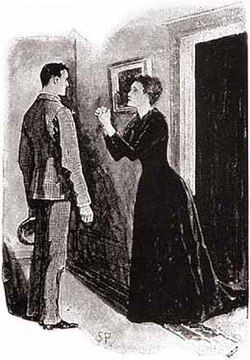
Illustration: Sidney Paget, public domain, via Wikimedia Commons
“He shot me one of his suspicious looks. ‘Perhaps we’d better get down to business, then,’ he said. ‘Mr. Ferguson and I will take you up to see the machine.’
“‘I suppose I’d better put my hat on.’
“‘Oh, no, it’s in the house.’
“‘What, you dig fuller’s-earth in the house?’
“‘No, no. This is only where we compress it. But never mind that. All we want is for you to examine the machine and tell us what’s wrong with it.’
“We went upstairs together, the colonel in front with the lamp, the fat manager and I behind. The old house was a maze of corridors, passages, narrow winding staircases, and little low doors whose thresholds had been worn hollow by generations of feet. Above the ground floor there were no carpets and no furniture at all. Plaster was peeling off the walls, and the damp was breaking through in green, unhealthy blotches. I tried to look as unconcerned as I could, but I hadn’t forgotten the lady’s warning, even if I’d ignored it, and I kept a sharp eye on my two companions. Ferguson seemed a sullen, silent man, but from the little he said I could tell he was at least an Englishman like me.
“Colonel Lysander Stark stopped at last in front of a low door and unlocked it. Inside was a small square room, barely big enough for the three of us. Ferguson stayed outside, and the colonel showed me in.
“‘We are now,’ he said, ‘actually inside the hydraulic press, and it would be particularly unpleasant for us if anyone turned it on. The ceiling of this little chamber is really the end of the descending piston, and it comes down with a force of many tons onto this metal floor. Outside there are small side columns of water that take the force, then pass it on and multiply it in the way you know so well. The machine works readily enough, but it’s stiff, and it has lost some of its power. Perhaps you’ll be good enough to look it over and show us how to set it right.’”
Here the engineer looked at me, and I nodded that I understood, for I did, and it is worth a moment. Water will not squash. Push on it in one place and the pressure is carried, undiminished, to every other surface it touches. So if you press down with a small piston on a narrow column of water, and that water is joined to a wide one under a great piston, the same pressure acts on every square inch of the big piston, and it has a great many more square inches. A man’s strength on a lever becomes the weight of a locomotive on the far side. It is the plainest trade-off in nature: the big piston moves only a fraction as far as the small one, but with many times the force. That room was the jaws of such a machine.
“I took the lamp from him and examined the thing thoroughly,” Hatherley went on. “It was a gigantic machine, capable of enormous pressure. When I went outside, though, and pressed down the levers that worked it, I knew at once from a whishing sound that there was a slight leak, letting water flow back through one of the side cylinders. On examining it, I found that one of the india-rubber bands around the head of a driving rod had shrunk, so that it didn’t quite fill the socket it worked in. That was plainly the cause of the lost power. I pointed it out to my companions, who listened very closely and asked several practical questions about how to fix it.”
A small fault with a large consequence. A rubber seal is the whole secret of the trick: it must fit its socket so snugly that the water has nowhere to go but forward. Let the rubber age and shrink by a hair, and the water, pressed with the force of tons, finds that hair and hisses back the way it came. The pressure bleeds off, and the great piston comes down weak and sluggish.
“When I’d made it all clear to them, I went back into the main chamber and took a good look around, to satisfy my own curiosity. It was obvious at a glance that the fuller’s-earth story was pure invention. It would be absurd to think anyone had built such a powerful engine for so feeble a purpose. The walls were wood, but the floor was a large iron trough, and when I examined it I saw a crust of metallic deposit all over it. I had bent down and was scraping at it to see exactly what it was, when I heard a muttered exclamation in German and saw the colonel’s corpse-like face looking down at me.
“‘What are you doing there?’ he asked.
“I was angry at having been fooled by such an elaborate story. ‘I was admiring your fuller’s-earth,’ I said. ‘I think I’d be better able to advise you about your machine if I knew exactly what it was used for.’
“The instant the words were out, I regretted them. His face set hard, and an evil light sprang into his gray eyes.
“‘Very well,’ he said. ‘You shall know all about the machine.’ He stepped back, slammed the little door, and turned the key. I rushed at it and pulled at the handle, but it held fast and didn’t budge an inch under my kicks and shoves. ‘Hello!’ I yelled. ‘Hello! Colonel! Let me out!’
“And then, in the silence, I heard a sound that put my heart in my mouth. It was the clank of the levers and the swish of the leaking cylinder. He had started the engine. The lamp still stood on the floor where I’d set it while examining the trough. By its light I saw the black ceiling coming down on me, slowly, jerkily, but, as no one knew better than I did, with a force that would grind me to a shapeless pulp within a minute. I threw myself screaming against the door and clawed at the lock. I begged the colonel to let me out, but the merciless clanking of the levers drowned my cries. The ceiling was only a foot or two above my head, and with my hand raised I could feel its hard, rough surface. Then it flashed into my mind that how painful my death was would depend a great deal on the position I met it in. If I lay face down, the weight would come on my spine, and I shuddered to think of that dreadful snap. Easier the other way, perhaps. And yet, did I have the nerve to lie there looking up at that deadly black shadow wavering down at me? I could no longer stand upright, when my eye caught something that sent a rush of hope back into my heart.
“I said that although the floor and ceiling were iron, the walls were wood. As I took a last frantic look around, I saw a thin line of yellow light between two boards. It widened and widened as a small panel was pushed back. For a moment I could hardly believe that here was a door leading away from death. The next moment I hurled myself through it and lay half-fainting on the other side. The panel had closed behind me, but the crash of the lamp, and a few moments later the clang of the two slabs of metal meeting, told me how narrow my escape had been.
“A frantic tugging at my wrist brought me back to myself. I was lying on the stone floor of a narrow corridor, and a woman was bending over me, pulling at me with her left hand while she held a candle in her right. It was the same good friend whose warning I had so foolishly brushed aside.
“‘Come! Come!’ she cried breathlessly. ‘They will be here in a moment. They will see that you are not there. Oh, do not waste the so-precious time, but come!’
“This time, at least, I didn’t scorn her advice. I staggered up and ran with her along the corridor and down a winding stair. It led to another broad passage, and just as we reached it we heard running feet and two voices shouting, one answering the other, one from our floor and one from the floor below. My guide stopped and looked around like someone at her wits’ end. Then she threw open a door into a bedroom, where the moon was shining brightly through the window.
“‘It is your only chance,’ she said. ‘It is high, but it may be that you can jump it.’
“As she spoke, a light sprang up at the far end of the passage, and I saw the lean figure of Colonel Lysander Stark rushing toward us, a lantern in one hand and a weapon like a butcher’s cleaver in the other. I dashed across the bedroom, flung the window open, and looked out. How quiet and sweet and wholesome the garden looked in the moonlight. It couldn’t have been more than thirty feet down. I climbed out onto the sill, but I held off jumping until I’d heard what passed between my rescuer and the ruffian chasing me. If she was harmed, I was determined to go back and help her, whatever the risk. The thought had barely crossed my mind when he reached the door and pushed past her. She threw her arms around him and tried to hold him back.
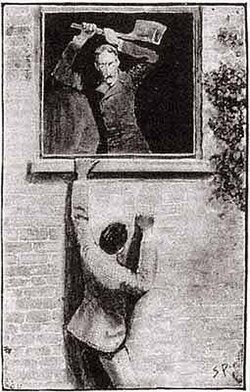
Illustration: Sidney Paget, public domain, via Wikimedia Commons
“‘Fritz! Fritz!’ she cried in English. ‘Remember your promise after the last time. You said it should not be again. He will be silent! Oh, he will be silent!’
“‘You are mad, Elise!’ he shouted, struggling to break free. ‘You will be the ruin of us. He has seen too much. Let me pass, I say!’ He flung her aside, rushed to the window, and slashed at me with his heavy weapon. I had let go and was hanging by my hands from the sill when the blow fell. I felt a dull pain, my grip gave way, and I dropped into the garden below.
“The fall shook me but didn’t hurt me, so I picked myself up and ran off among the bushes as hard as I could, knowing I was far from safe yet. Suddenly, though, as I ran, a deadly dizziness and sickness came over me. I looked down at my hand, which was throbbing painfully, and only then did I see that my thumb had been cut off and that blood was pouring from the wound. I tried to tie my handkerchief around it, but a sudden buzzing filled my ears, and the next moment I fell in a dead faint among the rosebushes.
“How long I was unconscious I can’t say. It must have been a very long time, because the moon had set and a bright morning was breaking when I came to. My clothes were soaked with dew, and my coat sleeve was drenched with blood from my thumb. The sting of it brought back every detail of the night at once, and I jumped to my feet, feeling I might still not be safe from my pursuers. But to my amazement, when I looked around, there was no house and no garden to be seen. I’d been lying in a corner of the hedge beside the main road, and a little way down was a long building that turned out, as I came closer, to be the very station where I’d arrived the night before. If it weren’t for the ugly wound on my hand, everything that had happened in those dreadful hours might have been a bad dream.
“Half dazed, I went into the station and asked about the morning train. There’d be one to Reading in under an hour. The same porter was on duty who’d been there when I arrived. I asked him if he’d ever heard of Colonel Lysander Stark. The name meant nothing to him. Had he seen a carriage waiting for me the night before? No, he hadn’t. Was there a police station anywhere near? There was one about three miles off.
“That was too far for me, weak and ill as I was. I decided to wait until I got back to town to tell the police. It was a little after six when I arrived, so I went first to have my wound dressed, and then the doctor was kind enough to bring me here. I put the case in your hands, and I’ll do exactly what you advise.”
We both sat in silence for a while after this extraordinary story. Then Sherlock Holmes pulled down from the shelf one of the heavy scrapbooks in which he kept his newspaper clippings.
“Here’s an advertisement that will interest you,” he said. “It ran in all the papers about a year ago. Listen: ‘Lost, on the 9th inst., Mr. Jeremiah Hayling, aged twenty-six, a hydraulic engineer. Left his lodgings at ten o’clock at night, and has not been heard of since. Was dressed in,’ et cetera, et cetera. Ha! That marks the last time the colonel needed his machine overhauled, I fancy.”
“Good heavens!” cried my patient. “Then that explains what the girl said.”
“Undoubtedly. It’s quite clear that the colonel was a cool and desperate man, absolutely determined that nothing should stand in the way of his little game, like those out-and-out pirates who leave no survivor from a captured ship. Well, every moment counts now, so if you feel up to it, we’ll go straight to Scotland Yard, and from there start for Eyford.”
About three hours later we were all on the train together, heading from Reading to the little Berkshire village: Sherlock Holmes, the hydraulic engineer, Inspector Bradstreet of Scotland Yard, a plainclothes officer, and me. Bradstreet had spread an ordnance survey map of the county across the seat and was busy with his compasses, drawing a circle with Eyford at its center.
“There you are,” he said. “That circle’s drawn ten miles out from the village. The place we want must be somewhere near that line. Ten miles, you said, I think, sir.”
“It was a good hour’s drive.”
“And you think they brought you all the way back while you were unconscious?”
“They must have. I have a muddled memory, too, of being lifted and carried somewhere.”
“What I can’t understand,” I said, “is why they spared you when they found you fainting in the garden. Perhaps the woman’s pleading softened the villain.”
“I hardly think so. I never saw a more merciless face in my life.”
“Oh, we’ll soon clear all that up,” said Bradstreet. “Well, I’ve drawn my circle, and I only wish I knew where on it the people we’re after are to be found.”
“I think I could put my finger on it,” said Holmes quietly.
“Really, now!” cried the inspector. “You’ve made up your mind! Come on, then, let’s see who agrees with you. I say south, because the country’s emptier there.”
“And I say east,” said my patient.
“I’m for west,” said the plainclothes man. “There are several quiet little villages up that way.”
“And I’m for north,” I said, “because there are no hills there, and our friend says he didn’t notice the carriage climb any.”
“Well!” cried the inspector, laughing. “That’s a pretty spread of opinion. We’ve boxed the compass between us. Who gets your deciding vote?”
“You’re all wrong.”
“But we can’t all be.”
“Oh, yes, you can. This is my point.” He placed his finger in the center of the circle. “This is where we’ll find them.”
“But the twelve-mile drive?” gasped Hatherley.
“Six out and six back. Nothing simpler. You said yourself the horse was fresh and glossy when you got in. How could that be if it had just come twelve miles over heavy roads?”
There it was: the chestnut horse, the thing I had filed away in Baker Street and then forgotten. A horse that has trotted twelve miles on bad roads arrives dark with sweat, its coat dull and its head low; sweat dries to a crust of salt on a horse’s hide, and there had been no time to brush that away while it waited in the shadow of the station. A fresh, glossy horse had not come far. Therefore it had started near the station. Therefore the long, jolting hour was a loop, driven out and back to fake a distance. The rule was simple, the clue had been in plain sight all along, and every one of us, Hatherley included, had looked at it and drawn a circle in the wrong place.
“It’s a likely enough trick, certainly,” said Bradstreet thoughtfully. “Of course, there can’t be any doubt what sort of gang this is.”
“None at all,” said Holmes. “They’re coiners on a large scale, and they’ve used the machine to form the amalgam that has taken the place of silver.”
Then the crust on the iron floor made sense, too. A coiner’s problem is to make a cheap metal pass for silver: pale, bright, and heavy enough in the hand. Press a whitish alloy hard enough, in a die cut with the Queen’s head, and you have a counterfeit half-crown that would fool a busy shopkeeper. To stamp them by the thousand takes exactly what Hatherley had been hired to repair: tons of pressure, delivered again and again. And every blow would leave a little metal smeared on the floor of the press.
“We’ve known for some time that a clever gang was at work,” said the inspector. “They’ve been turning out half-crowns by the thousand. We even traced them as far as Reading, but we couldn’t get any further, because they’d covered their tracks in a way that showed they were very old hands. But now, thanks to this lucky chance, I think we’ve got them, right enough.”
But the inspector was wrong. Those criminals were never to fall into the hands of justice. As we pulled into Eyford Station, we saw a huge column of smoke streaming up from behind a small clump of trees nearby and hanging over the countryside like an immense ostrich feather.
“A house on fire?” asked Bradstreet as the train steamed off again.
“Yes, sir!” said the station-master.
“When did it start?”
“I hear it was during the night, sir, but it’s got worse, and the whole place is ablaze.”
“Whose house is it?”
“Dr. Becher’s.”

Illustration: Sidney Paget, public domain, via Wikimedia Commons
“Tell me,” broke in the engineer, “is Dr. Becher a German, very thin, with a long, sharp nose?”
The station-master laughed heartily. “No, sir. Dr. Becher’s an Englishman, and there isn’t a man in the parish with a better-lined waistcoat. But he has a gentleman staying with him, a patient, as I understand, who’s a foreigner, and he looks as if a bit of good Berkshire beef wouldn’t do him any harm.”
The station-master hadn’t finished before we were all hurrying toward the fire. The road topped a low hill, and in front of us stood a great sprawling whitewashed building, fire spouting from every crack and window, while in the front garden three fire engines struggled in vain to keep the flames down.
“That’s it!” cried Hatherley, wildly excited. “There’s the gravel drive, and there are the rosebushes where I lay. That second window is the one I jumped from.”
“Well, at least,” said Holmes, “you’ve had your revenge on them. There’s no question that it was your oil lamp, crushed in the press, that set the wooden walls on fire, though no doubt they were too caught up in chasing you to notice it at the time. Now keep your eyes open in this crowd for your friends from last night, though I very much fear they’re a good hundred miles away by now.”
It was a neat piece of justice, and good chemistry besides. A lamp crushed flat spills its burning oil across whatever is near, and the walls of that chamber were wooden boards, shut in a closed room where the fire could smolder unseen for hours before it found its way out.
Holmes’s fears proved right. From that day to this, not a word has ever been heard of the beautiful woman, the sinister German, or the sullen Englishman. Early that morning a farm laborer had met a cart carrying several people and some very bulky boxes, driving fast toward Reading. But there every trace of the fugitives disappeared, and even Holmes’s ingenuity never found the smallest clue to where they had gone.
The firemen had been very disturbed by the strange arrangements they found inside, and even more by finding a freshly severed human thumb on a second-floor windowsill. Around sunset their efforts finally succeeded and they put the fire out, but not before the roof had fallen in and the whole place was so completely ruined that nothing was left of the machinery that had cost our unlucky friend so dearly except some twisted cylinders and iron piping. Large stocks of nickel and tin were found stored in an outbuilding, but no coins. That may explain the bulky boxes in the cart.
Nickel and tin: there was the recipe for their false silver, sitting in a shed. Both are pale, bright metals that take a good shine. Melted together, they make an alloy white enough to pass for the real thing at a glance, at a fraction of the cost.
How our hydraulic engineer had got from the garden to the spot where he woke might have stayed a mystery forever, if not for the soft garden soil, which told us a very plain story. He had clearly been carried by two people, one with remarkably small feet and the other with unusually large ones. All things considered, the likeliest explanation was that the silent Englishman, less bold or less murderous than his companion, had helped the woman carry the unconscious man out of harm’s way.
“Well,” said our engineer ruefully, as we took our seats for the trip back to London, “it’s been a fine business for me! I’ve lost my thumb and I’ve lost a fifty-guinea fee, and what have I gained?”
“Experience,” said Holmes, laughing. “Indirectly it may be of value, you know. You have only to put it into words to gain the reputation of being excellent company for the rest of your life.”